 Historical Figure MBTI
#1320 · 10-2-26 · The Heian–Kamakura Transition
Taira no Tokuko
Imperial Consort · Buddhist Nun · Survivor of Dynastic War
c. 1155–1214?; exact dates disputed
7 min read
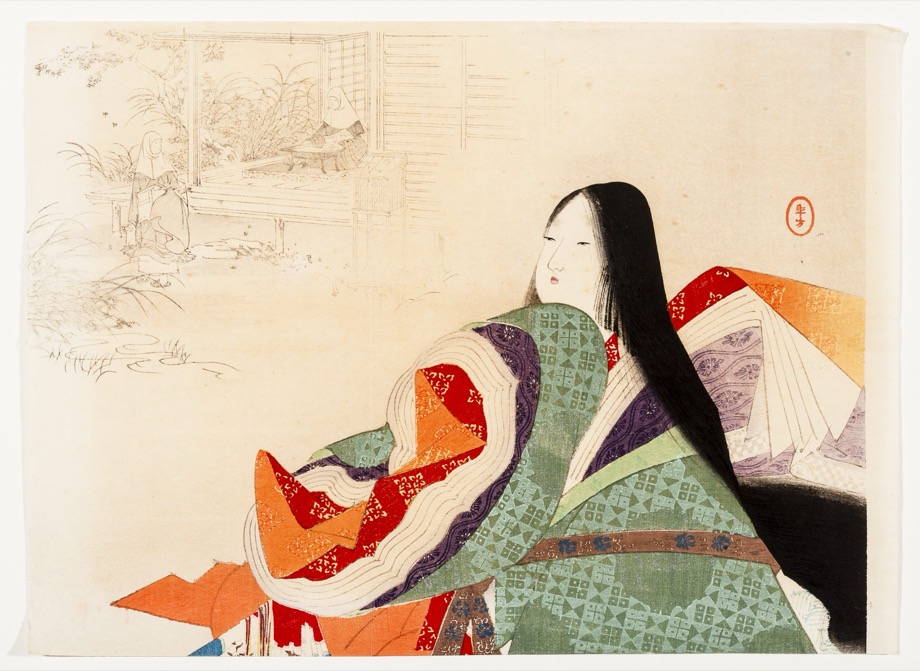
Taira no Tokuko — literary illustration, 1901 (later depiction)
The survivor was more than an ending
Taira no Tokuko is often encountered at the moment when the power surrounding her has disappeared. In the closing movement of the Tale of the Heike, the former imperial consort lives away from the court and remembers the family destroyed in war. The scene is powerful enough to overshadow her earlier position. A historical portrait has to restore the woman who held rank, inhabited an imperial household, and became the mother of a reigning emperor before she became a figure of survival.
She was a daughter of Taira no Kiyomori and the wife of Emperor Takakura. Her son Antoku died at Dan-no-ura in 1185, while Tokuko survived. Later she took Buddhist vows and lived at Jakkō-in in Ōhara. Those anchors establish a life that crossed an extraordinary political reversal. They do not establish every conversation and inward revelation that later narration gives her.
Tokuko remains Untyped. Her political relationships and religious withdrawal are known more securely than her recurring habits of judgment across different situations. Much of the apparently intimate evidence belongs to literary scenes designed to make the Taira’s fall intelligible. Assigning a personality from bereavement, devotion, or a surviving monologue would mistake the conditions of representation for a sufficiently documented private mind.
An imperial position carried institutions with it
Tokuko entered Takakura’s court in 1171 and became his principal consort the following year. Go-Shirakawa adopted her for the purpose of her court entry, a relationship that helped place her within the imperial family’s recognized structure. These formal acts were not merely decorative labels. Rank and household status determined access, ceremonial standing, and the relationships through which people could act.
Her marriage strengthened Kiyomori’s position, but its consequences did not belong to him alone. A consort’s household required attendants, ritual attention, material support, and connections with relatives and court officials. Tokuko occupied the center of that household. The surviving record may tell us little about each choice she made, yet the institution itself prevents her from being accurately described as only an object exchanged between men.
The birth of Antoku in 1178 further changed her position. Imperial childbirth was a matter of succession and collective concern, involving ceremonies and religious efforts as well as bodily risk. The child’s accession in 1180 joined motherhood to a new institutional prominence. Her importance cannot be separated from the family strategy around her, but neither can the experience be reduced to the successful execution of that strategy.
The title Kenreimon-in, granted in 1181, belongs to her court standing. It was not the Buddhist name she took after defeat. The distinction matters because collapsing the two makes the earlier imperial woman disappear into the later nun. Her religious name was Shinnyokaku. One life contained both identities, but they arose in different settings and should not be made interchangeable.
Flight altered the household around the child
When the Taira withdrew from Kyoto in 1183, Tokuko and Antoku went west with them. The emperor’s presence and the regalia helped sustain the family’s claim to legitimate authority even after it lost control of the capital. For Tokuko, a household organized around court ceremony became part of a moving and endangered political community. The change was material as well as symbolic.
The conflict cannot be understood as an imperial mother choosing a military policy that her young son then carried out. Adult relatives and commanders made the principal decisions. Tokuko’s location within the family placed her close to the consequences without proving command over their course. Historical agency has different scales: possessing standing, maintaining relationships, and enduring displacement are not identical to directing armies.
The Heike describes flight through scenes of separation, interrupted ceremony, uncertain refuge, and shrinking hopes. Such scenes give readers a sense of what the reversal meant to the represented household. They should be read as narrative arrangements, with their speakers and contrasts intact. A vivid scene can illuminate the experience imagined by later tradition without documenting every detail of Tokuko’s actual journey.
At Dan-no-ura, the child emperor drowned with his grandmother, Taira no Tokiko, who carried him into the water in the narrative tradition. Tokuko also entered the sea and was rescued. Confusing mother and grandmother transfers one of the tale’s most consequential actions to the wrong person. The distinction is essential both to the family history and to the way the narrative distributes responsibility and loss.
Religious withdrawal did not mean complete isolation
After her return to the capital, Tokuko took vows and eventually settled at Jakkō-in. The withdrawal changed the forms through which her life was sustained; it did not remove her from every human relationship. Attendants, donors, and former connections still mattered. A person living away from the center could remain dependent on networks created during an earlier institutional life.
An authored biographical entry records material support arranged through Minamoto no Yoritomo, drawing on former family resources. That detail complicates the image of a survivor existing only in absolute destitution. Support from the victorious side could preserve a reduced household without restoring its former power. The relation is historically more interesting than a simple division between total abandonment and full reconciliation.
The tale gives religious practice a larger interpretive role. Tokuko’s prayer for the dead helps transform a military catastrophe into a story about impermanence and the possibility of release. That is a claim made by the narrative through her represented life. It should not be turned into a confident assertion that she had resolved grief in exactly the form the text supplies.
Nor should vows be read as evidence that all earlier attachments had ceased to matter. Buddhist practice could give a surviving person a way to attend to the dead rather than require their erasure. The literary scene draws power from that coexistence. A historically careful account can recognize the practice and its cultural meaning while leaving the particular texture of her inward experience unrecovered.
A meeting becomes the tale’s interpretation
The closing book dramatizes Go-Shirakawa visiting Tokuko at Ōhara. Her account connects her experiences with the Buddhist six realms, making the former imperial household a setting in which radically different conditions of existence could be understood. The arrangement gives the survivor interpretive authority: she can say what the glorious rise and dreadful fall have meant.
That authority is a feature of the literary work, not automatic evidence that a stenographer recorded her explanation. The visit scene is shaped by place, season, dialogue, and the progression toward the tale’s end. Its force depends on those choices. Treating the speech as a complete personal testimony would remove the mediation that makes it such an effective ending.
The scene also places the retired emperor in the position of a listener. A woman whose family has lost the political contest becomes the person through whom he and the audience encounter its human and religious consequence. This is more than a passive emblem of sorrow. It is a narrative redistribution of authority, even while its correspondence with an actual encounter remains a separate historical question.
Even the last date has a textual history
Her conventional lifespan is often given as approximately 1155 to 1214, but both ends have alternative accounts. Some reference works express the death as the thirteenth day of the twelfth month of Kenpō one, a Japanese year beginning in 1213. Rendering that date in a Western calendar can produce 1214. An apparent difference between those two printed years is therefore not always a difference in the underlying event.
The Heike tradition supplies another chronology, placing her death earlier, in 1191 in the commonly cited closing narrative. That literary sequence must not be silently reconciled with the later conventional biographical date. The uncertainty belongs in the portrait’s dates. It shows that the final scene is one of the places where the remembered life and the historical reconstruction do not simply coincide.
Connected Figures
Further Reading
- The Tale of the Heike — Translated by Helen Craig McCulloughThe medieval narrative preserves the rise and fall of the Taira through a morally and artistically shaped account.
- Lovable Losers: The Heike in Action and Memory — Edited by Mikael S. Adolphson and Anne CommonsEssays distinguish Taira political activity from its later cultural representations.
- Eccentric Spaces, Hidden Histories: Narrative, Ritual, and Royal Authority from The Chronicles of Japan to The Tale of the Heike — David T. BialockExamines the relations among narrative, ritual space, and representations of royal authority.
- Treasures Hall (Hōchishō-den) — Jakkō-inThe temple’s account of objects, religious identity, and the transmitted closing book of the Heike.
