 Historical Figure MBTI
#584 · 5-2-26 · The Age of Justinian
Tribonian
Jurist · Architect of the Corpus Juris Civilis · The Mind Behind the Law
c. 485 — 542
7 min read
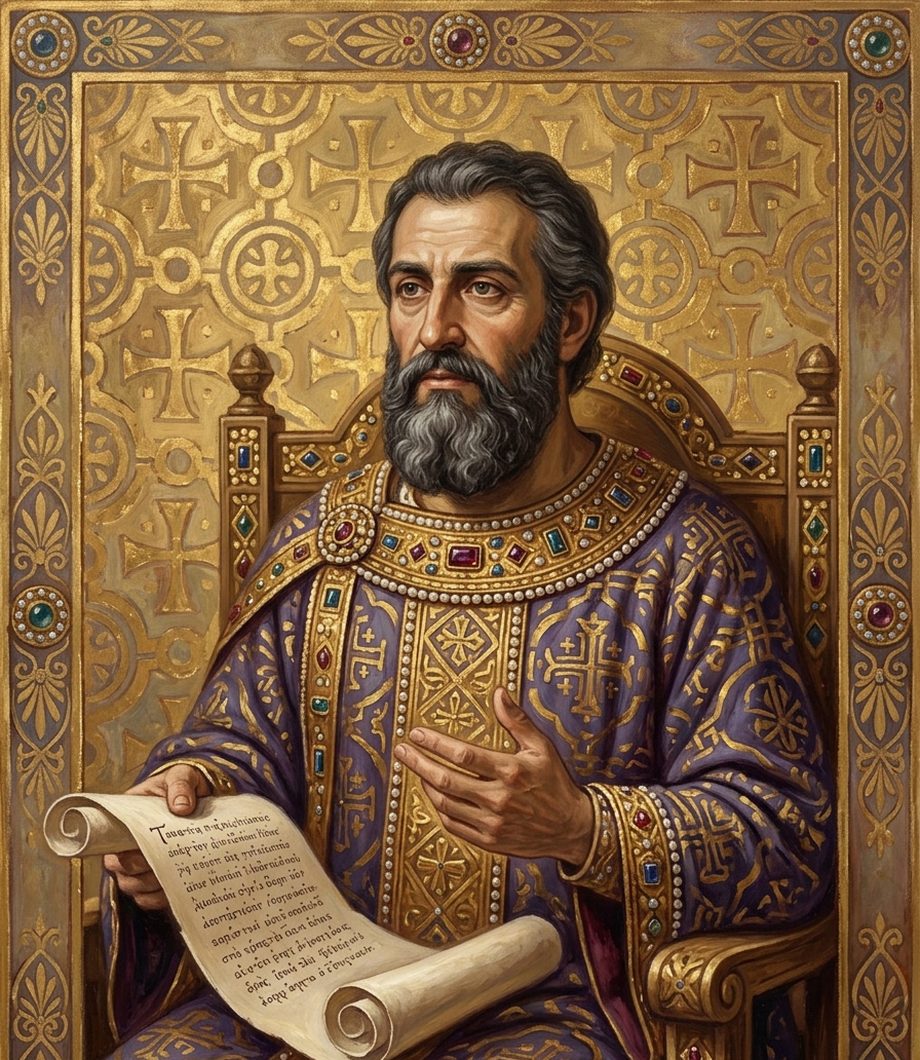
AI-assisted Portrait of Tribonian
The Man Who Made the Law Make Sense
By the sixth century, Roman law was a thousand-year junk heap. Generations of emperors had piled statute upon statute; the classical jurists had written some two thousand books of commentary, contradicting one another and themselves; and a judge who wanted the law on a given point could find three answers and no way to choose among them. Into this magnificent chaos walked a lawyer from Pamphylia named Tribonian — a man of prodigious learning and no vanity of his own, who looked at the wreckage of a legal civilization and saw a system waiting to be made coherent.
He was the intellectual engine behind Justinian's codification of Roman law — the INTP as master compiler. As quaestor he directed the commissions that produced the Corpus Juris Civilis: the Codex of imperial statutes, the student Institutes, the ongoing Novellae, and above all the Digest — the astonishing feat that distilled two thousand books of jurists into fifty consistent volumes in barely three years. He was reputed a secret pagan in a Christian empire and openly corrupt, accused of selling and rewriting laws for money. Both charges fit the same man: a mind loyal to the elegance of the system, and indifferent to everything else.
Tribonian is the INTP in its purest intellectual form: dominant Ti reducing a millennium of contradictory law to one coherent logical structure, driven by Ne's omnivorous erudition — a systematizer who served the coherence of the law itself, not any vision of his own.
The Architecture of Consistency
Ti — dominant
Dominant Ti is the drive to make a body of knowledge internally consistent — to strip out contradiction until what remains forms a single, rational whole. That is a precise description of the Digest. Confronted with centuries of jurists who disagreed on the same questions, Tribonian and his commissioners did not merely anthologize; they adjudicated. They chose among conflicting opinions, silently edited the classical texts to remove the disagreements — the notorious “interpolations” that would frustrate later scholars — and welded the survivors into a structure that spoke with one voice. It was an act of pure logical compression: the reduction of an unmanageable mass to a coherent system.
The speed is the tell. To read, sort, resolve, and organize two thousand books in three years is not the work of a diligent clerk but of a mind that sees structure faster than other people see disorder — a native gift for holding a vast system in view and finding the logic that makes it hang together. And the tell within the tell is his indifference to the outside world's verdict. The Ti systematizer serves the coherence of the thing itself; whether the world approved of Tribonian, or thought him corrupt or heretical, was beside the point. The law was to be made rational. He made it rational.
The Omnivorous Mind
Ne — auxiliary
Auxiliary Ne feeds Ti's machine with breadth — a restless appetite for material across every field, so that the systematizing mind never runs short of things to systematize. Tribonian's learning was famously encyclopedic. He was expert not only in law but in philosophy, in mathematics, in the natural sciences and the antiquarian curiosities of the ancient world; contemporaries remarked on the sheer range of what he knew. That range was not decoration. Codifying a thousand years of law demands a reader who can move fluently across the whole intellectual inheritance of antiquity, catch the connection between a Republican jurist and an imperial rescript, and see how disparate fragments belong to the same design.
His reputed paganism belongs here too. In an empire that had made Christianity the measure of respectable thought, Tribonian's mind reportedly ranged freely back into the older philosophical world — less an act of defiance than of curiosity that would not stay inside the approved boundaries. The Ne intellect follows the idea wherever it leads and treats orthodoxy as one option among many: exactly the sort of wide, undevout learning that lets a man reconstruct a vanished legal civilization — and exactly the sort that makes bishops nervous.
The Missing Conscience of the Crowd
Fe — inferior
Inferior Fe is the INTP's blind spot: a weak grip on collective sentiment, social expectation, and the shared moral feeling that binds a community. Tribonian's venality is the clearest symptom. He was accused, apparently with justice, of selling laws and altering them for the right price — a corruption that seems to have troubled his own conscience not at all. To a mind for which the law was an intellectual object, the ordinary sense that the law is also a sacred public trust simply did not register. The system was real to him; the crowd's reverence for it was not.
That deafness nearly killed him. In the Nika riots of 532, the mob of Constantinople, in open revolt, roared for his dismissal by name; Justinian sacked him to buy peace. But inferior Fe cuts both ways, and here the type's indifference to popularity was almost a strength — because Tribonian was too useful to spare. Once the riots were crushed, the emperor quietly restored the one man who could actually finish the law. The people hated him and the emperor could not do without him; both facts flowed from the same source. He had never been in the business of being loved.
Why INTP Over INTJ
Why not INTJ?
The Corpus Juris Civilis looks, from a distance, like an INTJ's life work — a vast, systematic edifice that reshaped the legal world. But the INTJ builds toward a personal vision, an end of his own devising; his Ni–Te drives at a strategic goal. Tribonian pursued no goal of his own. He was Justinian's instrument, handed a problem — make the law coherent — and he solved it with dazzling completeness, then had himself restored after the riots not to seize power but to finish the job. That is Ti–Ne solving the intellectual problem in front of it, not Ni–Te engineering an outcome. He built the cathedral; the vision was another man's.
The distinction is the whole man. An INTJ in his place would have wanted the empire, or a design of his own to impose on it; he would not have sold clauses for pocket money or drifted into heresy out of curiosity. Tribonian did both, because the law was never his instrument of ambition — it was the most beautiful puzzle he was ever handed, and solving it was reward enough. He is the type distilled to its essence: the pure intelligence that imposes order for the rightness of the order, and leaves the empire-building to the emperor.
Connected Figures
Further Reading
- Tribonian — Tony HonoréThe standard scholarly study of the man himself — reconstructs his career, his authorship of the codification, and his methods from the texts.
- Justinian: Emperor, Soldier, Saint — Peter SarrisA recent, authoritative life of the emperor that sets the legal project within the whole ambition of the reign.
- The Age of Justinian: The Circumstances of Imperial Power — J. A. S. EvansA clear narrative of the era — the Nika riots, the court, and the making of the Corpus Juris Civilis.
