 Historical Figure MBTI
#581 · 5-2-26 · The Age of Justinian
Justinian I
Emperor of the Romans · Codifier of the Law · Builder of Hagia Sophia
482 — 565
8 min read
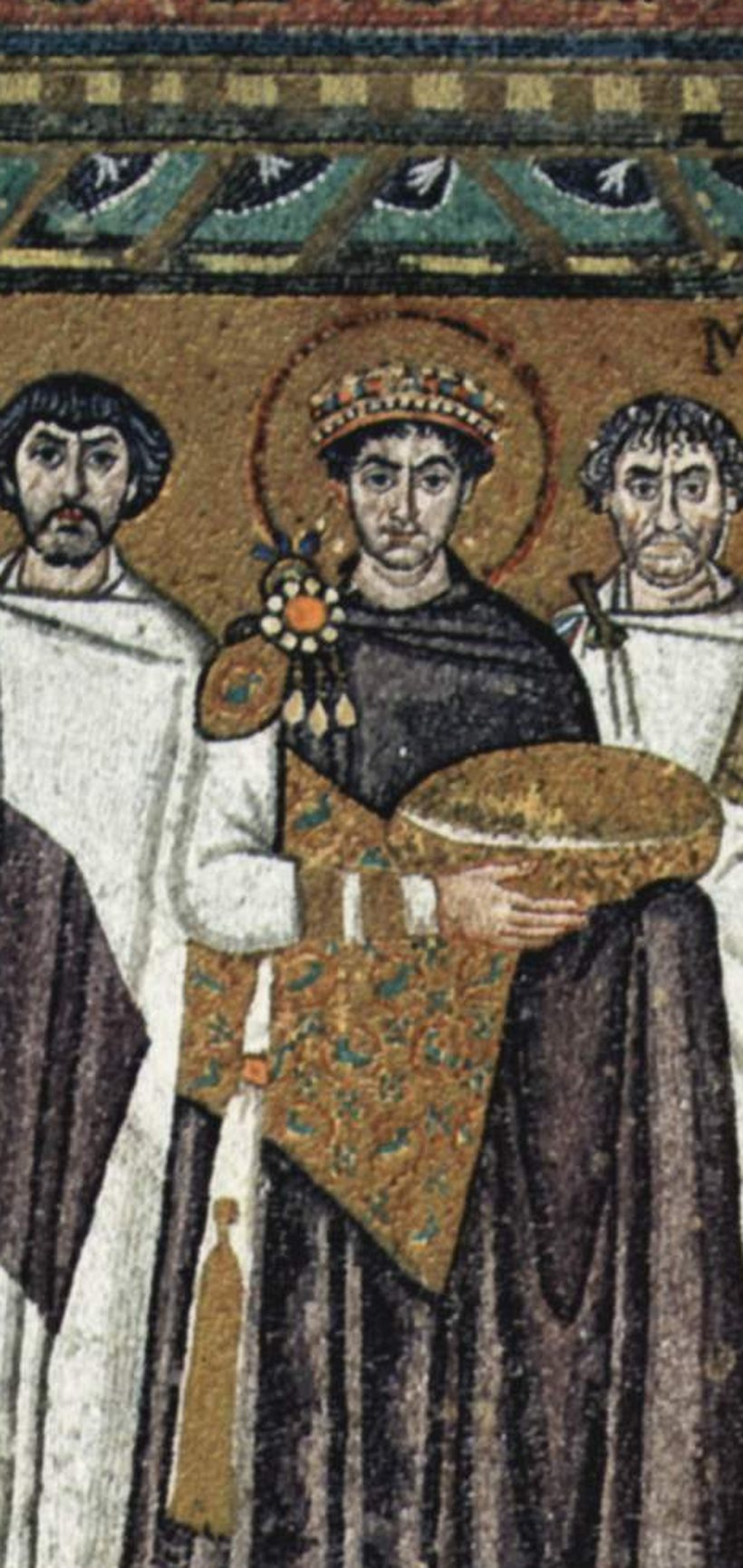
Portrait of Justinian I
The Emperor Who Never Slept
His contemporaries called him the emperor who never sleeps. He worked through the night in the Great Palace of Constantinople — reading, planning, dictating, fasting for days, turning over questions of law and theology and grand strategy while the city slept below him. And in a reign of nearly forty years, this restless, obsessive planner never once rode at the head of an army. He reconquered North Africa and Italy without setting foot on a battlefield. He rebuilt the greatest church in Christendom without laying a stone. He remade a thousand years of Roman law without arguing a case. Justinian did everything from a desk, in his own head, through other men — and what he built from that chair outlasted the empire that housed it.
He was born in 482, the son of a Latin-speaking peasant in the Balkans, with no more claim on greatness than any provincial farmer's child. He rose in the shadow of his soldier-uncle, Justin I, who improbably became emperor — and Justinian, sharper and more ambitious than the old soldier, became the real intelligence behind the throne long before he inherited it in 527. From the moment he held power he held a single idea, and he never let it go: renovatio imperii, the restoration of the Roman world. A century of loss had stripped the West from the empire; barbarian kings ruled in Rome, Carthage, and Ravenna. Justinian looked at that ruin and saw, with a clarity that never wavered, the whole Mediterranean made Roman again, governed by one law, worshiping in one faith. Almost no one else believed it possible. He organized the rest of his life around making it so.
That is the INTJ in imperial form: a single sweeping vision — Ni's image of the world not as it was but as it should be — welded to the Te machinery to actually build it. Codified law, directed generals, and an administration engineered to reach across a sea, all bent for decades toward one idea held in one man's mind.
The World As It Should Be
Ni — dominant
Dominant Ni is the mind that fixes on a single image of the future and reorganizes everything around it, and Justinian's image never changed for the forty years he held power. Where his predecessors had managed the empire's decline — negotiating with barbarian kings, accepting the loss of the West as permanent, defending what remained — Justinian refused to accept the world as it was handed to him. He saw a Rome that ought to exist: undivided, orthodox, Roman from Spain to Syria. That the actual empire had been shrinking for a century did not interest him as a fact; it interested him only as a thing to be reversed. This is the Ni tell that separates him from a mere able administrator — not the dutiful upkeep of an inherited order but a sweeping bid to remake the world as it should be.
The law is where this is clearest, and where it is most easily mistaken for something smaller. A thousand years of Roman jurisprudence had accumulated into chaos — millions of lines of contradictory statute, obsolete edict, and rival juristic opinion that no court could fully hold. Justinian could have simply pruned it, as a careful curator would. Instead he set Tribonian and a commission to distill the whole inheritance into a single coherent system — the Corpus Juris Civilis, the Codex, the Digest, the Institutes, and the later Novellae. That was not preservation. It was a radical act of synthesis: taking a millennium of accumulated disorder and reconceiving it as one rational whole, as law ought to be. The distinction is the whole of the type. A preserver keeps what exists; Justinian re-imagined what existed into what it should have been.
And then there is the dome. After the old cathedral burned in the Nika riots, Justinian rebuilt Hagia Sophia in five years, on a scale and daring no builder had attempted — a vast dome that seemed, to those beneath it, to hang from heaven on a golden chain. It was Ni made architecture: a picture of the numinous, held in one man's head, forced into stone by engineers who barely trusted it would stand. When he first entered the finished church, tradition has him murmuring, “Solomon, I have surpassed thee.” It is the perfect Ni sentence: not pride in a building, but satisfaction that a vision carried for years had finally been made real, and that reality had matched the vision.
Rome Rebuilt Through Other Men
Te — auxiliary
A vision without machinery is only a daydream, and what made Justinian dangerous was the auxiliary Te that supplied the machinery. He did not merely want Rome restored; he built the apparatus to restore it, and he ran that apparatus with a micromanager's grip. The reconquest — the renovatio made flesh — is the great example. Justinian could not fight, so he found the man who could: Belisarius, whom he pointed at North Africa in 533 with a modest force and a clear objective. Belisarius broke the Vandal kingdom in a single lightning campaign. Justinian then turned him on Italy and the Ostrogoths, and when that war dragged, sent the eunuch Narses to finish it between 552 and 554. For a moment the Mediterranean was a Roman lake again. None of it was won by the emperor's sword; all of it was directed by his will, from a room a thousand miles away.
The same Te ran through everything else. He reformed the provincial administration and the tax machinery to fund wars on multiple fronts. He drove a vast building program of fortresses, aqueducts, churches, and cities across the empire. He legislated ceaselessly, issuing new law to correct and extend the code even after it was promulgated. He was, by every account, an obsessive planner and reviser who trusted the system he had engineered more than any single subordinate — hence the sleepless nights, the endless dictation, the need to have his hand on every lever at once. Te does not merely act; it organizes reality into an instrument and pulls. Few rulers have pulled so many levers from one chair.
Justinian is the strategist as engineer of empire: he never held a sword, yet he conquered a sea — because Te let him turn generals, jurists, and administrators into the limbs of a single vision he ran entirely from his desk.
The Faith Beneath the System
Fi — tertiary
Beneath the cold machinery ran a current of intense private conviction — the tertiary Fi that gave the whole enterprise its moral charge. Justinian did not build for glory alone; he believed, with a personal and unshakable certainty, that he was God's viceroy on earth and that restoring Rome meant restoring the one true order of belief. He wrote theology himself, legislated on the nature of Christ, and spent enormous energy trying to force the empire's warring churches into a single doctrine. His code opens not with administration but with faith — the law of God before the law of men. This was not politics wearing the mask of piety; it was a deeply held inner conviction of how the world ought to be ordered, driving the outer machinery.
The same private, idiosyncratic value system shows in the most human decision of his life. When he fell in love with Theodora — a low-born former actress, the least suitable consort a Roman emperor could choose — he did not bend to convention. He had the law itself changed so that he could marry her, and then made her his genuine partner in rule, trusting her judgment above his court's. It was a fiercely personal choice made against every social pressure, the mark of a man whose deepest loyalties were interior and non-negotiable, whatever the world thought.
Tertiary Fi has its shadow, and Justinian's conviction had a hard edge. The same certainty that he served the one right order made him a persecutor: he hounded pagans, heretics, and dissenters, and in 529 he closed the ancient Academy of Athens, the thousand-year-old school of Plato, because a world remade as it should be had no room for the old philosophy. It is Fi turned inquisitorial — a private vision of the good, held so absolutely that it could not tolerate a rival. The tenderness that changed a law for Theodora and the rigidity that shuttered Plato's school sprang from the same interior source.
The World He Could Not Touch
Se — inferior
For all his mastery of the abstract, Justinian was strikingly weak in the immediate, physical, present-tense world — the domain of inferior Se. He mastered reality by turning it into law and strategy and delegating the actual, bodily, dangerous parts to other men. He never led an army, never fought, never seized a moment with his own hands. When the physical world broke in on him directly, unmediated by his machinery, he faltered.
The Nika riots of 532 are the definitive case. The racing factions of the Hippodrome, normally at each other's throats, suddenly united against him; the mob acclaimed a rival emperor and put the city to the torch. Faced with raw, immediate, physical chaos, the planner had no plan — and Justinian's nerve gave way. He was ready to flee the capital by ship, his reign collapsing in a single afternoon. What saved him was precisely the Se he lacked, supplied by someone who had it. Theodora refused to run, shaming the council with the line that the imperial purple made a fine burial shroud — and Belisarius did the brutal physical work, trapping the crowd in the Hippodrome and cutting down some thirty thousand of them. The emperor kept his throne because two people around him could act, decisively and violently, in the present moment when he could not.
The pattern held to the end. In 541 the great plague that bears his name swept the empire, killing perhaps a third of its people — a physical catastrophe no codified law or grand strategy could plan around. It nearly killed Justinian himself, gutted the manpower and money of the reconquest, and left his restored empire vast, overstretched, and exhausted. His endless war with the Persian shah Khosrow I ground on without the clean resolution his mind wanted. The world of matter — disease, riot, distance, attrition — was the one adversary his vision could not simply out-think. Inferior Se is the crack in every INTJ, and in Justinian it ran the length of his empire.
Why INTJ Over ISTJ or ENTJ
Why not ISTJ?
The great codifier of law, the sleepless administrator, the reverence for order and precedent — on the surface this reads like a monumental ISTJ, an Si guardian preserving the inherited Roman world. But the scale of the vision is the tell. An ISTJ maintains and refines what exists; Justinian tried to reverse a century of loss and remake the whole Mediterranean as it should be — and even his law code was not preservation but a radical synthesis, reconceiving a thousand years of chaos into one rational system. That is Ni reimagining reality, not Si conserving it.
Why not ENTJ?
He built and ran vast machinery, which invites the ENTJ reading — the commanding executive driving results. But the ENTJ is Te-dominant and extraverted: a field-commander who acts on the world directly and leads from the front. Justinian did the opposite. He directed everything from the palace through others — Belisarius and Narses in the field, Tribonian at the law, an army of administrators in between — and his nerve failed him when the physical present broke in at Nika. He is the architect behind the machine, not the driver of it: an Ni-dominant strategist, not a Te-dominant force.
The cleanest proof is in the room with him. The true ENTJ of Justinian's reign was Theodora — the one who, at Nika, seized the decisive moment and held the throne by sheer commanding will while he prepared to flee. Justinian's genius was of a different order: interior, patient, architectural. He held a single image of a restored Roman world in his mind for forty years and bent every general, jurist, and law toward it, and when the machinery worked, it worked at a scale no one else had dared to imagine. That is the INTJ signature — not the drive that commands a battlefield, but the vision that redraws a world and the cold engineering to make the drawing real.
Connected Figures
Further Reading
- Justinian: Emperor, Soldier, Saint — Peter SarrisThe best recent single-volume life — balanced, deeply researched, and strong on the man behind the machinery of empire.
- The Age of Justinian: The Circumstances of Imperial Power — J. A. S. EvansA thorough study of the reign and its structures — the law, the reconquest, the church, and the strains that undid the restoration.
- The Wars & The Secret History — ProcopiusHis contemporary chronicler — the official history of the campaigns alongside the venomous private account that darkens every official page.
- Justinian and Theodora — Robert BrowningA readable classic treatment of the emperor and his empress and the partnership at the heart of the reign.
- The Mediterranean World in Late Antiquity — Averil CameronThe essential wider context — how the world Justinian tried to restore was already becoming something else.
