 Historical Figure MBTI
#588 · 5-3-26 · The Age of Justinian
Theodora
Empress of the Romans · Courtesan Turned Augusta · Will Behind the Throne
c. 500 — 548
11 min read
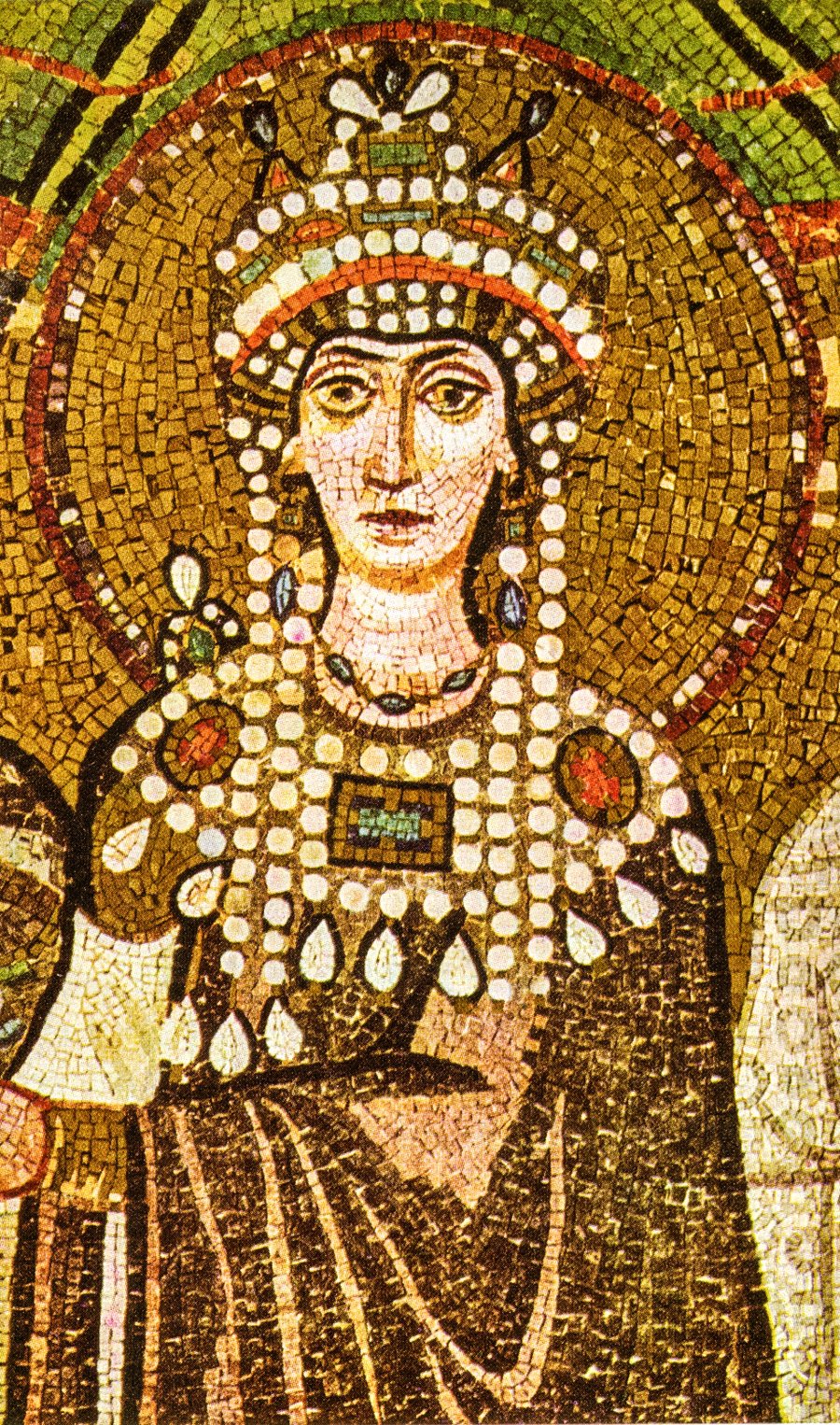
Portrait of Theodora
The Bear-Keeper's Daughter Who Would Not Run
She was born into the dirt of the Hippodrome. Her father kept the bears for the Greens, one of the racing factions that ran Constantinople's obsession, and when he died the child Theodora was paraded before the crowd as a suppliant, begging for her family's place. She grew up to become an actress and a courtesan — which in sixth-century Byzantium meant, plainly, a prostitute, the lowest rung of a society that had no lower one. There was no station on earth further from the purple. And yet within a few years this woman would be seated beside the emperor of the Romans as his acknowledged partner in power, and would, in a single afternoon, save his throne when every general and minister in the room had already decided to flee.
Theodora (c. 500 — 548) climbed from the bottom of the world to the top of it by two instruments: a quick, unsentimental intelligence and a nerve that did not break. Justinian fell for her, and to marry her he had the law rewritten — the statute barring high officials from marrying actresses was struck down so that a former courtesan could be made empress. But she was no ornament to his reign. She held her own court, ran her own diplomacy, championed her own religious cause against her husband's, wrote her own laws into the code, and destroyed the ministers she judged to be enemies. She rose like an actress seizing a scene; she ruled like a strategist who had studied the board for years. That second thing is the harder thing, and it is the thing that makes her an ENTJ rather than merely a survivor.
Theodora is the ENTJ forged at the bottom and proven at the top: Te's commanding, out-loud will to impose order on wavering men, wedded to Ni's cold reading of where events are heading — the empress who grasped, when the men around her did not, that flight meant death and defiance meant a throne.
Almost everything we know of her comes filtered through Procopius, who praised her in his public histories and then, in the venomous Secret History, painted her as a monster of lust and cruelty. Strip away both the flattery and the slander and the same figure remains underneath: a woman of iron purpose who knew exactly what she wanted the world to look like and bent it, coldly and patiently, toward that shape.
The Purple Is a Glorious Winding-Sheet
Te — dominant
Dominant Te is the will that organizes people and events toward a result and refuses to be moved off it. Theodora's supreme demonstration came in January 532, during the Nika riots — the hinge of her life and the single scene on which her whole type can be read. The racing factions, Blues and Greens, had for once united in fury; the mob had torched half the city, proclaimed a rival emperor, and was surging toward the palace. In the council chamber Justinian and his advisers had already resolved to run. Ships were waiting at the private harbor, loaded with treasure; the emperor of the Romans was minutes from becoming a fugitive. And then his wife spoke.
She told the room that flight was easy but that a throne was worth dying for — that she would not live to see herself un-empressed, that royalty made a fine burial shroud and the imperial purple a glorious winding-sheet. It is the most famous speech in Byzantine history, and whatever Procopius polished into it, the effect is a matter of record: the men stopped packing. Shamed by a woman who would not budge, Justinian held. Belisarius and Narses then herded the crowd into the Hippodrome and butchered some thirty thousand of them. The throne was saved — and it was saved because one person in the room had the Te to impose her resolve on everyone else's panic. She did not fight the mob. She commanded the men who could.
That same executive will ran through the decades that followed. Theodora did not treat power as something borrowed from her husband; she used it as an instrument in her own right. She wrote protections for women into Justinian's law — measures against forced prostitution, expanded rights for wives in divorce and property, harsher penalties for those who trafficked girls. She founded a convent, the Metanoia (“Repentance”), on the Asian shore and filled it with reformed prostitutes bought out of the brothels. She ran an independent foreign policy, corresponding with foreign courts and placing her own candidates. This is the Te horizon: not to be seen wielding power but to convert it into permanent structures — laws, institutions, endowments — that would keep doing her work after the moment passed.
The Woman Who Could See the Ending
Ni — auxiliary
Auxiliary Ni is what gave Theodora's will its aim — the capacity to read a situation to its conclusion before anyone else had, and to act on the ending rather than the noise. The Nika crisis is Ni as much as it is Te. Everyone in that chamber saw the same fire and the same mob; only Theodora seems to have followed the logic all the way down. A deposed Byzantine emperor did not retire into comfortable exile; he was hunted, blinded, and killed. She grasped that the ships were not an escape but a slower death, and that the only survivable move was the one that looked most dangerous: to stay. Flight felt safe and was fatal; defiance felt fatal and was the only road out. Seeing that inversion under pressure, while the professionals were already fleeing, is the strategist's eye, not the gambler's luck.
The long game confirms it. Theodora made herself the protector of the Monophysite Christians — the branch of the Church that Justinian's orthodoxy persecuted as heretical. This was not sentiment; it was a decades-long strategic project. She sheltered hunted Monophysite clergy inside the palace itself, kept exiled bishops under her wing, and played a deliberate good-cop / bad-cop game with her husband: he pressed orthodoxy with one hand while she preserved the dissenters with the other, so that whichever way the empire's faith finally settled, the throne would have a claim on the winners. She was building an insurance policy against the future shape of Christendom, and playing both sides of it on purpose.
Where the men saw a fire, Theodora saw the ending the fire was leading toward — and reached the throne's only survivable move while they were still loading the ships. That is Ni serving Te: the vision that tells the will exactly where to plant itself.
Even her patronage worked on the long horizon. She interceded in distant Church disputes, groomed clergy she trusted, and positioned allies where they would matter in a controversy that would outlive her. She was not managing today; she was arranging a board several moves ahead, in the confidence that she could see how the game would run.
The Stage and the Trap
Se — tertiary
Tertiary Se gave Theodora a genuine command of the present — the physical immediacy, timing, and theatrical instinct that let her seize a moment when it opened. Her origins are the obvious proof: she was, literally, a performer, a woman who had made her living reading a room and playing it. That trained sense for how a scene lands never left her. The Nika speech is a piece of theater as well as strategy — the empress choosing exactly the words that would shame fleeing men into standing, delivered at the precise instant before the ships sailed. Se supplied the stagecraft; Te and Ni supplied the reason to use it.
It shows most sharply in the destruction of John the Cappadocian, the brilliant, rapacious praetorian prefect who was her chief rival for Justinian's ear. Theodora did not merely oppose him; she engineered his fall as a trap sprung in real time. Working with her friend Antonina, she had Antonina pose as a disaffected conspirator and lure John into a night-time meeting where he would incriminate himself in treason — with Theodora's agents waiting in the dark to seize him. The ambush was botched only by the noise of the arrest; John escaped to sanctuary, but the scheme did its work. He was stripped of office and ruined. That is Se in the service of the strategist: the concrete, staged, physical trap — a set piece with a hidden audience — used to accomplish a long-held aim.
In a dominant position this instinct for the vivid present would make an opportunist. In Theodora it is tertiary — a talent she deployed on cue and then put away, never the thing that ran her. The actress's eye served the empress's purposes; it did not replace them.
The Loyalties She Would Not Trade
Fi — inferior
Inferior Fi is the ENTJ's buried interior — the private, personal set of loyalties and grievances that the instrumental mind usually keeps subordinate, but that gives the cold operator her few fierce, uncalculating attachments. In Theodora it burns narrow and hot. She never forgot where she came from, and the causes she poured her power into were the causes of her own past self: the women trafficked and discarded as she might have been, the reformed prostitutes she housed at the Metanoia, the persecuted and the powerless whom the machinery of the state was grinding down. There is real conviction in her women's-protection laws that no purely strategic reading fully explains.
It shows most clearly in her loyalties and her hatreds, both of which she held personally and pursued past the point of pure utility. Her friendship with Antonina was a genuine bond as well as an alliance; she protected her friend's interests, and their intrigues against shared enemies had the flavor of loyalty, not just politics. Her enmities were equally personal — the vendetta against John the Cappadocian was pursued with a relentlessness that exceeded the political threat he posed. When she loved and when she hated, she did so absolutely, and neither could be bought off.
Above all there was Justinian. The bond between them was, by every account, real and total — a genuine partnership of two wills. When she died of cancer in 548, the emperor who had shared power with her as with no one else was inconsolable, and mourned her for the two decades of life that remained to him. That a woman defined by cold command should be, at the center, held by a handful of unbreakable personal loyalties is the inferior function speaking: the private heart the strategist rarely showed, and never betrayed.
Why ENTJ Over ESTP or INTJ
Why not ESTP?
The ESTP reading is the seductive one, and it captures her rise exactly: the bear-keeper's daughter, the actress and courtesan who read every room and seized every opening, the sensual, adaptive survivor who improvised her way from the Hippodrome to the palace. That is a real part of her — her Se was formidable. But it explains the climb, not the reign. Once she wore the purple, Theodora pursued sustained strategic aims across decades: laws to protect women written permanently into the code, a multi-decade project to shelter the Monophysite cause, the patient, engineered destruction of John the Cappadocian. That is Te — Ni playing a long game with fixed objectives, not ESTP opportunism reading one moment at a time. The actress became a legislator, and the legislator is the deeper self.
Why not INTJ?
One might read the shelter of heretics, the long games, and the traps as the work of a shadow-strategist — an INTJ operating from behind the throne. But Theodora ruled out loud and in person. She was a proclaimed Augusta who held her own court, spoke the decisive words in the council chamber, received envoys, and commanded openly. She did not whisper power into her husband's ear; she sat beside him as an acknowledged co-ruler and imposed her will face to face. That is the extraverted commander, Te forward, not the private architect working in the dark.
The tell is the distance between the rise and the rule. An ESTP would have been the brilliant survivor and stopped there; an INTJ would have worked unseen. Theodora did neither. She took the improviser's gifts that carried her up from nothing and put them permanently in the service of a commanding, out-loud, institution-building will — the will that saved a throne in an afternoon and then spent twenty years converting that afternoon into law, faith, and legacy. That combination — the bottom-born seizer of the moment who becomes the strategist of the age — is the signature of the ENTJ who had to climb for it.
Connected Figures
Further Reading
- Theodora: Actress, Empress, Saint — David PotterA careful modern biography that reconstructs her world and weighs the sources against the legend.
- Theodora: Empress of Byzantium — Paolo CesarettiA vivid narrative life, strong on the texture of sixth-century Constantinople and her rise from the Hippodrome.
- The Secret History — ProcopiusThe scandalous, venomous contemporary account — indispensable and untrustworthy in equal measure; read against his public histories.
- Justinian and Theodora — Robert BrowningA classic accessible study of the imperial partnership and the age it defined.
- Justinian: Emperor, Soldier, Saint — Peter SarrisA recent authoritative account of the reign that situates Theodora within the politics, religion, and warfare of the era.
