 Historical Figure MBTI
#587 · 5-2-26 · The Age of Justinian
Totila
King of the Ostrogoths · Reviver of Gothic Italy · The Last Gothic Hope
d. 552
6 min read
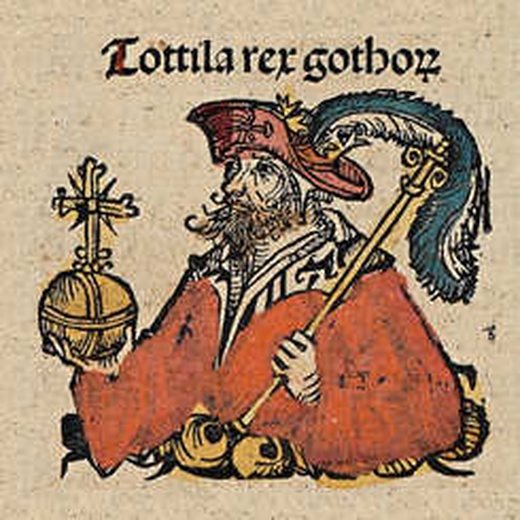
Portrait of Totila
The Man Who Almost Took Italy Back
He inherited a lost war. By the time Totila was raised on the shields of the Ostrogoths in 541, their kingdom in Italy was a ruin—Belisarius had taken Ravenna, hauled off the previous king, and all but closed the account for the emperor Justinian I. What remained was a scatter of demoralized garrisons north of the Po. Totila took that wreckage and, in barely a decade, nearly reconquered the whole peninsula. He is the great improviser of the Gothic War: a young king who read a hopeless board and found, move by move, the openings nobody else could see.
His method was speed and surprise. He struck where the Byzantines were not, took cities before relief could arrive, lived in the saddle, and turned the war's social wreckage into a recruiting engine—sparing civilians, treating captives well, freeing slaves and binding the tied peasants of the great estates to his cause. Twice he took Rome itself. He was, in temperament, the pure ESTP: a tactician of the live moment who won not by out-planning his enemies but by out-moving them, until the one enemy he could not out-move finally arrived.
Totila is the ESTP as reconquest incarnate: Se's fast, opportunistic warfare— striking where the enemy wasn't, seizing what was undefended—steered by Ti's cold tactical and political calculus. Even his famous mercy was less creed than shrewd read: the surest way to flip Italy to his side.
War at the Speed of the Moment
Se — dominant
Dominant Se seizes the present terrain and acts on it before it changes, and Totila's whole campaign was built on tempo. He refused to fight the war Byzantium wanted—the slow, siege-heavy contest of fortified positions— and fought instead a war of movement, sweeping down through Italy while the imperial commanders squabbled and waited for reinforcements. He appeared where he was not expected, took Naples, overran the south and much of the center, and reduced the emperor's hold to a handful of coastal strongpoints. He did not besiege the map; he raced across it.
The clearest Se signature is Rome, which he captured twice—once in 546 after a long blockade, and again in 550 after the Byzantines had retaken it. When he first took the city he considered razing it to the ground, then chose instead to strip its garrison value and move on: a man reading each position for what it was worth in the moment, unsentimental about monuments. Living in the field for years, mobile, aggressive, opportunistic, he was at his most dangerous when the situation was fluid and there was ground to take.
The Calculating Edge
Ti — auxiliary
Se supplied the aggression; auxiliary Ti supplied the logic that aimed it. Totila did not simply lunge—he calculated. He grasped early that the war would not be won by force alone against an empire that could always send more men, and that his real leverage lay in the fault lines of Justinian's Italy: an exhausted population, resentful of Byzantine tax collectors and landlords, and imperial armies chronically starved of pay and supply. His strategy was engineered around those weaknesses rather than around a fixed idea of empire.
That cool analysis shows in how he handled people as instruments of the campaign. He sent captured Roman senators and their families to safety in Campania, less from sentiment than from a shrewd sense of who was worth keeping alive and useful. He courted the emperor with offers of settlement even as he fought, probing for terms. He timed his blows to Byzantine disarray and struck when their command was divided. It is the ESTP's tactical intelligence: not the long, single vision of the strategist, but a fast, accurate reading of the mechanism in front of him—and exactly which lever to pull.
Mercy as a Weapon
Fe — tertiary
Totila came down through history with a chivalrous reputation—the clement king who spared the conquered, protected women in captured cities, and treated prisoners with a courtesy that startled his enemies. Byzantine writers, no friends of the Goths, granted him this. But the clemency reads less as tender-hearted idealism than as tertiary Fe pressed into the service of the campaign: a sharp, deliberate sense of how to make people want him to win.
He aimed that instinct at the war's social grievances. By freeing slaves and tying the coloni—the peasants bound to the great estates—to his own cause, he turned Italy's underclass against the Byzantine landlords and swelled his ranks in the same stroke. Sparing civilians in a stormed city cost him nothing and won him the next city's goodwill before he reached it. It was populism with an edge: the ESTP's feel for a crowd and a mood, deployed as coldly as any cavalry maneuver. Generosity that also happens to be the most efficient path to victory is the tertiary Fe of a man whose real center is the fight, not the sentiment.
Why ESTP Over ENTJ
Why not ENTJ?
His comeback looks like grand strategy, and it is tempting to cast him as the visionary empire-builder. But Totila built nothing to a fixed design—he improvised a stunning recovery move by move, seizing chances as they appeared rather than executing a long-range plan. The tell is the ending: when he finally faced a disciplined, well-supplied foe who would not be rushed or tricked, the improviser had no answer. That is Se–Ti opportunism reaching its limit, not the Te–Ni strategist adapting his design to a new obstacle.
The distinction is the whole shape of his life. An ENTJ measures a war against the institution it is meant to leave behind; Totila measured it against the next city, the next opening, the next chance to keep the momentum. That reactive brilliance carried him within reach of driving Byzantium out of Italy entirely. It also meant that when Justinian at last committed the overwhelming, well-prepared army under Narses, the old eunuch's patient, methodical line had exactly the thing the improviser could not supply— a plan Totila could not out-move. At Taginae his cavalry charge broke on a prepared position, and with it broke the last real hope of Gothic Italy.
Connected Figures
Further Reading
- The Wars (History of the Wars, the Gothic War) — ProcopiusThe contemporary Byzantine account and the primary source for Totila's campaigns — hostile in loyalty but often admiring of his generalship and clemency.
- The Goths — Peter HeatherA leading modern history of the Gothic peoples, setting Totila's reign within the long arc of Gothic Italy and its fall.
- History of the Goths — Herwig WolframThe standard scholarly survey of the Goths, strong on the institutions and politics of the Ostrogothic kingdom Totila fought to revive.
