 Historical Figure MBTI
#582 · 5-2-26 · The Age of Justinian
Belisarius
General of the Empire · Reconqueror of the West · The Loyal Sword
c. 500 — 565
8 min read
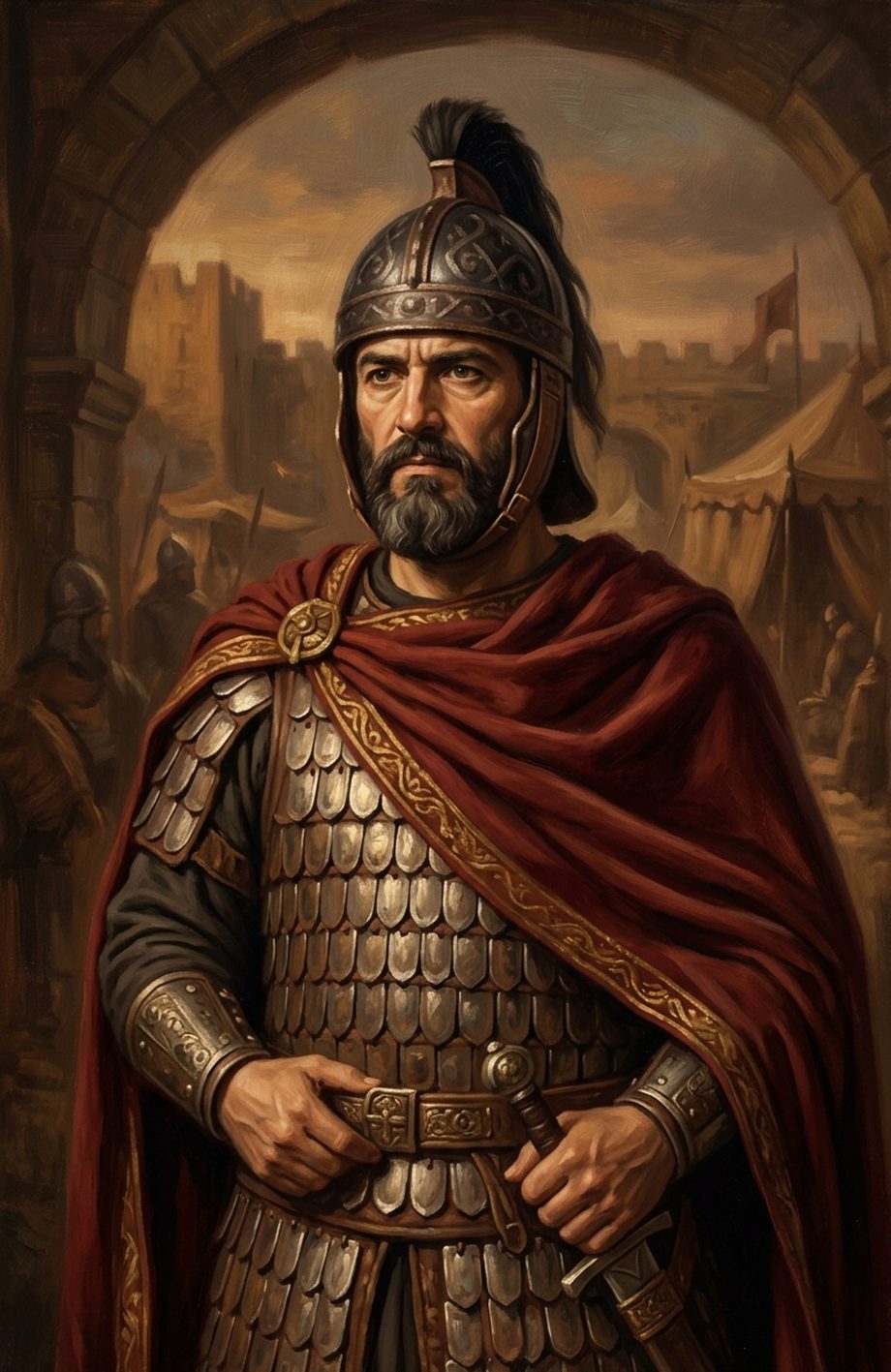
AI-assisted Portrait of Belisarius
The Man Who Would Not Take the Throne
In 540, outside the walls of Ravenna, the Ostrogoths made a beaten enemy an extraordinary offer: lay down the fiction of serving a distant emperor, and rule the West yourself. They would make Belisarius the Emperor of the Romans in Italy—the thing every ambitious general of the age dreamed of and half of them died reaching for. He said yes. He rode into the impregnable Gothic capital, took its king and its treasury—and then, the trap sprung, calmly handed all of it to the master he had never intended to betray. The most gifted soldier of his century had been offered a crown and used it only as a lever to win a siege.
Belisarius (c. 500–565) was the general who nearly put the Roman Empire back together. Born a provincial in the Balkans, he rose through the guard of the emperor Justinian I to command every front of a bankrupt, overstretched state—and won on all of them, almost always outnumbered, not with mass or money, which he never had, but with an unglamorous, almost engineering intelligence about how battles actually work. And the puzzle that follows him through every biography—the loyalty that survived a lifetime of the emperor's suspicion and ingratitude—dissolves the moment you stop reading it as duty and start reading it as indifference. He did not want the throne. He wanted the next battle.
Belisarius is the ISTP as master of war: a Ti mind that took the machinery of a battlefield apart and reassembled it into victory, wedded to a Se command that read terrain, timing, and the enemy's nerve in real time. His loyalty was never devotion—it was a craftsman's indifference to everything that was not the problem in front of him.
The Engineer of Battles
Ti — dominant
Belisarius won because he understood, more precisely than anyone facing him, why armies actually break—and dominant Ti is that analytical instinct turned on the mechanics of combat. The clearest case is Dara in 530, his first great victory, fought against a Persian army perhaps twice his size. He neither charged nor simply dug in: he had his outnumbered force dig an angled system of trenches designed to funnel the Persian attack, protect his flanks, and expose the enemy's, then positioned his cavalry to strike the moment the Persian line overextended. He won by making the larger army fight on ground that quietly disassembled its advantages. That is not inspiration; it is a mind taking a system apart to find the load-bearing point.
The same intelligence runs through his whole career. In Africa in 533 he finished the Vandal kingdom—a power that had once sacked Rome—in two battles inside a few months, reading the terrain and springing his blow at the exact hinge of each fight; in Italy he made a specialty of the impossible defense, holding walls against numbers that should have swept him aside because he saw where an assault would concentrate before the enemy did. What makes this Ti rather than mere competence is its detachment. He approached each battle as a discrete puzzle, unclouded by doctrine or the honor-culture of the pitched charge—retreating, feinting, digging, or fortifying a granary as the specific problem required. He fought outnumbered for thirty years and it almost never mattered, because he was not really counting men. He was counting angles.
The Sword in His Own Hand
Se — auxiliary
A Ti analyst who could not act in the moment would be a war-college theorist. What made Belisarius a commander was auxiliary Se—the hands-on, present-tense grip on the real battlefield that let him execute a plan while the ground was still shifting under it. He led from the front and fought in person, wounded and skirmishing, the kind of general soldiers could see; his plans were never rigid blueprints imposed from a tent but live things he adjusted stroke by stroke as he watched the enemy commit, striking into the exact moment a cavalry charge lost cohesion or an assault lost its nerve.
The great feat of Se in his life is the year-long defense of Rome in 537–538. With a garrison a fraction of the besieging Gothic host, he held the whole enormous circuit of the ancient walls by sheer restless physical presence—patrolling, plugging breaches, improvising engines and sorties, countering each attack where it actually fell rather than where he had expected it—and wore an army many times his size down to exhaustion because he simply out-reacted it, morning after morning, for a year. This is the ISTP's signature fusion: the analyst and the fighter in one body. Se supplied the courage and the reflexes; Ti supplied the reason those reflexes were pointed in the right direction.
The Ruse at Ravenna
Ni — tertiary
Tertiary Ni gives the ISTP flashes of strategic foresight—the ability, in his best moments, to see several moves ahead and grasp the shape of a whole campaign rather than just the fight in front of him. Ravenna in 540 is the case. The Gothic offer of the Western throne was a genuine trap, meant to pry him loose from Constantinople; Belisarius saw the deeper move, feigned acceptance, and used the pretense to walk into the one city his armies could never have stormed—taking the impregnable capital, its king, and its treasury without a siege, then discarding the crown. It was a single stroke that read the enemy's intention, turned it inside out, and ended a war.
But tertiary means unreliable, and Belisarius's foresight failed him exactly where an ISTP's tends to—in the arena of court politics and the long game of empire, which is not a battlefield and cannot be read like one. He never anticipated the emperor's jealousy, never built a faction to protect himself, never seemed to grasp that his very successes made him suspect. Recalled, distrusted, and sent back to Italy with too few men to beat the resurgent Totila, he watched much of his own reconquest come undone, and appears never to have played the intriguer's game that might have prevented it. Where the problem was war, his vision was uncanny; where the problem was power, he was almost blind. A dominant intuitive would have spent as much genius on the palace as on the field. Belisarius spent it all on the field, because the field was the only board he truly cared to see.
The Loyal Sword and the Domineering Wife
Fe — inferior
Inferior Fe is the ISTP's faint, undeveloped channel to the social and emotional world —and Belisarius's private life reads like a study in its weakness. His marriage is the clearest case. His wife, Antonina, an older, forceful, politically wired woman and a confidante of the empress Theodora, dominated him at home as completely as he dominated the battlefield. She managed his affairs, involved herself in his campaigns, and by the accounts of his own secretary humiliated him in ways the conqueror of two kingdoms proved helpless to resist. The man who read the intentions of Persian and Gothic armies could not read, or would not fight, the person closest to him.
His famous loyalty belongs here too, but as absence rather than depth of feeling. Belisarius served an emperor who repeatedly distrusted, recalled, underfunded, and briefly disgraced him, and he never rebelled—not out of warm devotion, and not out of a principled cult of duty, but because the alternative, the throne itself, simply held no attraction. A more Fe-driven man would have craved the acclaim, nursed the grievance, and built the network of friends and clients that turns a general into an emperor. Belisarius let the slights pass because his interior life ran on something other than status and belonging. He wanted the next battle, and he got it, coming out of retirement one last time, an old man, to drive a Bulgar raid back from the walls of Constantinople.
Why ISTP Over ISTJ
Why not ISTJ?
The obvious pull is his legendary loyalty, which looks like the ISTJ's dutiful service to the institution and the chain of command. But the ISTJ's loyalty flows from principle—a felt obligation to the office, the oath, the rules—and it would have burned with resentment at Justinian's ingratitude. Belisarius's loyalty had no such moral charge; it was the byproduct of a task-focused indifference to power. Offered the Western throne outright, an ISTJ would have felt the temptation and the weight of the choice; Belisarius felt neither, because ruling simply bored him. And his warfare was pure improvisation—Se–Ti reading each battle fresh—not the ISTJ's procedure-bound, precedent-driven method.
His loyalty and his genius were the same trait viewed from two sides. The indifference to power that made him no threat to Justinian left him free to pour every ounce of his intelligence into the craft of winning. He was not a servant defined by duty and not an opportunist defined by ambition, but a maker who had found his medium in war—content to solve the problem in front of him and leave the crown to men who wanted it.
Connected Figures
Further Reading
- Belisarius: The Last Roman General — Ian HughesThe best modern military biography — reconstructs the campaigns in detail and takes the general's generalship seriously.
- The Wars of Justinian — ProcopiusThe eyewitness history by Belisarius's own secretary — the indispensable primary source for Dara, Africa, and the Italian sieges.
- Justinian: Emperor, Soldier, Saint — Peter SarrisA rich recent life of the emperor that sets Belisarius within the whole strained, ambitious world of the reconquest.
