 Historical Figure MBTI
#590 · 5-3-26 · The Age of Justinian
Antonina
Wife of Belisarius · Confidante of Theodora · The Schemer on Campaign
c. 484 — after 565
6 min read
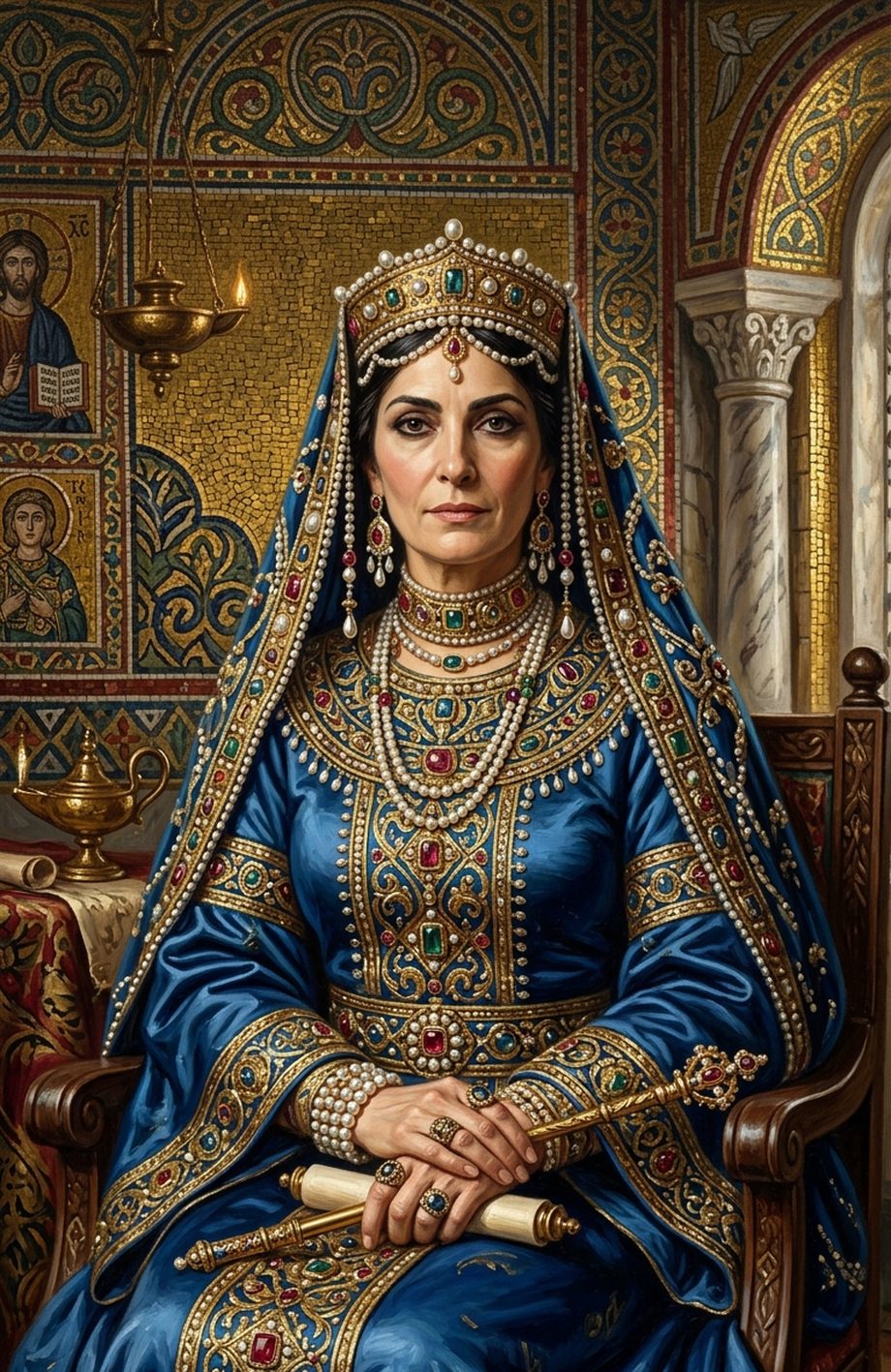
AI-assisted Portrait of Antonina
The Woman Who Never Lost Her Nerve
Nothing seems to have shocked Antonina, and nothing seems to have frightened her. Born around 484 into the raffish theatrical demimonde of the late Roman world — her father a charioteer, her mother an actress — she rose from the bottom of respectable society to stand at the very top of it: the wife of the empire's greatest general and the intimate of its empress. She managed the ascent the way she managed everything, by appetite, nerve, and a cold eye for advantage.
She married the young general Belisarius, whom she outstripped in years and utterly dominated, and she did not stay behind when he marched. Antonina followed the armies of Justinian across the Mediterranean world — to Africa, to Italy — sharing the campaigns, managing their logistics, and, according to Procopius's venomous Secret History, conducting a flaunted affair with her own godson Theodosius so openly that it became the scandal of the army. Whatever the truth of the gossip, the portrait it preserves is unmistakable: a worldly, physical, unembarrassable operator who took what she wanted and dared anyone to make her ashamed of it.
That is the ESTP signature: Se's bold, sensual appetite for the world as it is — married to a cool Ti cunning that reads power and people like a card-sharp and plays them without a flicker of guilt.
The Body on Campaign
Se — dominant
An ESTP lives through the senses and the immediate physical world, and Antonina was never a woman of the drawing room. Where a general's wife might have waited safely in Constantinople, she went to war. She crossed the sea with Belisarius on the great expedition to reconquer Vandal Africa in 533, and there she performed the most concrete service the sources credit her with: on the long summer voyage, with the fleet's drinking water spoiling in the heat, it was Antonina who had the supply stored properly below the waterline, where it stayed cool and fit to drink, so that the army landed with its thirst provided for. A small logistical detail — but a revealing one, the hands-on competence of someone who solves the physical problem in front of her rather than theorizing about it.
That same physicality ran through her private life. The affair with Theodosius, as Procopius tells it, was carnal, brazen, and pursued in the teeth of every risk: caught in the act more than once, she talked her way clear each time with a nerve that never broke. Se does not flinch and does not blush; it wants the thing and reaches for it. Antonina followed her husband through the long wreck of the Italian campaign, endured its sieges and reversals, and remained into old age a creature of the tangible world — of armies and supplies and bodies and the leverage they gave her.
The Card-Sharp's Cunning
Ti — auxiliary
Beneath the appetite ran a cold, analytic intelligence — an auxiliary Ti that read situations as mechanisms to be worked. Its masterpiece was the destruction of John the Cappadocian, Justinian's brilliant and rapacious praetorian prefect and the most powerful minister in the empire. John was Theodora's great enemy, too strong to be brought down by open accusation. So in 541 the empress used Antonina as her instrument, and Antonina laid a trap of pure tactical cunning.
She cultivated John, feigned her own disaffection with the throne, and dangled before him the one bait his ambition could not resist — the hint that she might help him seize supreme power for himself. She lured him to a secret meeting at night to discuss treason, having first arranged for Theodora's agents to be hidden within earshot. John, greedy and off his guard, spoke the incriminating words aloud; the witnesses sprang out; and the untouchable minister was finished, stripped of office and driven into exile. It was a con executed with a card-sharp's timing — a precise reading of exactly what her mark wanted, and exactly how his own greed could be turned into the rope to hang him.
Reading the Room, Working the Man
Fe — tertiary
An ESTP's tertiary Fe is less warmth than social radar — a quick, instrumental read of what people feel and how those feelings can be steered. Antonina had it in abundance, and her two great relationships show it working in opposite directions. With Theodora she found a true peer: the two women had risen from the same disreputable theatrical world, understood each other completely, and formed one of the most effective political partnerships of the age. Antonina was the empress's hand outside the palace, and the alliance carried her for decades.
With Belisarius, the same faculty became domination. She read her honest, straightforward husband — a soldier's soldier with no gift for intrigue — and managed him utterly, binding him to her through his own devotion even as she humiliated him. He forgave her the affair; he took her back; he could not break free. Antonina understood the emotional grip she held on him and used it without sentiment. It is the ESTP's tertiary Fe in its coolest register: not the wish to be loved, but the knowledge of how to use being loved.
Why ESTP Over ENTJ
Why not ENTJ?
The temptation is to read Antonina's schemes — the trap for John, the lifelong maneuvering — as the work of a strategist. But the ENTJ builds toward a long-range design, a structure of power meant to last. Antonina built nothing of her own. She schemed for immediate advantage: to protect her position, to indulge her appetites, to do Theodora's bidding and be rewarded for it. Each move answered the situation directly in front of her; none of them added up to an architecture. That is Se–Ti opportunism, not Te–Ni design.
The difference is the one between an operator and an architect. Theodora — her friend and the true ENTJ of the pair — wanted to reshape the empire and pursued that vision across a lifetime. Antonina wanted to win the hand she was holding, and she won it again and again, but she never played for the whole table. She was a fixer of genius, unshockable and unsentimental, who took each day's advantage as it came. When Theodora died in 548, Antonina simply went on maneuvering, outliving nearly everyone — the surest sign that survival, not empire, had always been the game.
Connected Figures
Further Reading
- The Secret History — ProcopiusThe scandalous, hostile source for nearly everything about Antonina — the affair, the schemes, the domination of Belisarius. Vicious, unreliable, and indispensable.
- The Wars of Justinian — ProcopiusThe official narrative of the African and Italian campaigns, where Antonina appears on campaign managing logistics — the sober counterpoint to the Secret History.
- Belisarius: The Last Roman General — Ian HughesA modern military biography of her husband that weighs the sources on Antonina's role beside him on campaign.
- Theodora: Actress, Empress, Saint — David PotterA life of Antonina's great friend and ally that illuminates the theatrical world both women came from and the partnership between them.
