 Historical Figure MBTI
#585 · 5-2-26 · The Age of Justinian
John the Cappadocian
Praetorian Prefect · The Rapacious Tax-Master · Engine of the Reconquest
c. 490 — 548
6 min read
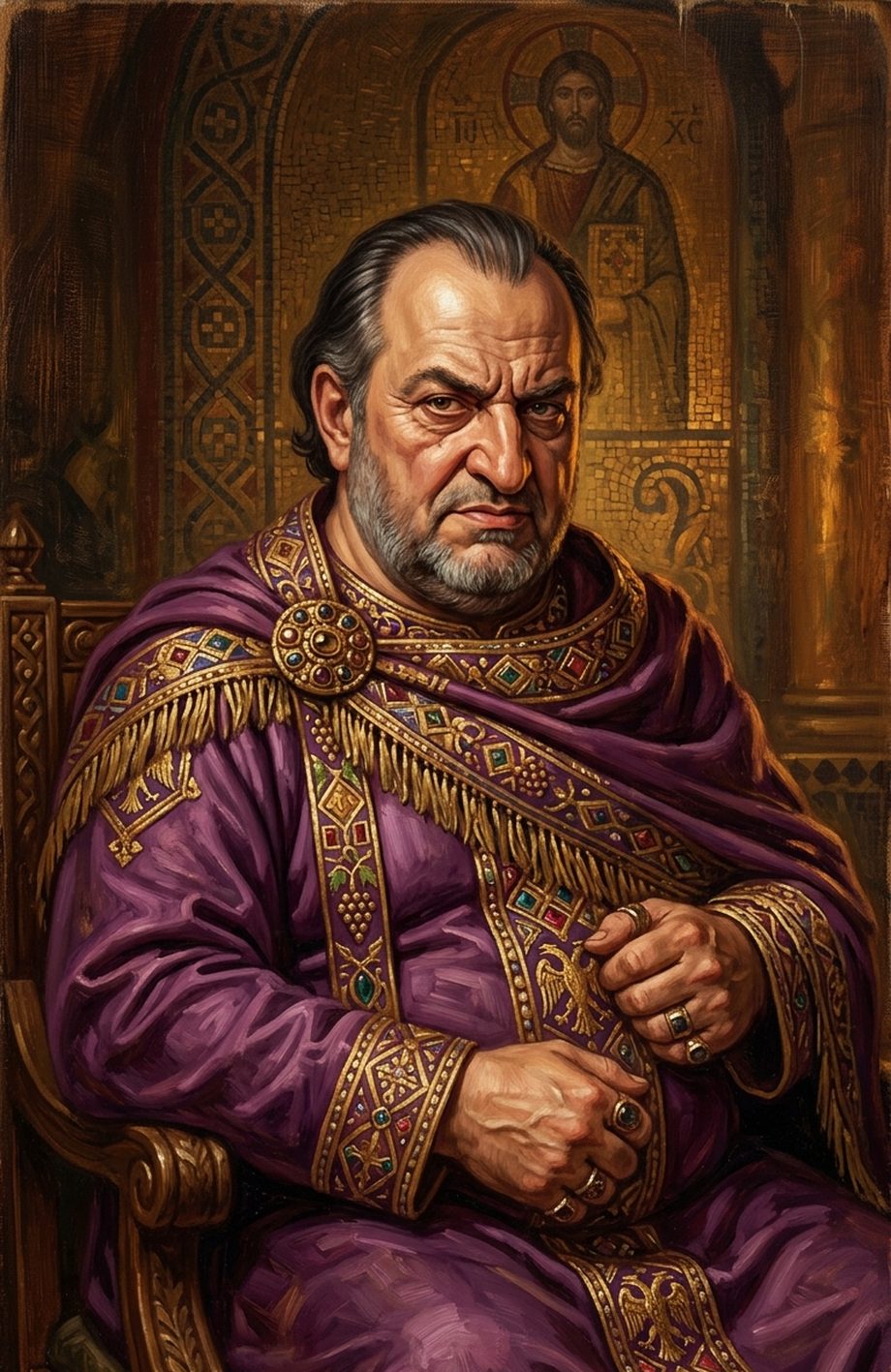
AI-assisted Portrait of John the Cappadocian
The Bureaucrat Who Bought a War
He had no birth, no learning, and no charm — and for a decade he was the most powerful man in the Roman world after the emperor himself. John of Caesarea, the Cappadocian, rose from a provincial nobody to praetorian prefect of the East on one undeniable talent: he could pull money out of a broken machine. Where senators saw the dignity of ancient offices, he saw waste to be cut; where provincials saw custom, he saw revenue going uncollected. Crude, rapacious, dissolute — and utterly indispensable, because Justinian's dream of reconquering the West ran on gold, and no one alive could raise it like the Cappadocian.
Born around 490 to obscure parents and barely educated, John made himself a financial and administrative genius by sheer aptitude for the levers of the fiscal apparatus. As praetorian prefect of the East — in effect the empire's chief finance minister — he overhauled the tax system with ferocious efficiency: slashing the perks of office, gutting the state post, and squeezing the provinces until they bled. He funded the wars in Africa and Italy. He was also the most hated man in the empire, a prime target of the Nika rioters in 532, who bayed for his dismissal before Constantinople burned.
John is the ESTJ stripped to its engine: a dominant Te that measures a man by his output and an office by its yield, braced by Si's total command of the fiscal machinery — every tax, exemption, and ledger of a creaking bureaucracy held in a functionary's exact memory and worked without sentiment.
The Ledger as Weapon
Te — dominant
Dominant Te judges the world by results, and John judged everything — offices, traditions, human beings — by what it produced. Handed the prefecture, he treated the venerable machinery of the Roman state not as sacred but as inefficient, and rationalized it with the cold zeal of an auditor. He abolished sinecures, curtailed the cursus publicus — the imperial post that had long been a standing charge on the treasury — and stripped away the customary perquisites officials treated as their due. Every cut answered one question: did it free money for the emperor's wars?
This is the ESTJ's ruthlessness in pure bureaucratic form. John did not extract for cruelty's sake; he extracted because extraction was the work, and he was better at it than anyone. He devised new levies, pressed the provinces for arrears, and used imprisonment and torture on those who would not pay — converting the empire's misery into the bullion that put Belisarius's armies in Carthage and Ravenna. Procopius loathed him but could not deny the result: the reconquest was, in a real sense, paid for by the Cappadocian.
Master of the Machine
Si — auxiliary
If Te supplied the drive, auxiliary Si supplied the instrument — an intimate, granular mastery of the fiscal apparatus itself. John rose without the education that made a gentleman-administrator; what he had instead was a functionary's memory for how the system actually worked: which office collected what, where revenue leaked, which exemptions had quietly become permanent, which levers moved money and which only moved paper. He knew the machine from the inside, and that concrete knowledge was the source of his power.
It is why the well-born ministers around him could never match him. They knew the dignity of the offices; he knew their plumbing. Si let him see the empire's finances not as an abstraction but as a vast, familiar mechanism whose every valve he could open or close — a man who trusted what he had handled and verified over any theory of how things ought to be done.
The Appetites and the Trap
Fi — inferior
Inferior Fi is the ESTJ's poorest country — the inner life of private value that the results-machine neither cultivates nor governs — and in John it curdled into the appetites for which he was infamous. Off the ledger he was a glutton and a debauchee, coarse and dissolute, indulging himself with the same absence of restraint he brought to wringing the provinces. The man who reduced every external thing to its yield had no developed interior to check his own hungers.
That unguarded interior was his undoing. His nemesis was the empress Theodora, who hated and feared him, and in 541 she and her friend Antonina baited a trap on exactly his blind spot. Antonina, feigning friendship, lured him to a night meeting and drew him into voicing treasonous ambition — hints of seizing the throne — while Theodora's agents listened. The supreme reader of ledgers could not read people, and walked straight in. Stripped of office, exiled, and forcibly ordained a priest, he was later beaten and reduced to poverty, only partly rehabilitated after Theodora's death in 548.
Why ESTJ Over ENTJ
Why not ENTJ?
The ENTJ and the ESTJ share dominant Te — the same commanding, results-first drive — so the temptation is real. But the ENTJ is an architect: Te yoked to Ni, a strategist who conceives a grand design and then executes it. John conceived nothing. He had no vision of empire, no policy of his own, no future he was building toward. He was the supremely capable executor of another man's design — Justinian's dream of reconquest — and his genius was purely instrumental: extracting, organizing, rationalizing what already existed. That is Te braced by Si's mastery of the concrete machine, not Te driving an Ni vision.
The distinction is the whole man. Justinian wanted the West back; John was the tool that made it affordable. He could tell you exactly how to get another hundred thousand solidi out of Egypt this year, but ask him what the empire was for and he had no answer — and no interest in the question. The strategist supplies the end; the ESTJ operator supplies the means, and asks only whether they work. John was the means — wielded to devastating effect, and discarded the moment he grew dangerous.
Connected Figures
Further Reading
- The Secret History — ProcopiusThe venomous contemporary exposé — the fullest (and most hostile) portrait of John's rise, rapacity, and fall.
- The Wars of Justinian — ProcopiusThe official narrative history; sets John's prefecture against the campaigns his taxation paid for and records his ruin by Theodora and Antonina.
- Economy and Society in the Age of Justinian — Peter SarrisThe modern economic study — situates John's fiscal reforms within the real workings of the sixth-century imperial economy.
- The Age of Justinian: The Circumstances of Imperial Power — J. A. S. EvansA clear scholarly overview of the reign, weighing John's administrative genius against Procopius's hostile testimony.
