 Historical Figure MBTI
#586 · 5-2-26 · The Age of Justinian
Khosrow I
Shahanshah of Persia · Anushirvan the Just · Justinian's Great Rival
c. 512 — 579
10 min read
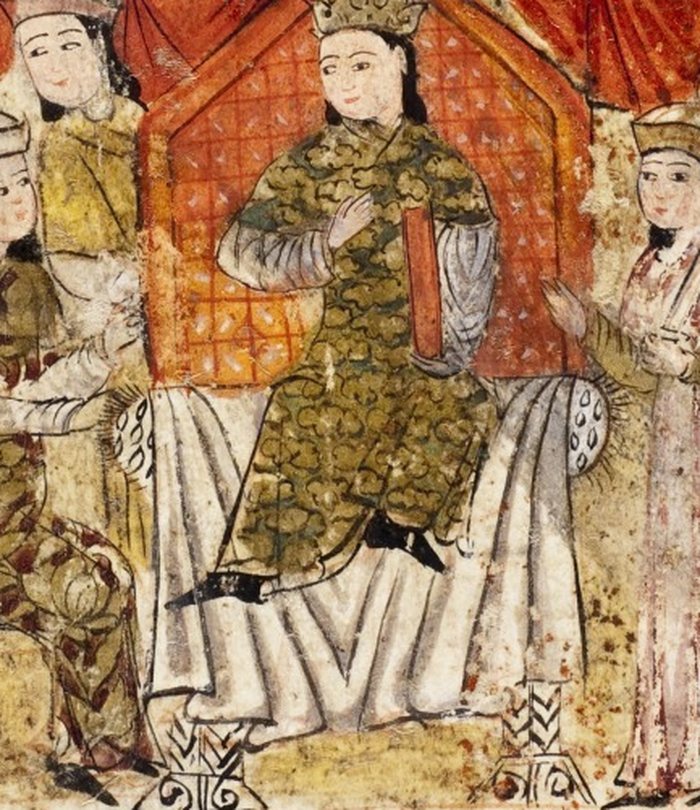
Portrait of Khosrow I
The King Who Built a State
When Justinian closed the thousand-year-old Academy of Plato in Athens in 529, the last pagan philosophers of the Greek world packed their books and rode east, into Persia. They went because they had heard that the young shah at Ctesiphon was a king who read Plato—that he collected doctrines the way other monarchs collected provinces, and that a philosopher might be safer at a Zoroastrian court than in the shadow of Justinian's orthodoxy. They were not wrong. Khosrow I received them, debated them, and when they grew homesick negotiated their safe return as a clause in a treaty with Rome. It is a small episode, but it fixes the man: a ruler who understood that a state is built not only of armies and taxes but of minds, and who wanted all three.
Khosrow Anushirvan — “of the Immortal Soul” — ruled the Sassanid empire of Persia for nearly half a century, from 531 to 579, and became the eastern rival of Justinian: the two great architect-kings of the age, staring at each other across the Syrian desert, each trying to build a rationalized, enduring order out of an inherited chaos. Where Justinian codified Roman law and raised the Hagia Sophia, Khosrow rebuilt the machinery of Persia from the ground—its taxes, its army, its nobility, its administration—and in doing so made himself, for a thousand years of Persian and Islamic tradition afterward, the very archetype of “the Just King.” He inherited a realm nearly broken by a communist-tinged religious revolt; he left it the most orderly power in the world. He is the INTJ on a throne—the reformer whose lasting monument is a system.
Khosrow is the INTJ as statesman: a mind that held a single vision of a rationalized, just, and enduring empire (Ni) and then spent a lifetime building the tax rolls, the army, and the bureaucracy that would make the vision real (Te). His conquests were instruments; his monument was the machine of state itself.
The Vision of a Just Order
Ni — dominant
Dominant Ni fixes on a single image of how things ought to be and bends everything toward it. Khosrow inherited a wound that would have defined a lesser king's whole reign—the Mazdakite movement, a radical sect that had preached the sharing of property and even of wives and had, under his father Kavad, half-dissolved the social order of Persia. Khosrow crushed it, by tradition in a single bloody stroke. But the significant thing is not the massacre; it is what he did with the cleared ground. He read the collapse as a systemic failure and set out to build a state that could not fail the same way again—an order engineered against its own weaknesses.
That is the mark of Ni: he treated the empire not as a set of present emergencies but as one long design. The old great families had grown into over-mighty warlords loyal only to themselves; Khosrow reached past them to create, beneath them, a new class of lesser landed gentry—the dehqans—whose land and status flowed from the crown, and whose loyalty therefore ran to it. It was not a battlefield decision but a piece of social architecture, a lever placed to hold for generations—and it did, outliving the dynasty itself and carrying Persian identity through the Islamic conquest. He handled Rome with the same forward sight, converting military leverage into gold—the subsidies Constantinople paid to keep him quiet and that financed his real project at home. The durable prize was never a captured city but a stable, funded, rationalized Persia. The wars were a means; the enduring state was the end.
The Machinery of the Crown
Te — auxiliary
If Ni supplied the vision, auxiliary Te supplied the tools—and Khosrow's reputation for justice rests, at bottom, on an accounting reform. The old land tax had been levied as a share of each year's crop, which meant assessors had to appraise the harvest field by field before anything could be collected: slow, arbitrary, and ruinous, a system that left a peasant unable to sell or eat his grain until the tax-man came, and that invited extortion. Khosrow ordered a full cadastral survey of the empire's arable land and replaced the guesswork with a fixed assessment based on area and crop, payable in three regular installments—rationalization in the most literal sense. This was the true foundation of his legend: a treasury that could forecast its revenue could pay a standing army on time, and a peasant who knew his obligation in advance could plan and could appeal against an official who took more. “The Just” was not, at first, a moral epithet; it described a functioning system in which the rules were fixed, written, and the same for everyone.
The army got the same treatment. Khosrow broke the empire's dangerous dependence on great nobles who brought their own retinues to war and could withhold them in a sulk: he reorganized the command into four regional marches under separate generals and paid and equipped the new dehqan cavalry directly from the crown, creating a military that answered to the state rather than to a handful of magnates. Tax, land, army, administration—each was a component, and together they formed one integrated machine. That is the auxiliary Te of a builder: not a single grand gesture but a working system, assembled part by part and made to run.
The Philosopher on the Throne
Fi — tertiary
Tertiary Fi in an INTJ surfaces as a private, deeply held set of values the strategist pursues for their own sake, apart from any calculation of power. In Khosrow it took the form of a genuine, almost personal reverence for knowledge. When the exiled Athenian philosophers came to his court, he sat with them and debated—and the tradition that he commissioned a summary of their doctrines and asked after Plato and Aristotle by name points to a curiosity that was his own, not his office's. He sponsored the translation of Greek, Syriac, and Indian works into Middle Persian and patronized the academy of Gundeshapur, which became one of the great intellectual centers of the age, a meeting-house of medicine and philosophy where Greek, Persian, and Indian thought converged. By tradition he sent a physician to India and brought back not only the game of chess but a book—the collection of animal fables that, translated at his court, became Kalila wa Dimna and would be retold across every language of the medieval world.
A purely instrumental Te ruler collects fortresses; Khosrow collected doctrines, fables, and games, because he valued the life of the mind as a good in itself. That is why he was remembered as wise and not merely competent. In the mirror-for-princes literature of later Persia and Islam he appears endlessly as the king in dialogue with his sages—posing questions, weighing answers, ruling by reflection. The historical man was harder and bloodier than that idealized image, but the image grew from something real, and that inward preference, acted on with a king's resources, is the tertiary Fi lending the cold systematizer a soul.
Better-than-Antioch
Se — inferior
Inferior Se in an INTJ is the eruption of the physical and the present into a mind that otherwise lives in long designs—and in a king with armies, it can turn spectacular and cruel. In 540, having torn up the “Eternal Peace” he had sworn to Justinian only eight years before, Khosrow swept into Roman Syria and took Antioch, the greatest city of the east, by storm. His soldiers sacked it and burned it. And then he did something that reveals the inferior function at its most telling: he deported the surviving population back to Persia and built them a brand-new city near his own capital, laid out on the plan of Antioch itself, which he named—with unmistakable relish—Weh-Antiok-Khosrow, “Khosrow's Better- than-Antioch.”
The gesture is almost boastful, a rare crack in the reflective surface. The systematizing king, who ordinarily let subsidies and treaties do his work, here indulged a very concrete, sensory kind of triumph: not just to defeat a rival city but to physically own a copy of it, to see his conquest rebuilt in brick within sight of his palace. It is Se in its inferior register— grandiose, possessive, tied to the tangible object—yet even this was pressed into the larger design, since the deported artisans enriched his realm. For the most part the inferior function stayed contained; his wars were calculated, his violence usually cold. The sack of Antioch stands out precisely because it was the rare moment the strategist let himself savor a spectacle—a reminder that even the most disciplined Ni–Te mind carries, underneath, an appetite for the vivid, immediate world it usually keeps on a short leash.
Why INTJ Over ENTJ
Why not ENTJ?
The case for ENTJ is easy to make: Khosrow commanded armies, sacked cities, reorganized a state, and drove his will through an empire with obvious force. But the ENTJ leads with Te— the outward commander who organizes people and events from the front. Khosrow's center of gravity sits one step further in. He ruled as a reflective architect and a patron of philosophy as much as a conqueror; his wars with Rome were one instrument inside a long, quiet design, not the design itself. His lasting monument is not a battlefield but a reformed system and a culture of learning—the signature of an Ni visionary who used Te to build, not a Te commander who reached for Ni to justify the fight.
The distinction is one of where the man lived. An ENTJ's glory is the campaign, the command, the visible mastery of the field. Khosrow inverts that order: for him the enduring, rationalized state was the point from the beginning, and the conquests, the subsidies, even the terror at Antioch were levers on a machine he was assembling for a future he would not live in. He is the philosopher-king of the Persian imagination precisely because his deepest work was inward and architectural—a single vision of a just order, patiently engineered into permanence. That is Ni–Te, the INTJ's hallmark, not the Te–front of the ENTJ.
Connected Figures
Further Reading
- Sasanian Persia: The Rise and Fall of an Empire — Touraj DaryaeeThe best single-volume modern account of the Sassanid state — strong on Khosrow's reforms and their place in the arc of the dynasty.
- The History of Ancient Iran — Richard N. FryeA magisterial survey by a leading Iranologist; sets Khosrow's reign within the long sweep of pre-Islamic Persian civilization.
- The Wars — ProcopiusThe contemporary Roman account of the Persian wars — the primary source for the sack of Antioch and Khosrow's duel with Justinian, told from the enemy's side.
