 Historical Figure MBTI
#591 · 5-3-26 · The Age of Justinian
Justin I
Emperor of the Romans · The Peasant Who Wore the Purple · Founder of the Dynasty
c. 450 — 527
6 min read
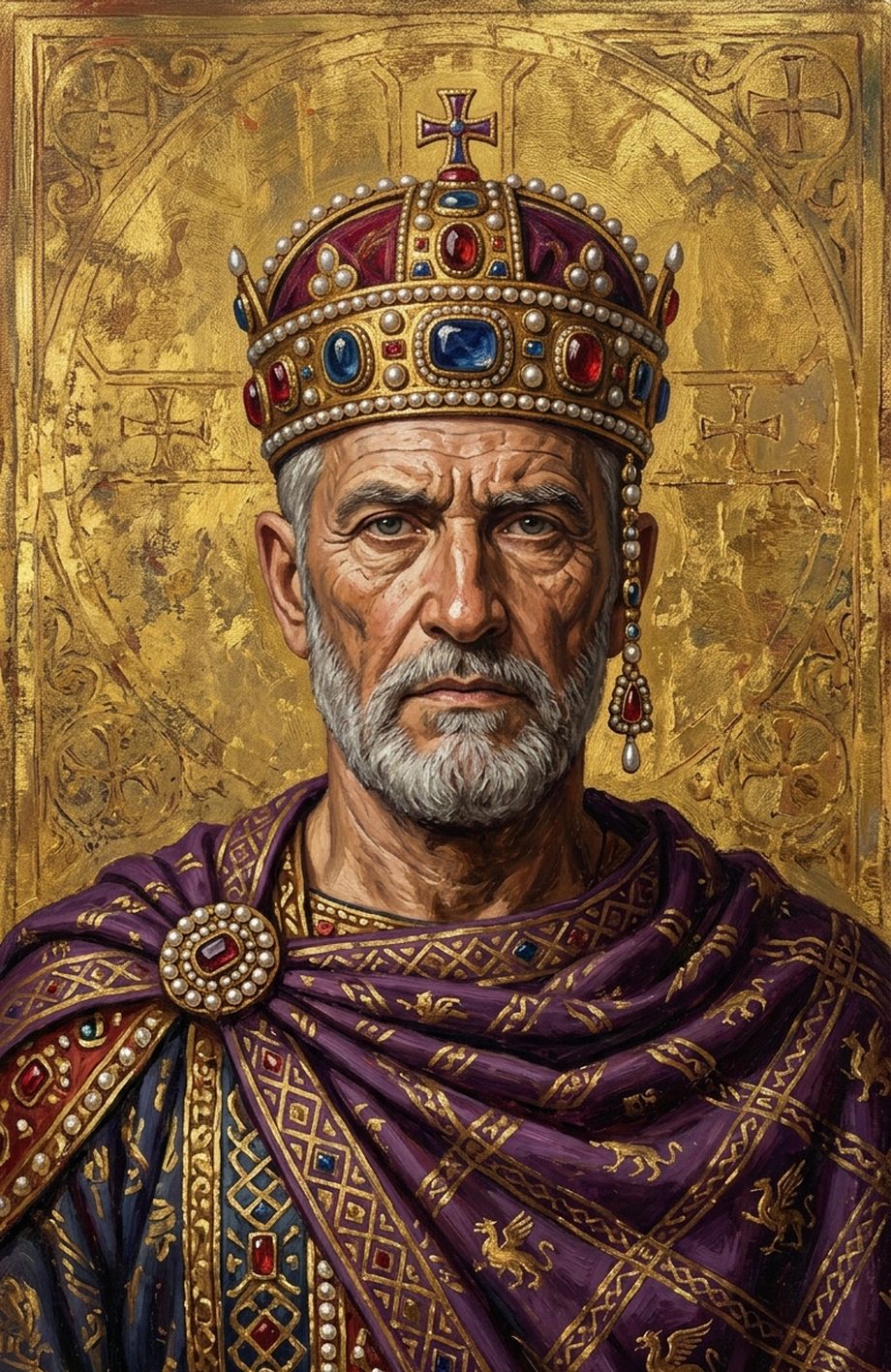
AI-assisted Portrait of Justin I
The Man Who Walked to the Throne
He arrived in Constantinople on foot — a Latin-speaking peasant boy from the Balkan uplands of Dardania, carrying nothing but a rough cloak and a few days' bread. He could barely read. He had no name, no patron, no schooling. Some seventy years later he died in the purple, sole emperor of the Romans and founder of a dynasty. It is one of the most improbable ascents in the ancient world, and the strangest thing about it is how little of it was dramatic. Justin did not seize his fortune in a bold stroke. He earned it the way a man wears down a stone — by showing up, day after day, for fifty years.
Enlisting in the palace guard, the excubitors, he rose not by brilliance but by dependability: brave in the field, reliable in garrison, orthodox in faith, never a threat. When Emperor Anastasius died in 518, the illiterate recruit had become their commander. Nearly seventy, he outmaneuvered better-born rivals for the vacant throne and had himself proclaimed Augustus. Out of his depth in theology and high policy, he leaned on his gifted nephew Justinian, whom he adopted and groomed as heir — so that his own quiet reign became the prologue to one of the greatest in Roman history.
Justin is the ISTJ at the summit of the world: a man who reached it through Si — a lifetime of disciplined, orthodox, unglamorous service — and held it through Te, the plain competence to command and the shrewdness to seize the crown the one time it came within reach.
Fifty Years of Showing Up
Si — dominant
Dominant Si builds a life out of accumulated reliability — the same duty performed correctly, over and over, until sheer endurance becomes a kind of power. Justin's career is that principle stretched across half a century. He rose not in a burst of talent but because he was still there, still steady, long after flashier men had risen and fallen. Guard duty is the perfect Si vocation: it rewards not imagination but constancy — the man always at his post, always where the routine says he should be. Justin was that man for fifty years, and the routine carried him from the ranks to command of the whole corps.
The same temperament shaped how he ruled. Si venerates what is established, and Justin was orthodox to the marrow — a plain, conservative soldier with a deep respect for order and the old certainties. In religion this made him a firm Chalcedonian who reversed his predecessor's tilt toward the monophysites and healed the decades-long Acacian Schism, restoring communion between Constantinople and Rome. It was not a theologian's reform but a traditionalist's instinct: mend the breach with the ancient see, put things back as they were meant to be. He governed as he had soldiered — by discipline and by the book.
The Soldier Who Counted the Guards
Te — auxiliary
If Si got Justin to the door of the palace, auxiliary Te walked him through it. Te reads a situation for what will actually work and executes it without sentiment, and decades of soldiering had made Justin a competent, unfussy administrator of men. Command of the excubitors was no ceremonial post: it meant organizing, provisioning, and holding the loyalty of the emperor's own bodyguard. He held it because he was good at the concrete work of running things, not because he could talk.
The Te shrewdness shows sharpest in the decisive act of his life. When Anastasius died without a clear heir, Justin was handed a large sum to distribute among the guards on behalf of another candidate. He spent it — on securing the throne for himself. It was not the flourish of an ambitious visionary but the cold arithmetic of a man who understood, better than the schemers above him, exactly who held the swords and what they cost. The prize went to the man who knew the machinery — and, knowing the limits of his own competence, he then did the effective thing rather than the vain one, elevating the ablest man he had, his nephew Justinian, to rule beside him.
The Loyalty That Founded a Dynasty
Fi — tertiary
Tertiary Fi in an ISTJ is a quiet, private conviction — firm where it matters, never worn on the sleeve. Justin was reserved and unlettered, no orator and no self-promoter; whatever he felt, he kept close. Yet the shape of his reign betrays a strong inner code beneath the soldier's reticence: an unshakeable orthodoxy of faith, and an almost familial loyalty.
That loyalty is written across his treatment of his own blood. Justin did not merely use Justinian as an able deputy; he adopted him as a son and bound the succession to him, ensuring the peasant family from Dardania would keep the throne. Where an insecure ruler guards power jealously, Justin gave it away, early and generously, to the nephew he trusted — the deepest kind of Fi commitment, expressed not in words but in the arrangement of a whole succession.
Why ISTJ Over ESTJ
Why not ESTJ?
The competent command, the institutional order, the seizing of the throne by practical calculation — all of this could read as ESTJ, the natural administrator-in-chief. But the ESTJ leads from the front: outward, charismatic, driving events by force of public will. Justin was the opposite — reserved, unlettered, and unassuming, a man who rose by steadiness rather than by commanding a room. Tellingly, once he had the purple he did not dominate the stage at all; he leaned on his educated nephew to carry the policy. That is the introverted, duty-anchored Si-dominant, not the extraverted Te engine of an ESTJ.
The distinction is one of source, not competence. The ESTJ pushes the world outward from a public center of gravity. Justin's ascent ran the other way — inward and cumulative, a private discipline of showing up until the sheer weight of fifty faithful years put the crown within a guardsman's reach. That is the ISTJ's peculiar route to greatness: not brilliance, but reliability carried far enough to become destiny.
Connected Figures
Further Reading
- Justin the First: An Introduction to the Epoch of Justinian the Great — A. A. VasilievThe classic monograph devoted entirely to Justin's reign — the fullest scholarly account of the peasant's rise and the founding of the dynasty.
- Justinian: Emperor, Soldier, Saint — Peter SarrisA recent authoritative biography of the nephew that sets Justin's reign in context as the indispensable prologue to Justinian's age.
- The Age of Justinian: The Circumstances of Imperial Power — J. A. S. EvansA lucid survey of the era that traces how Justin's steady, orthodox reign laid the groundwork for what followed.
