 Historical Figure MBTI
#592 · 5-3-26 · The Age of Justinian
Anthemius of Tralles
Mathematician · Architect of Hagia Sophia · Master of the Great Dome
c. 474 — c. 558
7 min read
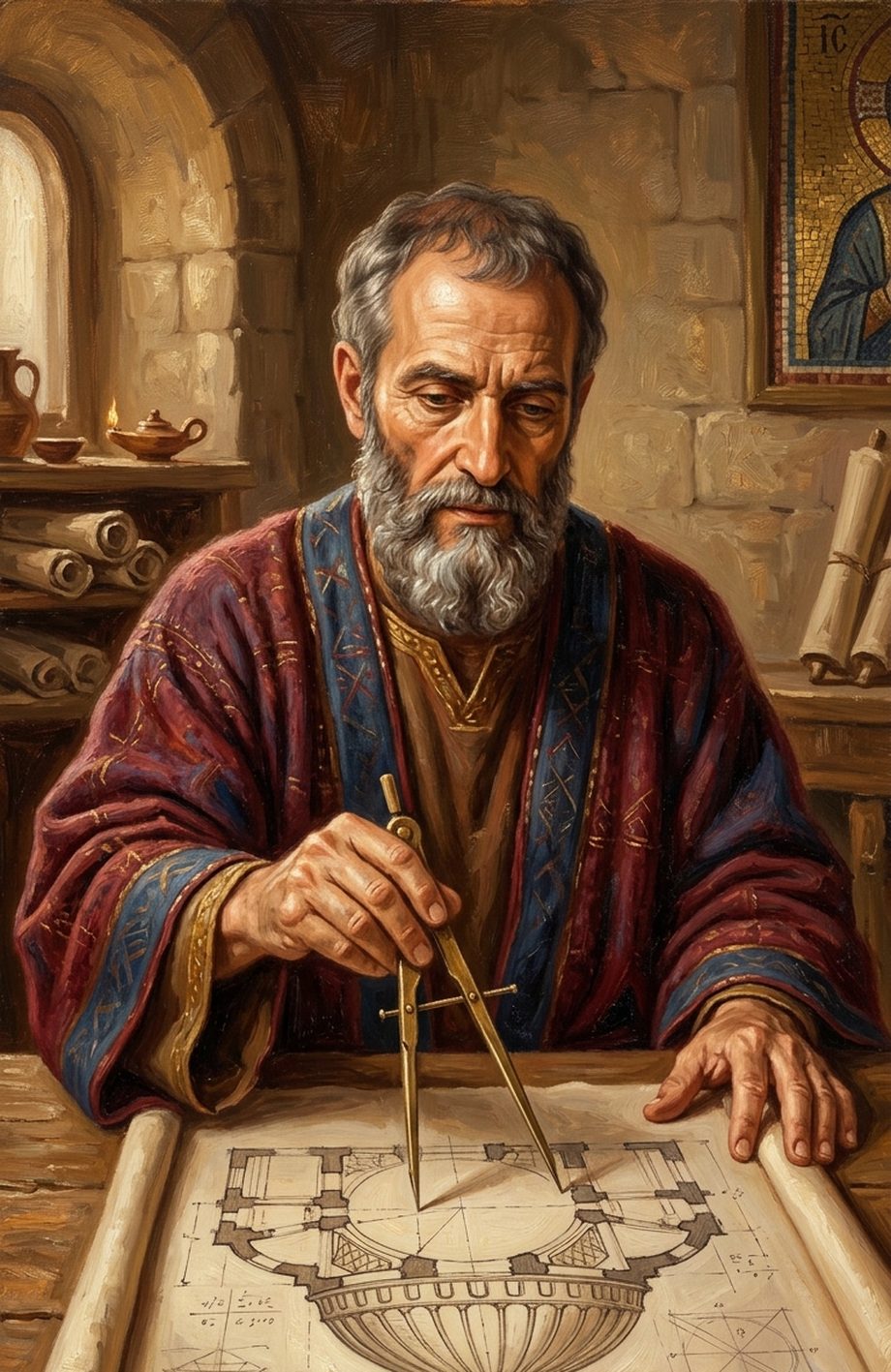
AI-assisted Portrait of Anthemius of Tralles
The Man Who Reasoned a Dome into the Sky
He was not, first of all, an architect. Anthemius of Tralles was a mathematician — a geometer who wrote treatises on conic sections and burning-mirrors, who thought in curves and foci and reflected rays — and when the emperor Justinian handed him the largest building commission of the age, he approached it as a problem in pure reason. To stand beneath the dome of Hagia Sophia is to stand beneath something that should not be possible, and it is possible because one man worked out, on paper, how to make an enormous mass of brick and mortar appear to float on a ring of light.
Born around 474 in Tralles in Anatolia, Anthemius was already a serious geometer when the Nika riots of 532 burned the old church of Holy Wisdom to the ground. Justinian chose two theorists to rebuild it — Anthemius and Isidore of Miletus, mathematicians rather than master masons — and in five years they raised a dome some thirty-one meters across, carried on pendentives and pierced at its base by a ring of windows so that the vast canopy seems to hang from heaven rather than press upon its walls. No one had built anything like it; no one would surpass it for the better part of a thousand years.
This is the INTP at its most exhilarating: Ti's ruthless, abstract command of structure — forces, curves, loads resolved in the mind before a stone is cut — married to Ne's restless delight in the untried. Anthemius did not refine a known form. He reasoned an impossible one into standing.
The Geometry of the Impossible
Ti — dominant
Dominant Ti builds an internal model of how a system truly works and trusts it over any received rule of thumb, and Anthemius trusted his geometry further than any builder before him had dared. The problem of Hagia Sophia was a problem of forces: a dome that size wants to burst outward at its base, and the whole art is to catch that thrust and carry it safely to the ground. Anthemius solved it with pendentives — curved spandrels that gather a round dome down onto a square of four piers — at a scale no one had attempted. There was no precedent to copy; he was reasoning from the mathematics of the shapes themselves.
His written work confirms that the mind behind the dome was an abstract one: a treatise on conic sections, a study of the parabola explaining how a curved mirror concentrates the sun's rays to a single burning point. This is a mind that lives among foci and reflected rays — the same command of curvature that let him calculate the profile of a dome that would hold. For him the building was an argument. Where a craftsman grows a structure outward from what he has already made stand, Anthemius worked inward from an idea, and the ring of light at the dome's base is the proof made visible: he removed material exactly where a cautious builder would never dare, because his model told him the load did not run there. He trusted the theory over the fear.
Burning Mirrors and Piped Steam
Ne — auxiliary
Auxiliary Ne is the restless, inventive reach that feeds Ti fresh problems to chew on, and Anthemius's curiosity ran far beyond the one dome that made him famous. His study of burning-mirrors described arrangements of reflectors to throw concentrated sunlight, anticipating by centuries the mathematics of focus; he speculated about the mechanical use of confined steam and about devices for producing artificial tremors. His was a mind forever asking what else a principle could do, forever pulling a new use out of an old geometry.
The most vivid proof of that playfulness is an anecdote preserved by the historian Agathias. Anthemius was feuding with a neighbor, the rhetorician Zeno, and rather than take the quarrel to court he took it to his workshop. He rigged boilers in his lower room and piped their steam up beneath the joists of Zeno's floor until the whole house shuddered and rocked, sending the terrified rhetorician running into the street convinced an earthquake had struck. On other occasions he dazzled Zeno by flinging sunlight at him from an array of mirrors. Here is Ne in its purest mischief: physics repurposed as a practical joke, a treatise's worth of ingenuity spent on unsettling a single irritating man. The reach that let him imagine a dome no one had seen is the reach that let him imagine a fake earthquake — the same inventive, unquiet mind that gave Justinian a cathedral and Zeno a fright.
The Feud He Solved with a Machine
Fe — inferior
Inferior Fe is the INTP's clumsiest register — the social and emotional world handled awkwardly, more often circumvented than managed — and the Zeno affair is as sharp a portrait of that weakness as it is of Ne's brilliance. A socially fluent man, wronged by a neighbor, smooths the matter over or simply endures it. Anthemius could do none of that gracefully: his answer to a human conflict was not persuasion but a device. He could not out-argue the rhetorician, so he terrorized him with engineering.
There is something telling in the choice of weapon. The problem was interpersonal; the solution was mechanical. Faced with the one domain his type handles least surely, Anthemius retreated to the domain he commanded absolutely and made physics do the work that tact could not — rather than manage Zeno's feelings he manufactured them, piping fear up through the floorboards. The most charming story we have of him is also, quietly, the story of a man who did not know a better way to be a neighbor.
Why INTP Over ISTP
Why not ISTP?
The ISTP case is the obvious one for a builder: the ISTP is the great hands-on problem-solver, the craftsman who masters materials by working them, refining a design through trial and touch on the site. But that is precisely what Anthemius was not. He was a geometer who wrote on conic sections and the parabola, who reasoned the dome into being from mathematics and realized it through other men's hands. His mastery was abstract and inventive — Ti–Ne, the theory and the untried idea — not the tactile Se command of stone and mortar that defines the ISTP artisan.
The distinction is sharp enough that the archive holds its own counter-example. The Ottoman master Mimar Sinan, who spent his career answering Anthemius's dome, was the ISTP builder in full: an apprentice-trained military engineer who learned construction with his hands and refined a working structural vocabulary across scores of buildings. Sinan perfected the dome by doing; Anthemius invented it by thinking. It is the leap, not the refinement, that raised Hagia Sophia.
Connected Figures
Further Reading
- Hagia Sophia: Architecture, Structure and Liturgy of Justinian's Great Church — Rowland J. MainstoneThe authoritative structural study — how the dome actually works, where Anthemius's geometry ran to its limit, and why the first dome fell.
- The Buildings — ProcopiusThe contemporary sixth-century description of Hagia Sophia and its construction under Justinian — the closest thing to an eyewitness account of the dome as new.
- Anthemius of Tralles: A Study in Later Greek Geometry — G. L. HuxleyThe scholarly reconstruction of Anthemius the mathematician — his work on conic sections and burning-mirrors, and the abstract mind behind the architect.
