 Historical Figure MBTI
#593 · 5-3-26 · The Age of Justinian
Hypatius
Nephew of Anastasius · The Reluctant Usurper · Crowned by the Mob
d. 532
5 min read
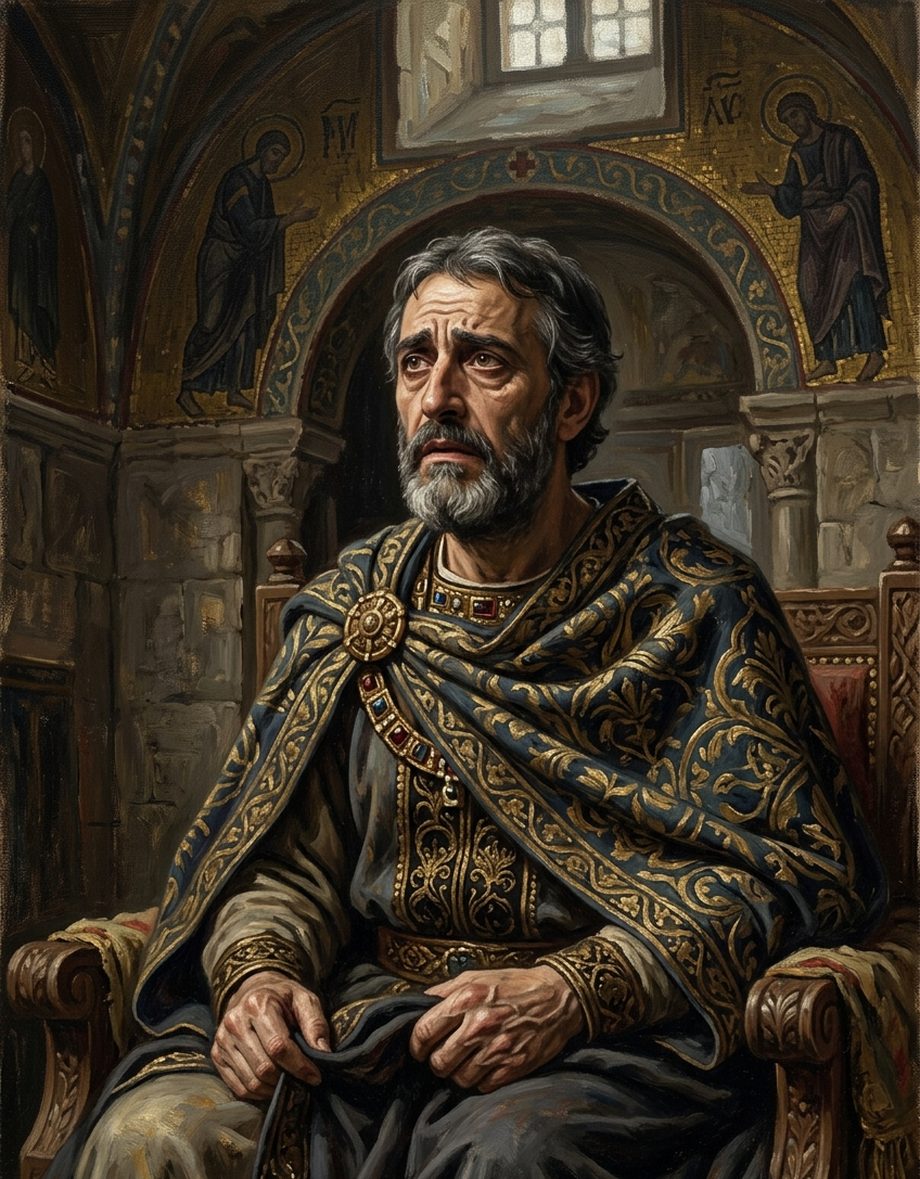
AI-assisted Portrait of Hypatius
The Man Who Wept at His Own Coronation
In January of 532, a frightened senator was dragged through the streets of Constantinople by a mob that had decided to make him emperor. He did not want the honor. His wife, Mary, wept and clung to him and begged the crowd to let him go; he protested that they were carrying him to his death. Having no imperial diadem to hand, the rioters looped a woman's gold necklace over his head and hailed him Augustus. Hypatius — nephew of the late emperor Anastasius, and by that accident of blood a man others could imagine on a throne — had spent a careful life avoiding exactly this moment. It found him anyway.
He was a senator and sometime general, respectable and unambitious — the kind of nobleman who wanted nothing so much as to keep his place secure. The Nika riots, a week of fire and slaughter when the factions of the racetrack turned on Justinian, needed a rival to raise up, and Hypatius's pedigree nominated him. He was a figurehead, not a rebel. When Theodora stiffened her husband's nerve and the troops stormed the Hippodrome, some thirty thousand died on its sands, and Hypatius was executed for a crown he had never reached for. His body was thrown into the sea.
Hypatius is the ISFJ caught in the type's worst nightmare: a cautious, dutiful man of settled Si habits and deference to the group's Fe pressure, swept by other people's ambition into the one role he had spent his whole life trying to avoid — and destroyed for it.
The Comfort of a Known Place
Si — dominant
Dominant Si is a conservative loyalty to the established order — a preference for the known, the safe, the continuous. Hypatius wore it in the ordinary shape of a senatorial career: he served the state, held commands, and asked for nothing beyond the security of his station. Being an emperor's nephew had already brought him one brush with danger under Anastasius, and he had learned that proximity to the purple was a hazard, not a prize.
This is why he read the mob's acclamation not as opportunity but as catastrophe. The Se-driven opportunist sees an open throne and lunges; the Si-anchored man sees the collapse of the settled world and recoils. Hypatius knew, with a clarity his captors lacked, that emperors who rose on a week of rioting rarely died in bed. The crown was not a promotion but the destruction of everything his caution had protected.
Carried by the Will of Others
Fe — auxiliary
Auxiliary Fe attunes a person to the mood and momentum of the group — and in Hypatius it became the instrument of his ruin. A colder, more self-directed will could have refused the crowd outright, forced them to kill him or let him go. Hypatius could not. He protested, he wept, his wife pleaded — and then he let himself be carried, because the collective will pressing on him was stronger than any purpose of his own. He was swept along in the most literal sense: crowned by hands that were not his.
The sources capture the paralysis exactly. Some say that once the necklace was on him he began, briefly and half-heartedly, to play the part — the Fe reflex of conforming to what the room demands. Others say he secretly sent word to Justinian that he was still loyal. Both may be true, and both are the same man: bending first to the mob in front of him and then to the emperor above him, trying to be whatever each audience needed so that neither would destroy him. It was the tragedy of a temperament built to go along, dropped into a moment where going along was fatal.
The Quiet Calculation to Survive
Ti — tertiary
Tertiary Ti is the ISFJ's private logic — not the strategist's bold gambit but the careful man's attempt to think his way out of a trap. Hypatius's secret message to Justinian was exactly this: a calculated hedge to keep a line open to the winning side even while the crown sat on his head, so that if the revolt failed it would be on record that he had never really been its emperor.
But tertiary Ti is a weak instrument against events this large. When Belisarius and Narses cut down the trapped crowd, Hypatius pleaded that he had been coerced — which was true, and did not matter. Justinian could not leave a living alternative breathing, and the private logic that had told Hypatius how to survive had no answer to a power that did not need him to be guilty. He had calculated for a world that ran on reasons; he died in one that ran on necessity.
Why ISFJ Over ISTP
Why not ISTP?
One could imagine the reluctant usurper as an ISTP — a cool, detached operator reading the moment for advantage. But nothing in Hypatius suggests that self-possession. The ISTP is autonomous and unbothered by the crowd; Hypatius was passive, frightened, and buffeted, protesting even as he was crowned and weeping in his wife's arms. His conformity was Fe-driven, not tactical detachment, and his caution was Si's attachment to a settled place, not the ISTP's free improvisation. He was moved by events, not moving through them.
The distinction is agency. The ISTP would have used the moment; Hypatius was used by it. Every act the record preserves — the tears, the pleading wife, the secret message, the plea of coercion at the end — belongs to a man reacting to forces larger than himself, never authoring them. That is the ISFJ core: a dutiful man whose tragedy was not that he grasped for power, but that power was pressed into his unwilling hands and killed him for holding it.
Connected Figures
Further Reading
- The Wars of Justinian — ProcopiusThe eyewitness contemporary account of the Nika riots — the primary source for Hypatius's coronation, protests, and death.
- The Nika Riot: A Reappraisal — Geoffrey GreatrexThe standard modern scholarly re-examination of the revolt (Journal of Hellenic Studies), weighing the sources on Hypatius's role and reluctance.
- Justinian: Emperor, Soldier, Saint — Peter SarrisA recent full biography of Justinian that sets the Nika crisis and Hypatius's fate within the politics of the reign.
