 Historical Figure MBTI
3 min read
#33 · 2-10-26 · Petrine Russia
Tsarevich Alexei Petrovich
Heir · Dissenter · Moral Casualty of Empire
1690 — 1718
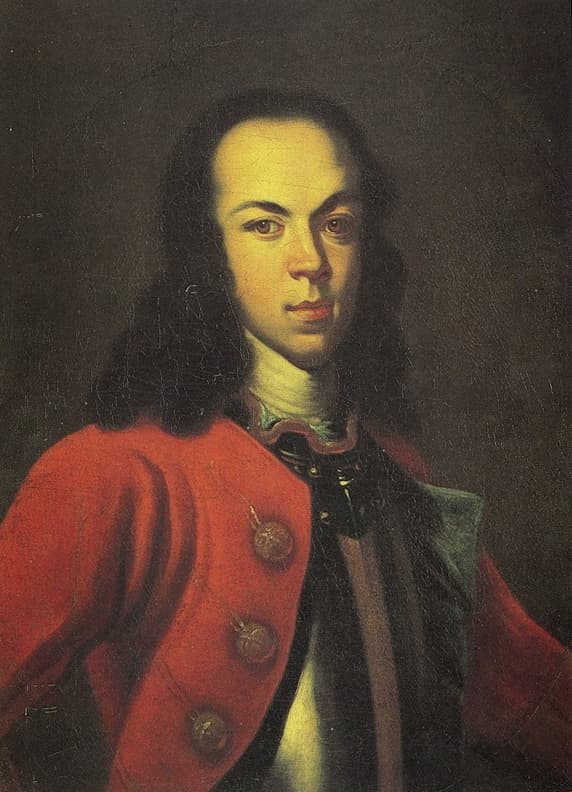
Portrait of Tsarevich Alexei Petrovich.
The Son Who Could Not Become the State
Tsarevich Alexei Petrovich was born into a world that demanded transformation at any cost. As the only surviving son of Peter the Great, he was expected not merely to inherit Russia, but to embody its rupture with the past.
Alexei could not.
Where his father saw necessity, Alexei felt violation. Where the state demanded hardness, he felt guilt. Where power required motion, he longed for stillness.
He is often dismissed as timid, reactionary, or incapable. But these labels mistake conscience for incompetence. What emerges from his letters, confessions, and behavior is a psyche guided not by strategy or authority, but by inner moral alignment — the psychology of an INFP placed at the epicenter of forced modernization.
His tragedy was not weakness. It was incompatibility.
Fi — Dominant
Alexei's inner life revolved around personal moral judgment. His letters are saturated with self-reproach, apology, fear of wrongdoing, and concern with sin, guilt, and unworthiness.
When conflict arose, he blamed himself — not the system, not history, not his father. He did not argue policy. He confessed failure.
Rather than asserting an alternative vision, Alexei sought to remove himself from harm by renouncing the throne and retreating into religious life. This is Fi at its clearest: when the world violates one's values, the self withdraws rather than instrumentalizes itself.
Ne — Auxiliary
Alexei's intuition did not express itself as possibility-building or reform. Ne appeared instead as longing for a different kind of life — imagining withdrawal, peace, and spiritual refuge, envisioning monastic existence as an escape from moral injury.
He did not imagine a different Russia. He imagined a world where he did not have to betray himself to survive.
This is Ne used defensively — as exit, not exploration.
Si — Tertiary
Alexei gravitated toward Orthodox ritual, religious history, and traditional court customs. Where Peter shattered the past to build the future, Alexei sought reassurance in what had endured.
This was not political conservatism. It was psychological anchoring. Si offered him a sense of moral and temporal stability in a world that felt violently unrecognizable.
Te — Inferior
Alexei struggled profoundly with execution, authority, enforcement, and role-based performance. When forced into Te-heavy expectations — military service, public command, dynastic duty — he did not adapt. He froze, avoided, drank, and withdrew.
This was not laziness. It was Te collapse under chronic coercion. He could endure tasks briefly, but could not internalize a system that treated people as means rather than moral ends.
Why Not ISFJ or ISFP?
Why not ISFJ?
An ISFJ heir would likely have internalized duty, complied outwardly, managed expectations, and performed the role despite suffering. Alexei did not. His struggle was not with endurance but with moral self-betrayal — a distinctly Fi crisis rather than an Si one.
Why not ISFP?
An ISFP would have shown hands-on competence, physical grounding, and sensory engagement as coping. Alexei avoided embodiment and action under stress. His escape was into imagination and religious interiority, not into physical reality. His struggle was existential, not practical.
The Family Dynamic That Sealed His Fate
An ENTJ father like Peter the Great experiences Fi-dominant withdrawal as betrayal, weakness, or sabotage. To Peter, Alexei's refusal to harden was not tragic — it was dangerous.
An ENFJ stepmother like Catherine could stabilize emotion, but she could not rewrite the system or protect Alexei from its logic.
As an INFP, Alexei had no such buffer. He felt everything personally. And the state demanded impersonality.
Connected Figures
Further Reading
- Peter the Great: His Life and World — Robert K. MassieThe definitive English-language biography of Peter, with extensive coverage of the Alexei trial and its aftermath.
- The Romanovs: 1613–1918 — Simon Sebag MontefiorePlaces Alexei's fate in the broader arc of Romanov dynastic violence and succession crises.
- Peter the Great: The Struggle for Power, 1671–1725 — Paul BushkovitchA scholarly reassessment of court politics and the role of Alexei's network of Old Muscovite allies.
