 Historical Figure MBTI
#1216 · 9-6-26 · The Mughal Empire
Udai Singh II
Ruler of Mewar · Father of Maharana Pratap
1522–1572
5 min read
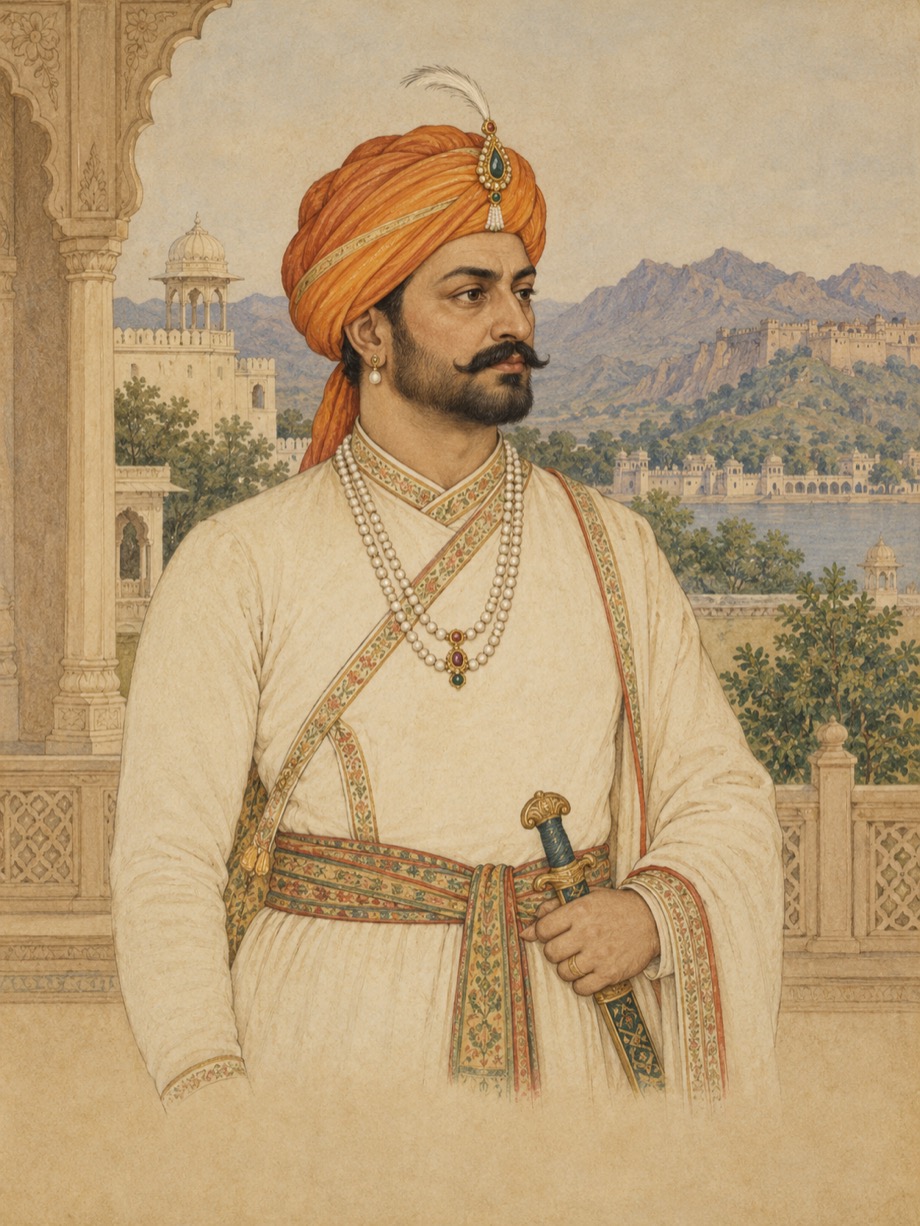
AI-assisted Portrait of Udai Singh II
The ruler who survived his fortress
Udai Singh II’s reputation is trapped at the gates of Chittor. The fortress fell to Akbar in 1568 while its ruler remained outside the siege, and later accounts have often made that absence a complete judgment on his life. The men who defended the fort become courage itself; the man who survived becomes its opposite. Such a picture is morally convenient and historically incomplete. The fall of a capital and the extinction of a dynasty were different events. Udai’s continued existence helped keep them different.
To say this is not to turn withdrawal into a secretly perfect strategy. His reign ended with a devastating loss, and the defense was entrusted to people who faced consequences he escaped. It is to ask what a ruler’s survival meant in a polity whose authority belonged to a house as well as to a place. The surviving dynasty would still have lands, dependents, claims, and a successor. A fortress could be conquered without making all of those things disappear.
Udai remains untyped here. We can recover the pressures on his position and the consequences of major decisions more clearly than a recurring pattern of private judgment. Heroic rescue stories and accusations of cowardice both make poor evidence of cognitive preference. Neither admiration nor indignation supplies the missing interior record.
Mewar before its most famous refusal
Born in 1522, Udai belonged to the Sisodia ruling house that had already experienced serious military and dynastic upheaval before his own rule. He was a son of Rana Sanga, whose contest with Babur belonged to the preceding generation. The relationship matters because it placed Udai inside a long history of regional authority; it does not mean that he inherited his father’s temperament. A famous ancestor is often used to establish what a descendant ought to have been, and then to condemn him for the difference.
His reign belongs to the decades when Mughal power was being restored and enlarged. Humayun’s return and Akbar’s consolidation altered the possibilities facing regional rulers. Mewar did not confront a static outside force. It confronted a court that could use siege warfare, marriage, rank, and patronage to make different kinds of submission possible. Udai’s position must be read inside that changing field rather than against a timeless test of courage.
The development of Udaipur under his rule also belongs in the picture. The City Palace Museum dates the palace’s foundation to 1559, before the final Mughal siege of Chittor. The chronology matters: the city was not simply an overnight replacement invented after the fortress fell. Royal power was already developing another center in the hills. The later city grew through the work of successive rulers, so its mature palaces and urban landscape should not all be credited to its founder.
An emperor approaches, a dynasty withdraws
Akbar’s siege began in 1567 and ended in the capture of Chittor the following year. Udai withdrew to the hills, leaving the defense under commanders including Jaimal. Contemporary imperial narrative treated the capture as a great assertion of the emperor’s authority. Rajasthani remembrance could instead concentrate on the defenders’ fidelity and sacrifice. Both traditions explain why the ruler’s absence became so charged: the fortress was a place where competing claims to legitimacy could be dramatized.
The distinction between a decision and its explanation remains essential. We know that Udai was absent during the siege. We cannot read a complete psychology of fear, prudence, or indifference out of that fact. A withdrawal could preserve a ruler for continued resistance and still expose others to death. Calling it preservation does not erase the cost; calling it flight does not explain the political calculations. The historian’s task is to keep those questions open long enough to see what happened next.
Chittor’s fall involved far more than a change in the flag above the walls. Akbar ordered a massacre after the capture, and the violence became part of the fortress’s enduring memory. Udai’s story should not absorb that suffering into an argument about whether one man was brave enough. Soldiers, townspeople, and households lived the consequences of the conquest. They were historical people, not supporting figures assembled to make a verdict about their ruler more satisfying.
The authority that remained
Udai lived until 1572. When Pratap succeeded him, Mewar’s ruling house still existed as an opponent that Akbar would need to accommodate or overcome. The later campaign against Pratap is evidence that conquering Chittor had not completed the whole political task. Udai did not leave an intact kingdom, but neither did he leave only a memory. His successor had a position from which further choices could be made.
This is a limited but important legacy. It does not prove that every measure Udai adopted was farsighted, and it does not turn Pratap’s later resistance into an accomplishment of the father. Each ruler faced his own decisions. What connected them was the survival of a house and a claim through the loss of a major stronghold. Continuity depended on more people than either man alone, including nobles whose allegiance gave the royal name continuing force.
Accounts of succession and household preference also require care. Later narratives can explain political disagreement through a favored wife, an undeserving son, or a hero whose claim must eventually prevail. Those patterns may preserve real tensions, but their narrative neatness is not itself verification. This profile leaves private motive uncertain rather than converting a dynastic outcome into a diagnosis.
Connected Figures
Further Reading
- The Akbarnama, volumes II–III — Abu’l-Fazl; translated by Henry BeveridgeImperial narrative of the Amber alliance and campaigns; read its judgments of submission and resistance critically.
- The Mughal Empire — John F. RichardsA scholarly account of imperial institutions, regional incorporation, and the succession of 1605.
- Mewar and the Mughal Emperors, 1526–1707 A.D. — Gopi Nath SharmaA detailed regional study; distinguish its evidence from its older patriotic framing.
- Monuments to Enemies? ‘Rajput’ Statues in Mughal Capitals — Eugenia VaninaExamines the competing memories of conquest and Rajput heroism; check regional traditions against court accounts.
