 Historical Figure MBTI
#1215 · 9-6-26 · The Mughal Empire
Maharana Pratap
Ruler of Mewar · Defender of an Inheritance
1540–1597
6 min read
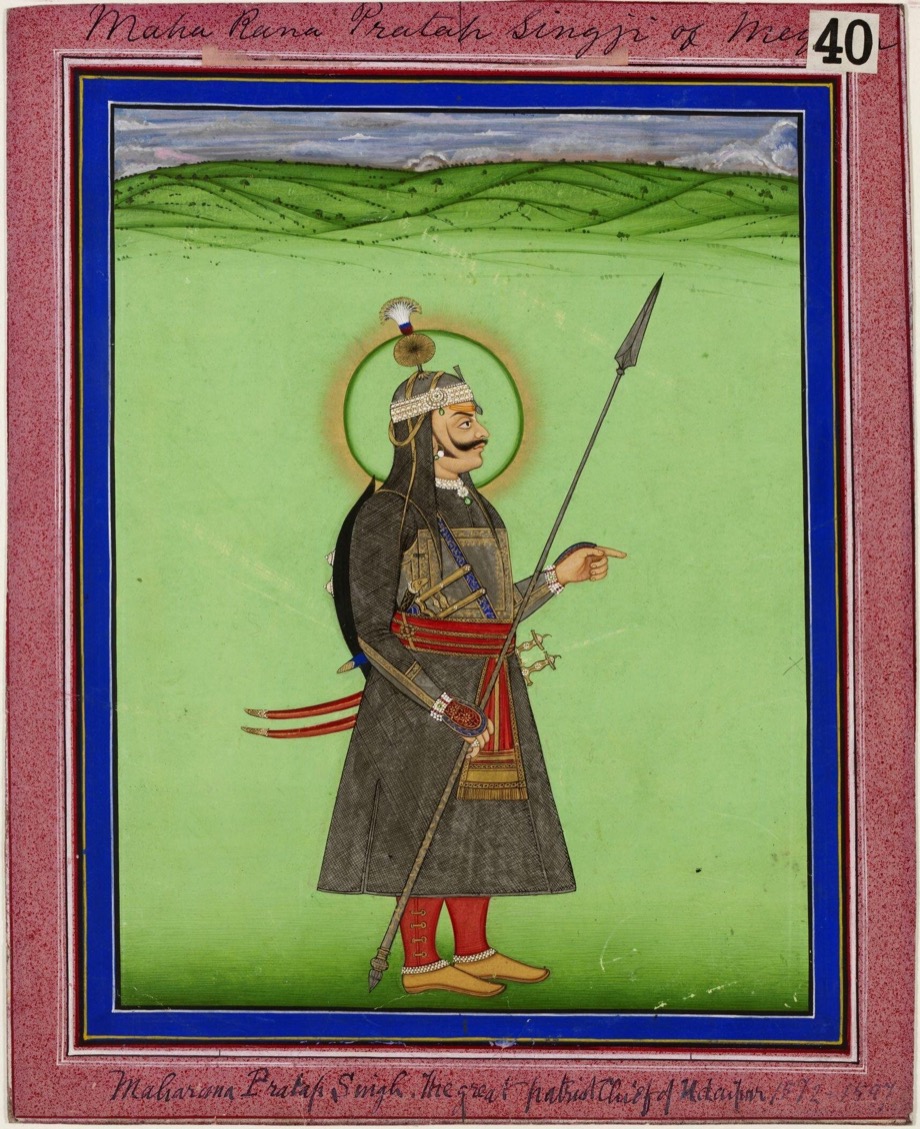
Portrait of Maharana Pratap — circa 1880 (later depiction)
The inheritance that would not become a favor
Maharana Pratap inherited a kingdom whose most famous fortress was already in another ruler’s hands. Chittor had fallen to Akbar in 1568, four years before Pratap succeeded his father. The question was therefore never simply whether he would surrender an untouched inheritance. It was whether the remaining authority of Mewar would be exercised in its own name, or confirmed within a hierarchy whose summit belonged to the Mughal emperor. Pratap chose the first course, and spent much of his reign making that choice survivable.
His refusal has acquired a life larger than his political world. Later memory makes him a national liberator, a flawless warrior, or the solitary embodiment of religious resistance. Those images obscure a contest in which Rajput commanders served on both sides, and in which inheritance, rank, territory, and obligations mattered more than a modern national border. The compelling figure is the ruler who continued after a serious defeat, preserving enough power to keep an alternative political future open.
The ISTJ reading is tentative. It rests on the durable priority he gave to an inherited office and on his practical adaptation in its defense, rather than on the proposition that stubbornness reveals a personality type. His inner account of that duty is not recoverable with the confidence that later admirers often imply.
The tentative ISTJ reading places dominant Introverted Sensing in Pratap’s treatment of inherited sovereignty as an obligation that present hardship did not cancel.
The office outlasts the fortress
For Pratap, the central political reference point was the continuity of Mewar’s ruling house. Other Rajput dynasties had accepted Mughal service and could retain local authority while receiving imperial rank. Mewar’s refusal was therefore a choice among recognizable arrangements, not an inability to imagine that arrangements existed. Accepting service would change the relationship between his office and the authority above it. A kingdom might remain on a map while its ruler’s standing acquired a different source.
This is where Introverted Sensing offers an interpretive possibility: the inherited claim supplies the measure against which a new offer is judged. The argument is not that Pratap mechanically repeated ancestral conduct. He governed a damaged inheritance in conditions his ancestors had not faced. What appears stable is the reference point, the sense that he held something received and answerable to more than immediate advantage. The historian must still distinguish that public claim from a private preference. Dynastic legitimacy could demand the same language from people with very different temperaments.
His accession in 1572 and the continuation of resistance after Haldighati suggest that this claim did not disappear when its defense became inconvenient. Yet the evidence should remain concrete. We can describe the persistence of his political position without supplying imagined vows, childhood scenes, or conversations in which he conveniently explains the whole of himself. The remembered hero is often eloquent exactly where the contemporary record is least intimate.
The meaning of continuity was therefore political as well as familial. A ruler could lose a seat, move through a damaged territory, and still insist that his office had not become a grant from the emperor. That distinction helps explain why a lost battle could leave the central dispute unsettled.
A refusal needs provisions
At Haldighati in June 1576, Pratap faced an imperial force commanded by Man Singh of Amber. The encounter did not produce the decisive liberation sometimes assigned to it. Mughal forces held the field, and Pratap escaped. Equally, battlefield defeat did not deliver the ruler himself or settle the submission of Mewar. Both statements are necessary. Removing either turns the war into a ceremony of praise for one side.
The continuation matters more to the psychological argument than an embellished account of the charge. Resistance had to survive in a landscape of hills, routes, strongpoints, and uneven access to resources. Pratap’s authority could not be sustained by declaring independence once. It required followers who remained available, places from which power could be exercised, and a way of avoiding the conversion of every military encounter into final destruction. Withdrawal was part of this problem, not automatically evidence that conviction had failed.
Auxiliary Extraverted Thinking is a useful name for this practical side of the interpretation: the inherited purpose needs arrangements that can continue working. But the available sources do not make Pratap the solitary author of every successful measure. Commanders, local communities, and the terrain all helped shape the conflict. His capacity to remain a ruler depended on their participation. Leadership here was collective maintenance under pressure, even when later portraits reduce it to one armored man.
What the imperial offer could not purchase
The strongest complication is that Pratap’s refusal can also be understood as a personal valuation of honor and autonomy. Such a reading belongs to Introverted Feeling, whether placed high in a different type or treated as a supporting part of this one. No surviving administrative outline tells us exactly how he experienced the prospect of paying homage. The distinction between defending an inherited duty and refusing a personally intolerable submission cannot be settled merely by repeating that he refused.
Nor should his principle be made costless. A prolonged contest over sovereignty brought danger and disruption to people who did not themselves negotiate with Akbar. To admire persistence is not to prove that every sacrifice it required was freely chosen by everyone affected. A serious portrait keeps the ruler’s commitment and the population’s exposure in the same frame. Political honor was an institution with material consequences, rather than an untouched jewel inside a private conscience.
This restraint also changes how we read imperial testimony. Abu’l-Fazl’s account describes the Rana through the vocabulary of disobedience and delusion, while placing the emperor’s victory within a providential scheme. That is evidence of the court’s claim to define legitimate authority. It is not neutral access to Pratap’s intelligence. The rival memory that makes every decision a triumph is equally ill-suited to reconstructing a mind.
Why this tentative reading?
Why not ISFP or INFP?
A ruler who declines profitable submission can plausibly be read through dominant Introverted Feeling. That alternative becomes stronger if personal moral autonomy is the organizing motive. The tentative preference here is for a duty framed by inherited sovereignty, followed through practical efforts to preserve its institutions. The surviving evidence establishes that public pattern more securely than it establishes the private emotional source of the refusal.
His tactical adaptation should not be mistaken for evidence against continuity. Changing the means of resistance may have been what allowed the central commitment to endure. Even so, a type code adds no certainty to the record. It offers a provisional way to distinguish the end he kept from the methods he could change.
Connected Figures
Further Reading
- The Akbarnama, volumes II–III — Abu’l-Fazl; translated by Henry BeveridgeImperial narrative of the Amber alliance and campaigns; read its judgments of submission and resistance critically.
- The Mughal Empire — John F. RichardsA scholarly account of imperial institutions, regional incorporation, and the succession of 1605.
- Mewar and the Mughal Emperors, 1526–1707 A.D. — Gopi Nath SharmaA detailed regional study; distinguish its evidence from its older patriotic framing.
- Pilgrimage, performance, and peripatetic kingship: Akbar’s journeys to Ajmer and the formation of the Mughal Empire — Pratyay NathPlaces the campaigns in the geography and logistics of imperial travel.
