 Historical Figure MBTI
#498 · 4-18-26 · Plantagenet England
Wat Tyler
Leader of the Peasants' Revolt of 1381
d. 1381
6 min read
AI-assisted Portrait of Wat Tyler
The Man Who Marched on London
For a few electric days in June 1381, a tiler from Kent held the most powerful kingdom in Christendom by the throat. We know almost nothing of where Wat Tyler came from and will never know exactly how he died, but between those two blanks lies the most dangerous fortnight in medieval English history—the days he took a leaderless mob of furious commoners, gave it direction, and drove it straight at the capital.
The fuse was a hated poll tax, a flat levy that fell as hard on a ploughman as on a duke, demanded a third time in four years for a failing war in France. But the powder had been packed for a generation: the Black Death had killed perhaps a third of England, and the survivors—suddenly scarce, suddenly worth more—wanted higher wages and an end to the serfdom that still bound them to their lords' land. When the collectors came round, Kent and Essex exploded, and Tyler led the rebel host into London, where they burned John of Gaunt's magnificent Savoy Palace to the ground, threw open the prisons, and beheaded the Archbishop of Canterbury and the royal treasurer.
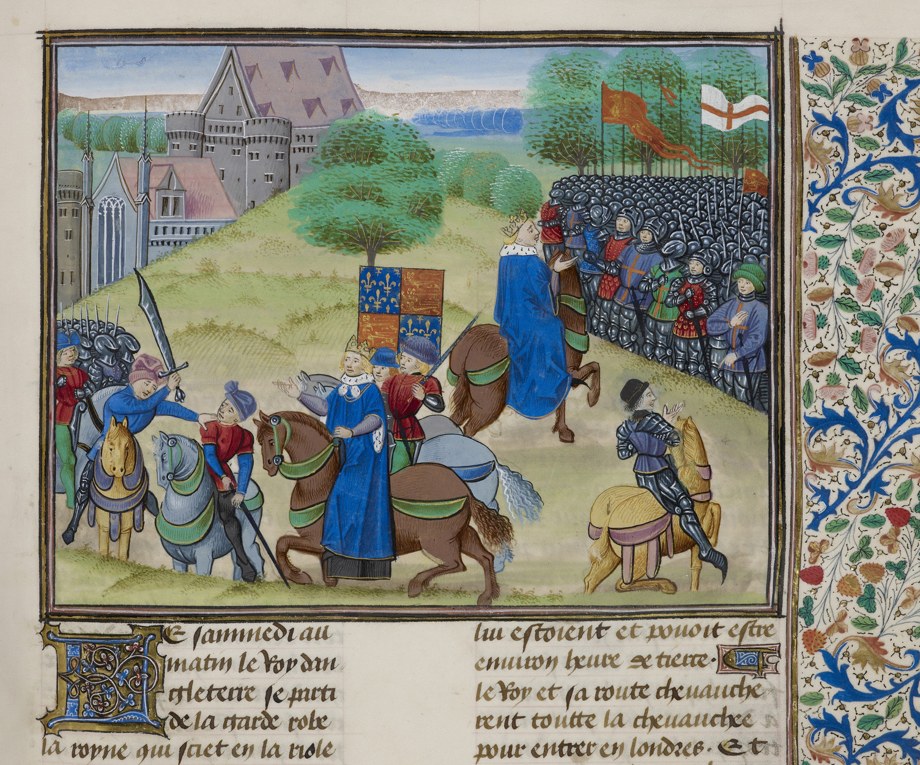
At Smithfield, Tyler came face to face with the fourteen-year-old Richard II to put the rebels' demands to the king himself. He was, in every line of the chronicles that loathed him, a man of pure action—bold, defiant, magnetic, utterly in the moment. He is the ESTP who seized the largest moment medieval England ever offered a commoner.
Tyler led not by ideology or office but by sheer nerve and presence—the ESTP signature of dominant Se: read the moment, ride the wave, walk up to the king himself. What he could not do was see past the moment to the trap inside it.
The Man of Action
Se — dominant
Dominant Se lives in the physical present and acts on it without hesitation—it reads the crowd and the terrain and moves. Everything we know of Tyler is Se in motion. He did not draft a manifesto or convene a council; he put himself at the head of a marching column, aimed it at London, and let the sheer momentum of his presence carry tens of thousands with him. At Smithfield he rode out almost alone to face an anointed king with a swagger that appalled the chroniclers—rinsing his mouth, calling for ale, clapping the boy familiarly. Treating that meeting as a contest of nerve is dominant Se with no brake on it: the conviction that the man who holds the present holds everything. For three days it very nearly was true.
The Shrewd Organizer
Ti — auxiliary
Audacity alone does not move tens of thousands of men in good order through a hostile city. Behind the swagger ran a hard, practical intelligence—auxiliary Ti, the operator's grasp of how a thing works and how to make it work for you. Tyler used it to impose a rough discipline on a leaderless crowd and to strike targets with a logic to them: the Savoy of the despised John of Gaunt, the prisons, the men held responsible for the tax and the war—while taking pains to present the rebels as loyal to the king and aiming the violence only at his “traitor” ministers. The same mind shaped the demands he carried to Smithfield: the end of serfdom, the abolition of lordship—the plainest solutions to the plainest grievances. If bondage is the problem, abolish bondage. That blunt clarity is Ti in service of Se's drive—a working man's direct answer to who owns whom.
The Voice of the Crowd
Fe — tertiary
Tertiary Fe gives the ESTP a live feel for the mood of a crowd—not deep personal empathy but a performer's read on what a mass of people wants to hear and how to give it back amplified. Tyler commanded the host not by rank or birth but by speaking its anger aloud, becoming the face and voice of what thousands already felt. But tertiary Fe is a thin and volatile thing, and at Smithfield it failed him. Reading the king and his men as just another crowd to be faced down, he misjudged the temperature of the most dangerous room of his life: the boldness that had electrified the commons read as intolerable insolence to the men around Richard. A function that thrives on a sympathetic audience has nothing to work with when the audience is a wall of mounted enemies waiting for an excuse.
No Plan for After
Ni — inferior
Inferior Ni is the ESTP's blind side: the long view, the trap concealed inside an apparent triumph. Tyler had conquered the present so completely that he seems never to have asked what came next. When Richard, cornered, agreed to the demands and promised charters of freedom, Tyler took the king at his word—with no contingency for betrayal, no grasp that a crown would never honour a charter signed under duress. The promise was worth nothing the instant he was dead. When a scuffle flared at Smithfield, the Lord Mayor, William Walworth, struck him down and killed him before the king, and the whole rising—which had no spine but Tyler's presence—collapsed. Richard rode coolly to the leaderless mob, claimed to be their captain, and led them out; the charters were revoked and the revolt crushed. Everything Se, Ti, and Fe had built in three astonishing days, inferior Ni could not preserve for a single hour.
Why ESTP Over ESTJ
Why not ESTJ?
The ESTJ leads by structure—builds the institution, sets the chain of command, governs through durable systems that outlast the founder. Tyler did none of that. He led by audacity and the seized moment, an improviser riding a wave he had not planned. The revolt was a thunderclap of action, not an organization: it produced no offices, no succession, no machinery, and it died with the one man at its head. An ESTJ would have left a structure standing; Tyler left a legend and a grave.
The distinction is momentum versus machinery. The ESTJ's power is cumulative and impersonal, a system that runs whether or not its architect is in the room; Tyler's was immediate, physical, and bound entirely to his own presence. That is dominant Se with weak Ni—the genius of the moment paired with blindness to everything past it.
Connected Figures
Further Reading
- Summer of Blood: The Peasants' Revolt of 1381 — Dan JonesThe most vivid narrative account of the rising — fast, dramatic, and strong on Tyler's days in London and the confrontation at Smithfield.
- England, Arise: The People, the King, and the Great Revolt of 1381 — Juliet BarkerA richly researched social history that sets the revolt against the deeper grievances of post-plague England.
- The Peasants' Revolt of 1381 — R. B. DobsonThe standard scholarly sourcebook, gathering the contemporary chronicles and documents on which all later accounts depend.
