 Historical Figure MBTI
#1131 · 8-21-26 · The Fall of the Han
Zhang Lu
Five Pecks of Rice · Hanzhong Theocrat · The Surviving Mirror
d. 216 CE
3 min read
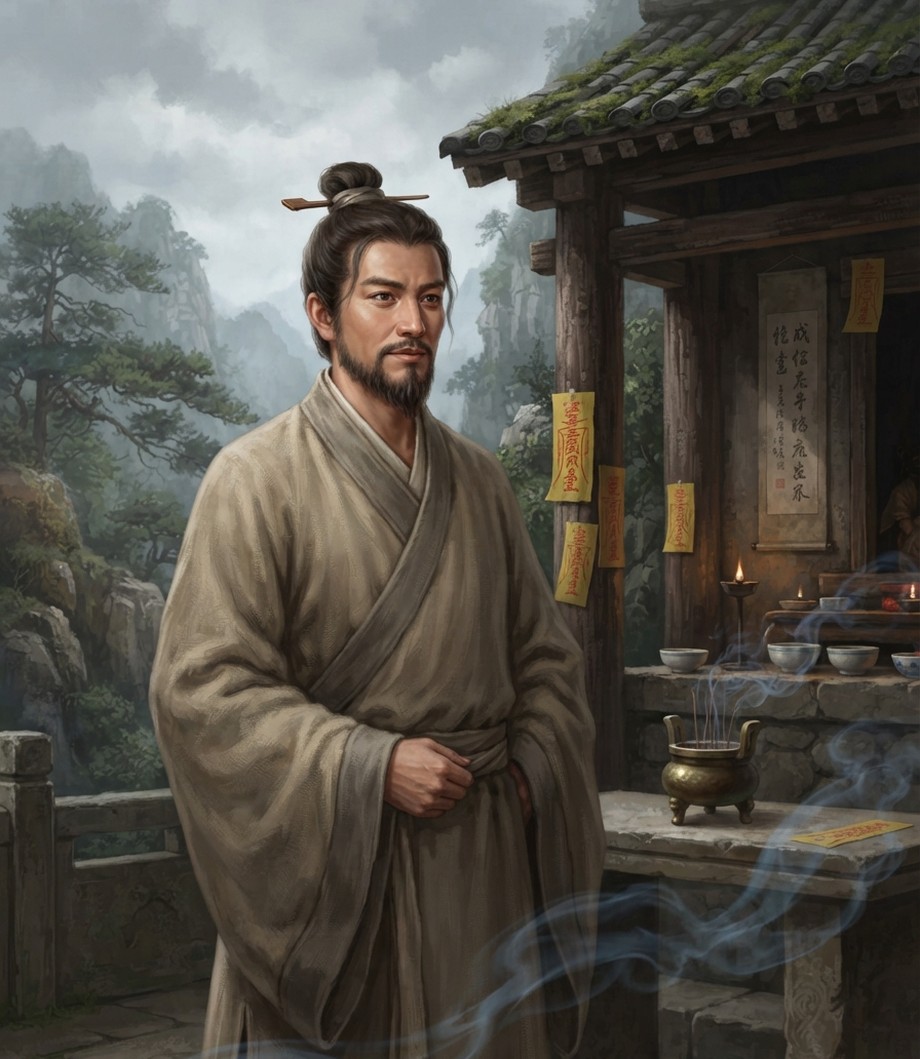
AI-assisted Portrait of Zhang Lu
The Warlord Who Ran a Charity
Grandson of the founder of the Way of the Five Pecks of Rice — an early organized Daoist religious movement named for the modest rice tithe its members paid — Zhang Lu inherited a faith and turned it into a state. Amid the collapse that followed Dong Zhuo's fall, he seized the mountainous Hanzhong region and held it for roughly two decades, an independent theocracy answering to no warlord while the rest of China tore itself apart.
What he built there was unusual for the era on every count that mattered. Free rest-houses stocked with rice and meat stood open to any traveler, no charge asked. First offenses were met not with corporal punishment but with confession, forgiveness, and a sentence of road repair. Alcohol was banned outright. When Cao Cao's army finally arrived in 215 CE, Zhang Lu read the military situation correctly, chose surrender over annihilation, and sealed the region's treasuries rather than burn or loot them on his way out — a last gesture that cost him nothing to give and said everything about what he had actually been doing in Hanzhong.
Zhang Lu was an ISFJ — a caretaker whose authority never once needed to announce itself, because it was too busy stocking the rest-houses.
Nothing in the record points to a man chasing conquest, doctrine, or personal glory. Every documented act points instead to maintenance — of people, of order, of what had been inherited and would need to be handed on. That is the profile of dominant Si paired with auxiliary Fe: a steward's memory for what already works, applied in service of the people standing in front of him.
Psychological Verdict
The free rest-houses and the confession-based justice system are not the acts of a man building a personal legend. They are the acts of someone whose values run toward the concrete wellbeing of ordinary people under his care — Si's instinct to preserve and provision, expressed through Fe's pull toward communal harmony rather than toward doctrine, spectacle, or territorial appetite. A sect inherited from a grandfather became, in Zhang Lu's hands, a functioning welfare state, because that is what stable, well-tended systems look like when the person running them has no taste for disruption.
The surrender confirms the type rather than complicating it. Zhang Lu did not need a symbolic last stand to prove anything to himself or to history; he needed Hanzhong's treasuries intact for whoever came next. Sealing them rather than burning them was the same caretaking reflex that built the rest-houses, just turned toward an ending he had no illusions about surviving as ruler. Cao Cao noticed — the marquisate and the marriage alliance that followed were the recognition of a man who had governed well and lost gracefully, not a man who had merely lost.
Set beside Zhang Jiao, the era's other major religious-mass-movement founder, the contrast sharpens the type. Zhang Jiao turned his following outward into open war on the dynasty; Zhang Lu turned his inward into two decades of quiet provisioning, and when the fight became unwinnable, folded without a fire. Two founders, two temperaments, one dynasty falling around them both.
Connected Figures
Further Reading
- A Biographical Dictionary of the Later Han to the Three Kingdoms — Rafe de CrespignyThe standard reference entry on Zhang Lu and the Hanzhong theocracy.
- Imperial Warlord: A Biography of Cao Cao — Rafe de CrespignyCovers the 215 CE Hanzhong campaign and Zhang Lu's surrender in detail.
- Celestial Masters: History and Ritual in Early Daoist Communities — Terry KleemanThe fullest modern study of the Way of the Five Pecks of Rice.
