 Historical Figure MBTI
#738 · 6-2-26 · The Portuguese Indian Ocean
Ahmad ibn Majid
Navigator · Author of the Book of Profitable Things
c. 1432 — c. 1500
3 min read
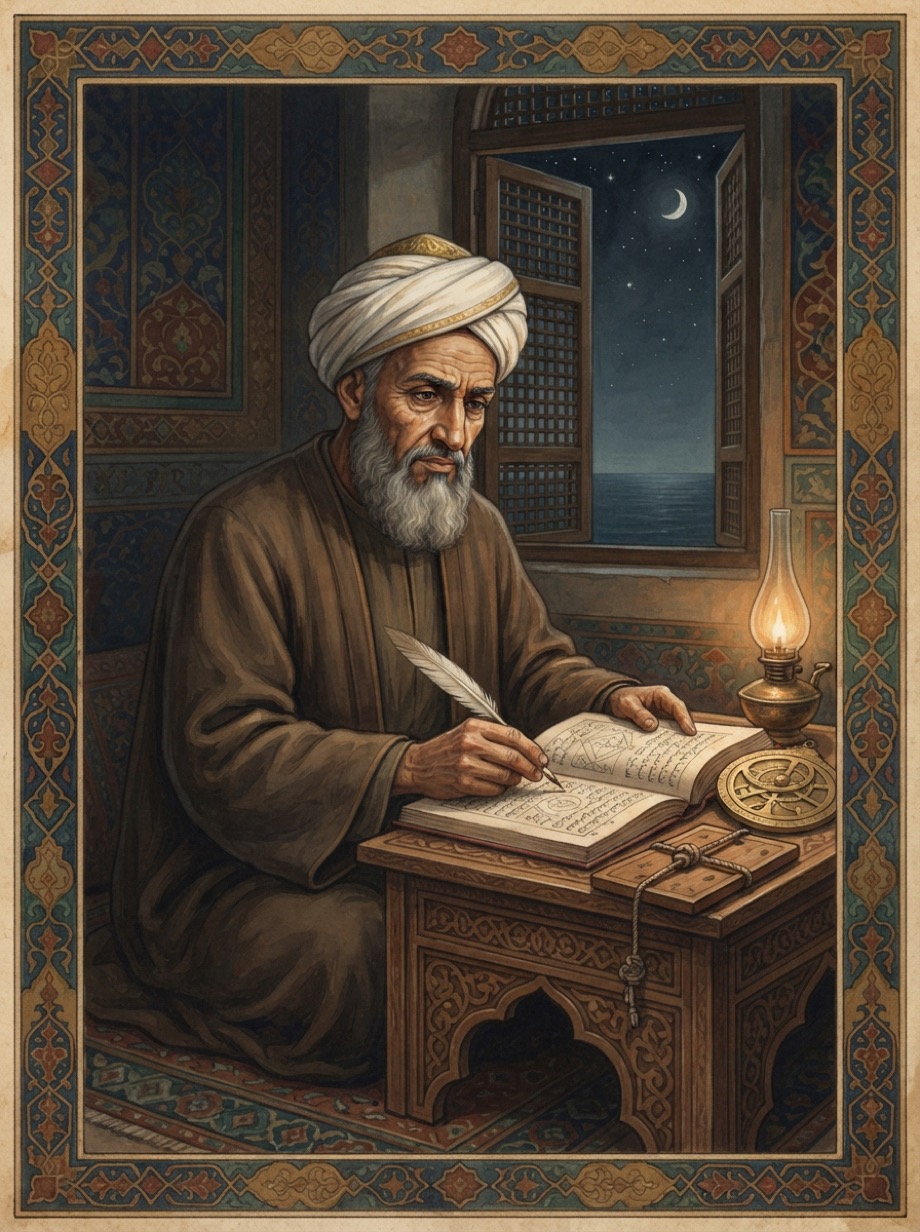
AI-assisted Portrait of Ahmad ibn Majid
The Fourth Lion of the Sea
Ahmad ibn Majid was born around 1432 in Julfar, a pilots' town on the Arabian shore of the Gulf now folded into Ras al-Khaimah. His father and grandfather had both been mu'allim — master pilots — and he claimed the title as the fourth in a line of great navigators, "the fourth of the lions of the sea." He inherited a craft taught the way crafts had always been taught in the Indian Ocean: aboard ship, by apprenticeship, mouth to ear across a lifetime of monsoons. What he did with it was different. Over some forty works, most of them poems built to be memorized at sea, he turned that craft into a system — stellar bearings, coastal pilotage, monsoon timing, latitude by star altitude, the magnetic compass, the lunar mansions used to fix a ship's position on a trackless ocean. The summit of the effort is the Kitab al-Fawa'id fi Usul al-Bahr wa'l-Qawa'id ("The Book of Profitable Things on the First Principles and Rules of Navigation"), completed in 1490 — still the fullest surviving account of how the pre-modern Indian Ocean was actually sailed. He died around 1500, an old man by the time a handful of Portuguese caravels worked their way up the East African coast — a coincidence of timing that later swallowed his reputation whole.
An INTP impulse runs under all forty books: not to sail better, but to write down, once and for all, the principles by which anyone could.
Psychological Verdict
The record on ibn Majid is a record of pages, not conversations, so any psychological reading has to be inferred from how he chose to spend a life: not simply piloting, which he did well, but codifying. That is an INTP signature — a mind that treats a working skill as an unfinished theory, unwilling to rest until the theory is written down, checked against its exceptions, and handed off in a form that outlives the man who built it. His poems are dense with taxonomy — winds classified, stars ranked, routes reduced to rule — the habit of someone more interested in a problem's underlying structure than in credit for solving it. There is little sign of the courtier's ambition or the merchant's networking that drove many of his Portuguese contemporaries; what evidence survives points to a systematizer content to leave his name on treatises rather than conquests.
The Legend That Was Never His
The story that will not die is that Ahmad ibn Majid was the Arab pilot who guided Vasco da Gama from Malindi across the open ocean to Calicut in 1498 — sometimes embroidered with his being drunk at the helm, sometimes with dying of remorse for delivering his own sea to the Franks. It is almost certainly false. The tale traces to a garbled 16th-century passage in the Ottoman writer Qutb al-Din al-Nahrawali and was popularized by the French orientalist Gabriel Ferrand. The Portuguese eyewitness accounts never name him; their unnamed Malindi pilot is described in terms that do not match him, and ibn Majid's own voluminous writings show no trace of the encounter. He was also, by 1498, an old man past his working years. Modern specialists, above all Gerald Tibbetts and Ibrahim Khoury, treat the identification as unsupported.
The legend survived because it flattered everyone but its subject. It gave Portuguese and later European chroniclers a convenient Arab collaborator to credit for "discovering" the route to India. It gave later Arab writers, mourning Portuguese cannon in a sea that had never needed them, a traitor to mourn. Both versions erased the real point: there was no discovery to be made. The ocean ibn Majid charted — its ports run by the Zamorin of Calicut, its trade carried by pilots trained as he was — had been thoroughly known and written about for centuries before a Portuguese sail appeared on it.
Connected Figures
Further Reading
- Arab Navigation in the Indian Ocean before the Coming of the Portuguese — G. R. TibbettsThe standard translation and study of the Kitab al-Fawa'id, and the definitive debunking of the da Gama pilot legend.
- Kitab al-Fawa'id fi Usul al-Bahr wa'l-Qawa'id (critical Arabic edition) — Ed. Ibrahim KhouryThe scholarly Arabic edition of ibn Majid's central work.
- Trade and Civilisation in the Indian Ocean — K. N. ChaudhuriSituates ibn Majid's world within the wider pre-Portuguese Indian Ocean trading system.
- Monsoon Islam: Trade and Faith on the Medieval Malabar Coast — Sebastian R. PrangeOn the commercial and religious world that Portuguese arrival disrupted, not created.
