 Historical Figure MBTI
#744 · 6-4-26 · The Portuguese Indian Ocean
Afonso de Albuquerque
Governor of Portuguese India · Architect of the Chokepoints
1453 — 1515
7 min read
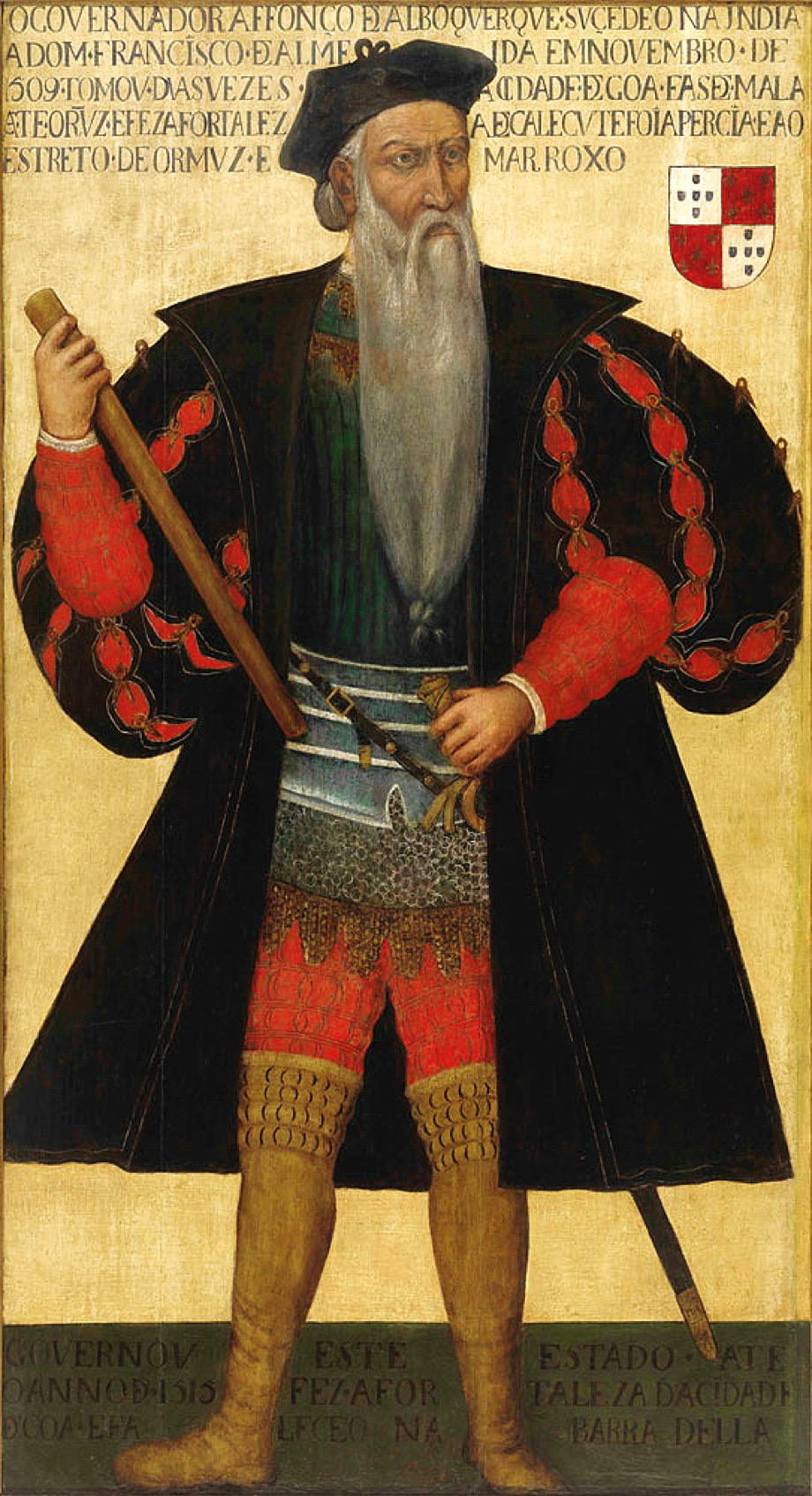
Portrait of Afonso de Albuquerque
The Man Who Looked at an Ocean and Saw a Diagram
Every other Portuguese in the East was chasing a cargo. The fleets came out with the monsoon, filled their holds with pepper at Cochin, burned what shipping they met, and went home to be weighed. Afonso de Albuquerque, arriving in his fifties after Moroccan sieges and a campaign against the Ottomans at Otranto, looked at the same ocean and saw what nobody had bothered to draw: a closed system. All the spice that reached Venice moved through a handful of narrow places. Shut them and it stopped, as a valve shuts. He named four — Goa for a permanent base, Hormuz to seal the Persian Gulf, Malacca to seal the straits to the Spice Islands and China, Aden to seal the Red Sea. Portugal did not need India. It needed four doors.
He held the governorship for six years and spent every one of them executing that sketch against the resistance of nearly everyone. He also proposed diverting the Nile to starve Egypt and stealing the body of the Prophet to ransom Jerusalem. The same mind produced both, which is the psychological interest of the man — the gift and the pathology run down one channel. This archive reads him as an INTJ, the clearest case of the type in the age of exploration.
An INTJ whose dominant Ni built a working model of an ocean, and who spent the rest of his life forcing the world to match it.
Four Doors and Nothing Else
The idea was conceived whole and early, and it never moved. Trade between the Indies and the Mediterranean had to pass either Hormuz or the Bab-el-Mandeb; everything east of India had to pass the Strait of Malacca. Three straits, plus one place to keep a fleet and a government. The insight is not that these were valuable ports — everyone knew that. It is that they were the only ones that mattered, that territory was irrelevant, and that a few fortified points could govern the commerce of a continent nobody occupied.
Goa shows the abstraction most clearly. He did not want a feitoria — a warehouse on someone else’s beach, held at a local ruler’s pleasure, which was the Portuguese pattern at Cochin and Cannanore. He wanted sovereign ground: a capital with a mint, a shipyard and a settled population, the one place in Asia where Portugal was not a guest. When Timoji offered him the city in early 1510, he took it not because it lay on his route but because it completed a shape he had been carrying for years. He was right in the way Ni is characteristically right — not in detail but in structure. Within a decade of his death the Levantine spice trade had collapsed and Venice was buying its pepper in Lisbon.
The Instrument: Stone, Coin, and Terror
A vision this abstract is worthless without an executor, and Albuquerque was one of the century’s most efficient. Driven out of Goa in May 1510 by the forces of Bijapur, he refitted through the monsoon, came back in November, and took it again. Malacca fell in August 1511 after a summer’s campaign at the far end of the known world with a fleet too small for the job. Hormuz he took twice, losing it in 1507 only because his captains mutinied and sailed away. He fortified every point he held, opened a mint at Goa, regularised customs, abolished sati in Goan territory, and sent Lisbon memoranda so detailed they remain the best source on his own operations.
The same faculty produced the atrocity. When Goa fell the second time, in November 1510, he ordered the Muslim population killed — men, women and children — over four days, and reported to the king that some six thousand had died. He wrote of it not with bloodlust but with satisfaction at a job done: the city clear, the message to the coast unmistakable. Terror was a tool selected for its efficiency, which is precisely what makes it unforgivable rather than merely brutal.
The other half of the Goa policy belongs in the same breath. Having emptied the city, he encouraged his men to marry local women — many of them widows of the dead — granting land and standing to the couples who stayed. This is sometimes read as tolerance. It was demography as engineering: a self-reproducing Portuguese population that would hold the base without ships from home. By accident of its own success it created the Goa that followed. Both facts are true, and the second does not soften the first.
Right, Alone
Underneath the plan sat a private, immovable conviction that he alone understood it. This is tertiary Fi in its least attractive form: not sentiment but a personal certainty that needs no external validation and therefore never seeks any. He did not persuade; he asserted, and when assertion failed he produced the commission in his pocket. Arriving in 1508 with a royal patent to succeed Francisco de Almeida, he expected the office; Almeida refused and had him held at Cannanore for months. Rivals he arrested, overrode or ignored, including men far better connected at court than himself. His letters carry the tone throughout — a man explaining the obvious to fools, patient in form and contemptuous in substance.
The cost was total isolation. He had no faction, no client network, no friends in Lisbon to answer the letters going home about him. When his enemies moved — chiefly Lopo Soares de Albergaria, whom he had humiliated — nobody at court had a reason to defend him. He had spent six years proving he was right and no time at all making himself necessary to anyone but the king.
Diverting the Nile
The inferior function is where this type reaches past its grip, and Albuquerque’s reach is spectacular. He proposed to Manuel I that men be sent into the Ethiopian highlands to cut a channel and divert the Nile into the Red Sea, drying out Egypt and destroying the Mamluk state at its root. He proposed, separately, a raid on Medina to seize the Prophet’s tomb and hold the relics hostage against the surrender of Jerusalem. Neither was a rhetorical flourish; both went to the king as operational suggestions from the senior Portuguese officer in Asia.
What makes these Se rather than mere fantasy is their physicality: not schemes of diplomacy or finance but of earth and stone and cavalry, imagined by a man whose contact with the sensory world came through the narrow slot of an idea. The Ni had modelled an ocean correctly; asked to model a continent’s hydrology or the Hejaz, it produced the same confident geometry with none of the underlying knowledge.
The failure at Aden in March 1513 sits on the same fault line. He arrived without sufficient scaling ladders, they broke under the weight of the men, and the assault collapsed. He then sailed into the Red Sea — the first European commander to do so — and spent a sickly season at Kamaran with nothing to show for it. Aden was the one door he never shut, and his empire leaked at exactly that point for the next hundred years.
Why INTJ Over ENTJ
Why not ENTJ?
The case is genuinely strong: the Te is loud, the command style imperious, and the output — forts, mints, customs regimes, three captured chokepoints — exactly what an ENTJ empire-builder leaves behind. But ENTJ leads by organising people. It builds coalitions, cultivates followings, and treats the political arena as the medium of execution rather than an obstruction to it. Albuquerque built no faction in six years of supreme command and lost the court fight so comprehensively that he was replaced by a man he had held in open contempt. His authority came from the design itself, never from marshalled support — Ni leading with Te as its instrument, not Te leading.
The tell is that he never regarded politics as real work. An ENTJ in his position would have written to the great houses, placed relatives, bought the returning captains; he wrote to the king about hydrology. He preferred to be right, alone, and to let the fortresses argue on his behalf. When they did prove him right, he was already dying, and the man sailing out to replace him was the one who had spent those years doing the other kind of work.
Connected Figures
Further Reading
- The Commentaries of the Great Afonso Dalboquerque (Hakluyt Society, 4 vols., 1875–84) — Brás de AlbuquerqueCompiled by his son from his papers — indispensable and openly partisan; read it as advocacy, not record.
- Conquerors: How Portugal Forged the First Global Empire (2015) — Roger CrowleyThe best narrative account of the Indian Ocean campaigns, unsparing about Goa and Malacca.
- The Portuguese Empire in Asia, 1500–1700 (1993) — Sanjay SubrahmanyamThe standard analytical history of the Estado da Índia, sceptical of the heroic frame.
- The Portuguese in India (1987) — M. N. PearsonPlaces the Portuguese inside an Asian trading world that long predated them and largely outlasted them.
- Foundations of the Portuguese Empire, 1415–1580 (1977) — Bailey W. Diffie & George D. WiniusThe full institutional and chronological backbone, from Ceuta to the union of crowns.
