 Historical Figure MBTI
#735 · 6-2-26 · The Portuguese Indian Ocean
Manuel I of Portugal
King of Portugal · The Fortunate · Patron of the Cape Route
1469 — 1521
7 min read
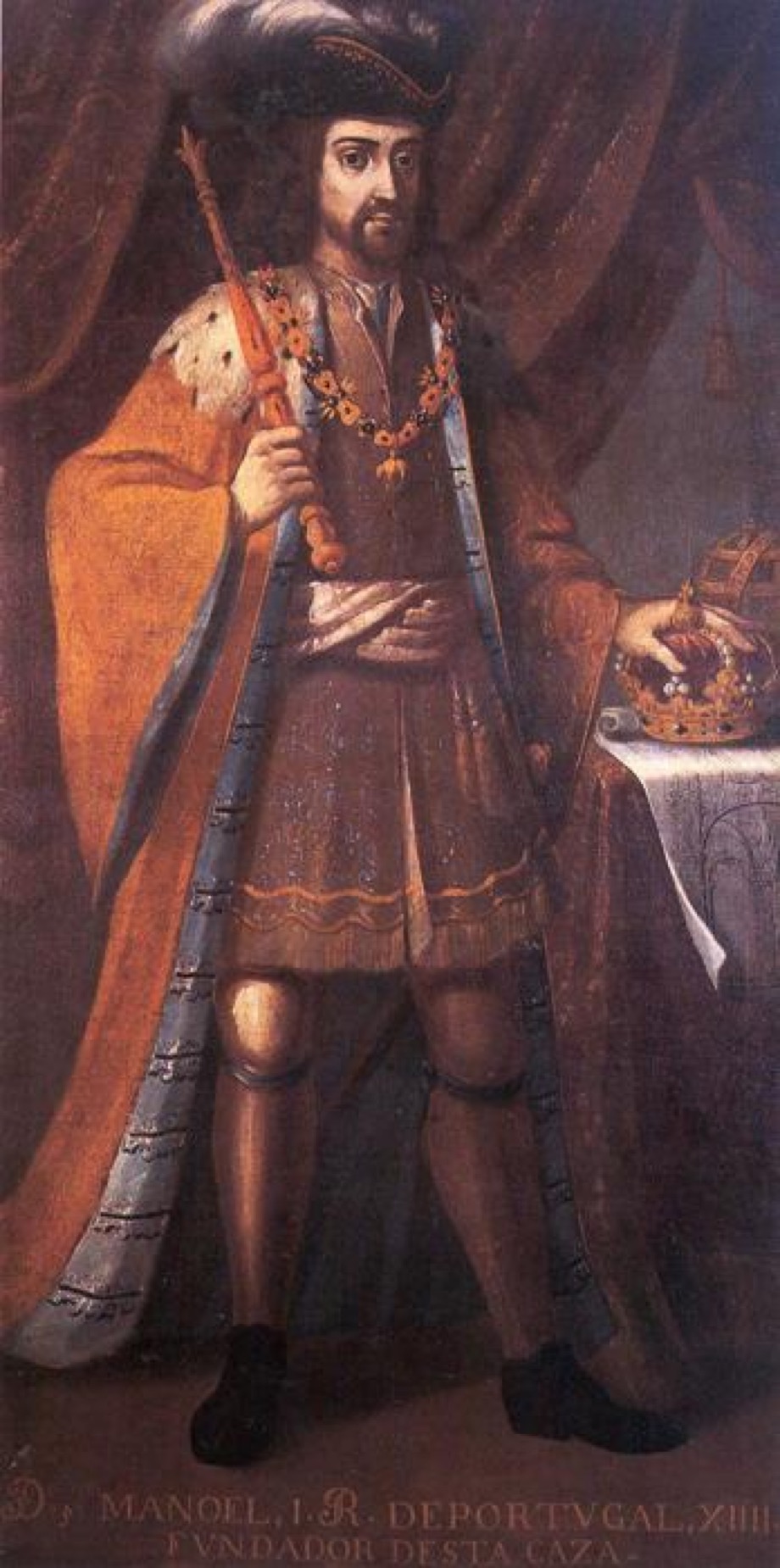
Portrait of Manuel I of Portugal
The King Who Inherited the Sea
They called him o Venturoso — the Fortunate — and the nickname is the whole argument in one word. Manuel of Beja had no plausible route to the throne and reached it in 1495 by attrition — his brother Diogo stabbed to death in 1484 by King João II's own hand, João's heir Afonso killed by a fall from a horse in 1491. He walked into a crown three deaths had swept clear, and into a state programme sixty years in the assembling that stood one voyage short of India.
He executed it beautifully. In 1497 he sent Vasco da Gama round the Cape with charts and pilots his predecessor had gathered; in 1500 Cabral, who found Brazil on the way; in 1509 he made Afonso de Albuquerque governor. Within twenty years a kingdom of a million people held the pepper trade of the world, and its king styled himself Lord of the Conquest, Navigation and Commerce of Ethiopia, Arabia, Persia and India — a title so long it had to be read aloud slowly, which was the point.
And to secure a Spanish marriage he ordered every Jew in Portugal expelled, then closed the ports so they could not leave and had them baptised by force. Both achievements belong to the same man and, more uncomfortably, to the same faculty. Manuel governed by the applause of the room he was standing in.
Manuel I was an ESFJ — a dominant-Fe monarch who ruled by the approval of Christendom, executed an inherited plan with immaculate ceremony, and could destroy a people rather than give offence to a neighbour.
Fe — The Elephant in the Roman Street
In March 1514 an Indian elephant walked up the Via Papale into Rome, knelt three times before Leo X and sprayed the cardinals from a water trough. Hanno was the centrepiece of the embassy Manuel sent under Tristão da Cunha — Persian horses, leopards, brocade, jewelled vestments — staged at ruinous expense for one court. Portugal wanted its Eastern patronage rights confirmed; the theatre vastly exceeded the ask, because Manuel wanted Christendom to look at Lisbon and feel something. That is dominant Fe: a kingdom governed by its effect on the assembled room. The same instinct hardened into stone in the Manueline style — Jerónimos, Belém, Tomar — architecture as press release, encrusting cables, anchors and armillary spheres until the buildings recite the reign to passers-by.
Fe is often mistaken for warmth. Its real content is attunement to the values of the surrounding group; its real danger is that the group's approval becomes the standard of truth. To marry Isabella of Aragon — daughter of Isabella I and Ferdinand II, and the key to the Iberian union he wanted — he paid her parents' price and in December 1496 decreed the expulsion of Portugal's Jews, many already refugees from Castile. Then, unwilling to lose their capital and their skills, he refused to let the expulsion happen. The ports were closed, children seized from their parents and baptised, crowds herded to the fonts by force; the country acquired overnight a permanent underclass of coerced converts — the New Christians — whom their neighbours slaughtered by the thousand in the Lisbon massacre of 1506.
This is Fe at its most monstrous: horror of an open breach with a powerful neighbour, refusal to bear the cost of one's own gesture, a population destroyed to avoid a difficult conversation. Manuel did not hate as Ferdinand hated. He would not say no and would not pay, so he did both at once to people with no power to refuse him.
Si — The Stored Plan
Manuel did not conceive the India enterprise. It was assembled across three reigns — Henry the Navigator and the Atlantic islands, Afonso V's African forts, and above all João II, who sent Dias round the Cape in 1488 and Pêro da Covilhã overland to Calicut. When Manuel took the throne his own council urged him to drop it as a money pit. He kept it — the archives, the pilots, the shipwrights, the standing course. Auxiliary Si is not nostalgia but continuity: the established way is the tested way, and the burden of proof lies on change.
Everything about his reign runs on precedent. Three marriages, all Spanish, all aimed at the same Iberian union: Isabella of Aragon, dead in 1498; her sister Maria, who gave him João III and Catarina; and in 1518 Eleanor of Austria, sister of Charles V. The strategy failed three times and he never revised it. Nor did he revise the voyages when Gama came home in 1499 having discovered that Calicut did not want Portuguese cloth: Manuel sent bigger fleets to do the same thing harder, leaving a subordinate to invent the system of forts and licensed passes that actually made the empire work.
Ne — Letters to Prester John
Tertiary Ne shows up as flashes — real imagination, arriving unbidden, never stress-tested. Manuel had two of his own: the crown as merchant, making the Casa da Índia a royal monopoly and its king the largest pepper wholesaler in Europe; and the pincer, in which Portuguese fleets in the Red Sea joined to the Christian empire of Ethiopia would strangle Muslim commerce and open the road to Jerusalem. He was serious enough about the second to keep sending embassies toward the legendary Prester John until a real one reached the Ethiopian court in 1520.
The third great idea of the reign was Albuquerque's, adopted: seize Goa, Malacca and Hormuz and the ocean becomes a system rather than a shipping lane. To Manuel's credit he recognised it when handed to him. To his discredit he could not tell it from the schemes of Albuquerque's enemies at court, and in 1515 replaced the man who had built the empire on the strength of factional letters — news Albuquerque received while dying off the bar of Goa. Ne without judgement weighs every possibility the same, and the loudest is the one already in the room.
Ti — The Ledger Nobody Read
Portugal under Manuel looked like the richest state in Europe and was quietly becoming one of the most indebted. The pepper arrived; so did the armadas, the garrisons from Sofala to Malacca, the ships lost every season on the Cape run, and the habit of borrowing against next year's cargo from German and Italian bankers. The crown was a merchant that never audited its own margins, because the man at the top had no appetite for the cold, sceptical accounting inferior Ti supplies only under duress.
The same blindness governs the aftermath of 1497. Having manufactured tens of thousands of nominal Christians nobody believed in, Manuel answered with a twenty-year moratorium on inquiring into their faith — a procedural patch over a problem he would not think through, which postponed the reckoning into his son's reign, where it arrived as the Portuguese Inquisition and three centuries of blood-purity law. Inferior Ti is not stupidity: Manuel was cultivated, curious about cosmography and botany, a careful reader of reports. It means the analytical faculty never gets to overrule the social one.
Why ESFJ Over ENFJ
Why not ENFJ?
ENFJ leads the same Fe, but pairs it with Ni — a private vision of what people might become, pursued whether or not the room approves. Manuel's messianism is the strongest case for it: the armillary sphere, the crusade to Jerusalem, the chosen kingdom. But every element was received rather than generated — standard crusading eschatology, Joachimite prophecy already circulating in Iberia, a Prester John legend two centuries old. He adopted convictions; he did not originate them. And his method was flatly Si-conservative: continue João II's programme, marry the correct infanta, keep the forms, marry a third time when it has failed twice. An Ni visionary redirects the machine. Manuel decorated it.
Where a genuine Ni idealist collides with his own society and pays for it, Manuel never did: he was in perfect step with the values of Latin Christendom at every moment, including the moment those values demanded a crime. His reign contains no dissent, no unpopular conviction held under pressure, no plan of his own that anyone thought mad — only superb execution, unmatched pageantry, and a fortune that arrived on ships he did not design.
Connected Figures
Further Reading
- A History of Portugal and the Portuguese Empire, vols. 1–2 (2009) — A. R. DisneyThe standard modern survey; the clearest account of how João II's programme became Manuel's inheritance.
- The Persecution of the Jews and Muslims of Portugal: King Manuel I and the End of Religious Tolerance (2007) — François SoyerThe definitive study of 1496–97 and the invention of the New Christians. Unsparing on Manuel's motives.
- Conquerors: How Portugal Forged the First Global Empire (2015) — Roger CrowleyNarrative history of the Indian Ocean campaigns, strong on Albuquerque and on the violence the chronicles record without flinching.
- The Portuguese Empire in Asia, 1500–1700 (1993) — Sanjay SubrahmanyamThe structural counterweight: what the Estado da Índia actually was economically, and why the crown monopoly leaked.
- Crónica do Felicíssimo Rei D. Manuel (1566–67) — Damião de GóisThe official chronicle, and the source of the reign's own self-image — read against the grain, since it was commissioned by the dynasty it praises.
