 Historical Figure MBTI
#734 · 6-1-26 · The Conquest of Mexico
Juan Ginés de Sepúlveda
Scholar · Apologist · The Case for Natural Slavery
1489 — 1573
7 min read
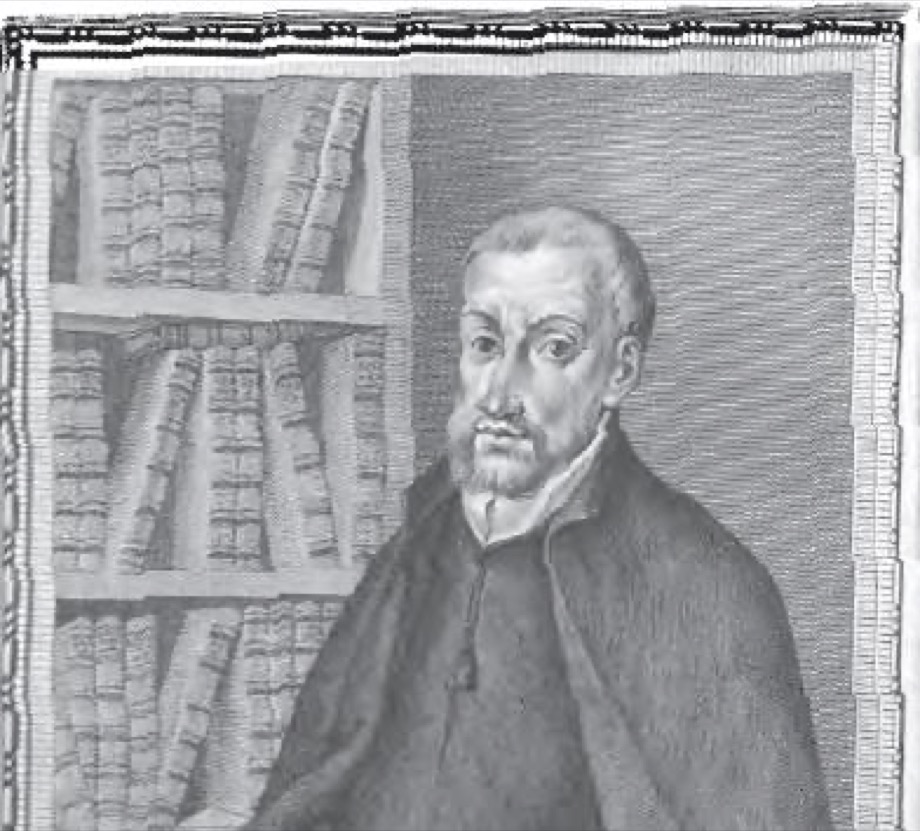
Portrait of Juan Ginés de Sepúlveda (engraving, 1791–1819)
The Syllogism and the Sword
Juan Ginés de Sepúlveda never crossed the Atlantic. He never saw a temple at Tenochtitlan or spoke to a Nahua lord; his entire case against the humanity of the Indies was built at a writing desk in Spain, out of Aristotle, secondhand chronicles, and a chain of deductions he trusted more than any report a sailor could bring him. That trust is the whole man. A humanist trained at Bologna, translator of Aristotle's Politics into Latin so precise it was still being read generations later, royal chronicler to Charles V, Sepúlveda approached the conquest of the Americas the way he approached any inherited text: as a problem to be solved by rigorous application of first principles, not a spectacle to be felt.
The principle he reached for was Aristotle's doctrine of natural slavery — the claim that some men are so deficient in reason that subjection to a wiser master is not injustice but their own good. In Democrates Alter, composed around 1544, Sepúlveda laid out the argument in the driest possible terms: reports of human sacrifice, cannibalism, and the absence of a written language in the Spanish sense were, to him, empirical confirmation of a category Aristotle had already defined. The conquest followed from the premises. So, worse, did the case for coercive conversion. It is one of the coldest pieces of reasoning in the archive — not cruelty performed for its own sake, but cruelty derived, step by step, from evidence assembled without ever leaving the study.
Sepúlveda was an INTP: a Ti-dominant system-builder who trusted the closed chain of his own logic over anything he might have learned by looking his subject in the eye.
The Closed System
What distinguishes Sepúlveda from a mere propagandist is that he built an argument, not a slogan. Democrates Alter is structured as formal disputation — premises, an authority cited for each, a conclusion drawn and defended against objections he anticipated himself. He did not simply assert that the Indians could be conquered; he tried to prove it, working outward from Aristotle's categories of natural rule the way a geometer works from axioms. The rigor was genuine. So was the blindness it enabled: once the syllogism was sound on its own terms, no report from the Indies could unseat it, because Sepúlveda was never testing the premises against the world — he was testing the world against the premises.
That is Ti in its purest and most dangerous register. He trusted the internal coherence of his own reasoning over the testimony of men who had actually been there, Las Casas chief among them. When the Crown convened the Valladolid junta in 1550 to judge the justice of the conquest, Sepúlveda did not soften his position under pressure from bishops, friars, or the king's own councillors — he restated it, more precisely, as though clarity alone should be sufficient to compel agreement. He was, by his own lights, not a bigot but a logician, and he never seemed to grasp that the two could produce identical cruelty.
Even his defeat did not touch the system. Denied a publication license for Democrates Alter in Spain, watching royal policy drift quietly away from his position over the following years, Sepúlveda kept writing in his own defense until his death in 1573 — not because he was stubborn for its own sake, but because nothing in the world had actually refuted the argument as he understood it. Practical loss and logical loss were, to a Ti-dominant mind, two entirely different categories of event.
Evidence at a Distance
Sepúlveda's auxiliary Ne is visible not in openness but in its opposite use: the restless generation of analogies and categories applied to material he had never examined firsthand. Human sacrifice, cannibalism, the absence of alphabetic writing — each secondhand fact, filtered through Spanish chroniclers and colonial administrators, became for him a data point slotted into an existing Aristotelian frame. Ne supplied the connective tissue: this custom resembles that category of barbarism Aristotle described; therefore the category applies. It is pattern-recognition working in service of a conclusion already fixed by Ti, rather than pattern-recognition open to where the evidence might actually lead.
This is what made him formidable at Valladolid rather than merely offensive. He could reach across classical history, canon law, and travelers' accounts and braid them into a single argument on demand, meeting Las Casas's eyewitness testimony with an equally fluent counter-citation. But it is also what made the argument false in a way pure malice could not have been: a mind genuinely curious about the Americas, rather than curious only about how the Americas could be made to fit Aristotle, might have followed the same associative leaps to a very different place.
Fidelity to the Text
Si shows up in Sepúlveda not as nostalgia but as an almost devotional loyalty to received authority — Aristotle above all, but also canon law, the Church fathers, and the precedent of just-war theory as inherited from Roman and medieval sources. He did not invent the doctrine of natural slavery; he retrieved it, polished it, and insisted it still governed a world Aristotle could never have imagined. That is the tertiary function doing what it does in an INTP: anchoring the system to something established and trusted, so that the Ti-Ne engine has fixed ground to build on rather than starting from nothing.
It also explains his complete indifference to Indigenous testimony as a category of evidence. A codex, an oral account, a custom observed without a corresponding Latin authority to validate it — none of this registered for Sepúlveda as data in the way a citation from Aristotle or Augustine did. The written, classical, precedented record was real; everything outside it was raw material to be classified by that record, never a rival source of knowledge in its own right.
Why INTP Over ENTP
Why not ENTP?
An ENTP arguing Sepúlveda's case would have relished the debate itself — Valladolid as sport, the pleasure of dismantling Las Casas in real time, positions taken up and discarded as the exchange demanded. Sepúlveda shows none of that appetite for the live contest. He wrote his argument in full before the junta ever convened, and he defended the same fixed position for decades afterward without revision, refinement by restatement rather than by improvisation. The extraversion is missing; so is the willingness to let a conclusion move. What ENTP treats as raw material for the next clever synthesis, Sepúlveda treated as settled — a system built once, in solitude, and then simply reasserted against the world.
The distinction matters because it is easy to mistake Sepúlveda for a debater, a rhetorician who happened to lose a famous argument. He was something narrower and, in a sense, more troubling: a closed-system thinker who reached his conclusion the way a mathematician reaches a proof, then treated any subsequent conversation — including the one at Valladolid — as an occasion to explain the proof again rather than to test it. That is Ti-dominant conviction, not extraverted contest.
Connected Figures
Further Reading
- All Mankind Is One: A Study of the Disputation Between Bartolomé de las Casas and Juan Ginés de Sepúlveda — Lewis HankeThe standard English-language account of the Valladolid debate and its aftermath.
- The Fall of Natural Man: The American Indian and the Origins of Comparative Ethnology — Anthony PagdenPlaces Sepúlveda's Aristotelian argument within the broader intellectual history of European ideas about the Americas.
- Democrates Segundo, o, De las justas causas de la guerra contra los indios — Juan Ginés de SepúlvedaSepúlveda's own treatise, the core text denied a Spanish publication license in his lifetime.
