 Historical Figure MBTI
#733 · 6-1-26 · The Conquest of Mexico
Bartolomé de las Casas
Friar · Reformer · Defender of the Indies
1484 — 1566
6 min read
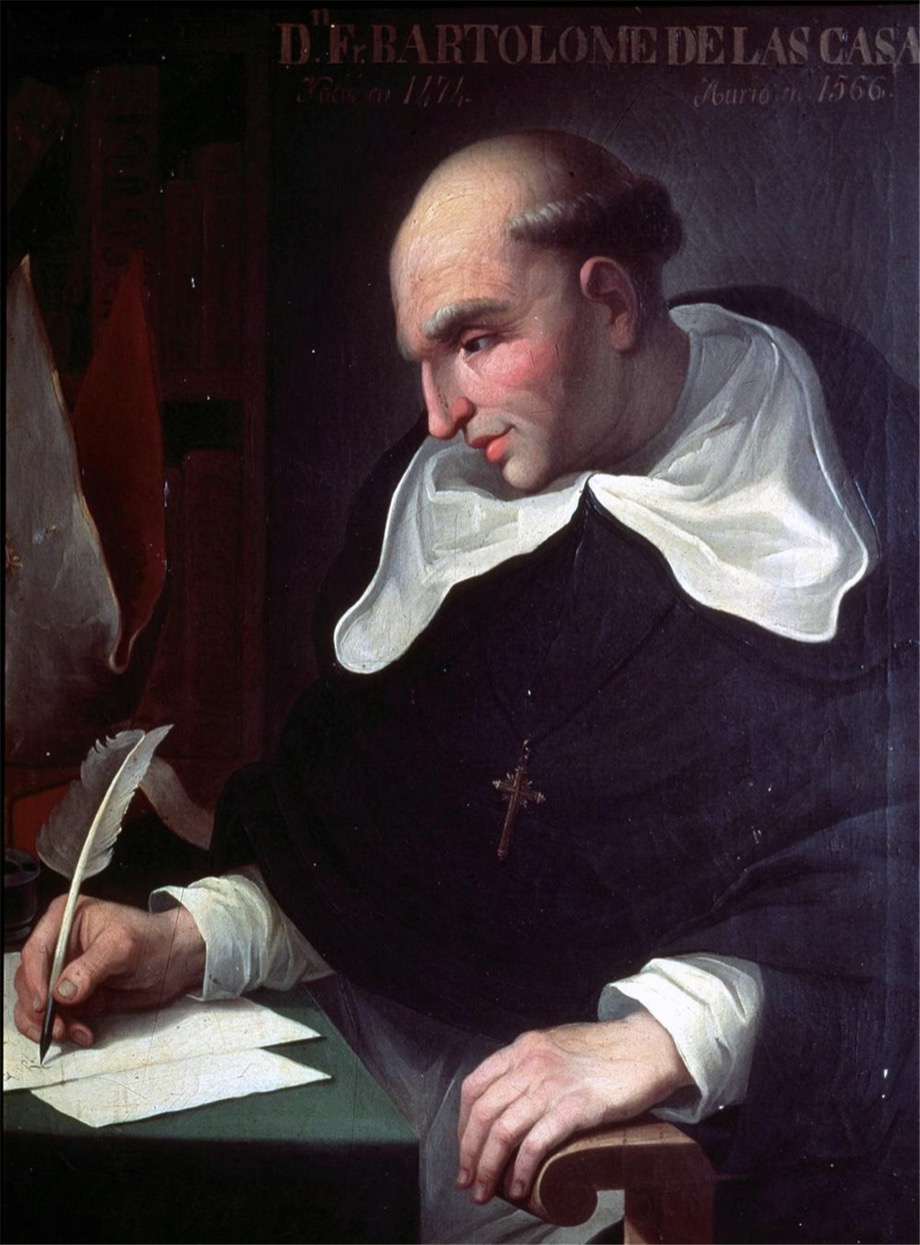
Portrait of Bartolomé de las Casas (16th-century)
The Slaveholder Who Spent Fifty Years Arguing With Spain
He did not begin as a conscience. He began as a beneficiary. Bartolomé de las Casas sailed to Hispaniola in 1502 as an ordinary young Spaniard on the make, took his allotment of Indigenous labourers under the encomienda, and worked them as everyone around him did. In 1512 he was ordained — the first priest ordained in the Americas — and kept the encomienda anyway. When the Dominican Antonio de Montesinos stood up on Hispaniola in Advent 1511 and asked the colonists by what right they held these people in servitude, Las Casas was in the congregation. He was not converted. He went home.
The turn came around 1514, in Cuba, after he had seen what conquest did to villages that offered no resistance. He gave up his own encomienda — the gesture of a man who understood that an argument delivered by a slaveholder is not an argument — and then did something stranger than renunciation. He spent the next fifty-two years campaigning: crossing the Atlantic again and again to work the Spanish court, drafting colonization schemes, preaching, printing, and finally submitting to a public debate on whether the people he defended possessed rational souls at all. That is not the shape of a private moral vision. It is the shape of an ENFJ — a man for whom conviction is worthless until it has been carried into other minds, by whatever institutional machinery is available.
Las Casas is the ENFJ in its most consequential historical form: dominant Fe aimed not at a room but at an empire, for half a century, without letting go.
Fe — dominant · The Empire as Congregation
Fe treats a group's moral temperature as something one is personally responsible for adjusting, and Las Casas chose the largest available group. He did not try to be good quietly in the Indies; he tried to make Spain collectively change what it did, through the only instruments that could deliver it — the Crown, the Church, the press, the formal debate.
The lobbying was skilled. He attached himself to Cardinal Cisneros, worked Charles V's councils, and in 1542 got what almost no reformer gets: legislation. The New Laws barred new enslavement of Indigenous people and ended the inheritability of encomiendas — a strategy to kill the system by attrition rather than by a decree colonists could ignore. They ignored it anyway. Revolt in Peru forced a partial repeal, and as Bishop of Chiapas he found his own clergy refusing his instruction to deny absolution to unrepentant encomenderos. Fe's characteristic wound is discovering that the group will applaud the sentiment and keep the profit.
So he escalated to propaganda. A Short Account of the Destruction of the Indies (1552) is not a historian's book and was never meant to be one: a catalogue of atrocity, province by province, written to be unbearable and aimed at Spanish public and royal feeling. He got his wish so completely that the book was translated across Protestant Europe and weaponised into the Black Legend for centuries. An Fe dominant at full force does not calibrate for the archive; he calibrates for the audience in front of him.
Ni — auxiliary · Playing a Fifty-Year Game
Fe supplies the aim; Ni supplies the patience and the single unchanging picture of where it must end. Las Casas had that picture early and never revised it: the Indigenous peoples of the Americas were free subjects of the Crown, possessed of full reason and full souls, and every claim to their labour by conquest was void. Once the vision was fixed, everything else was tactics — and he would spend decades on tactics that could not pay out in his lifetime.
Hence the schemes. The Cumaná venture of 1521 tried to prove colonisation could work by peaceful settlement and preaching alone; it collapsed, and he retreated into a Dominican house for the better part of a decade, reading law and theology. That withdrawal was rearmament. He emerged with a doctrinal apparatus — most durably De unico vocationis modo, his argument that the only legitimate way to bring anyone to the faith is persuasion of the intellect — that let him fight on canon-law terms rather than sentiment. Ni lets a campaigner lose Cumaná, lose the New Laws, lose his own diocese, and treat each as a move in a game still being played.
Se — tertiary · The Man Who Kept Getting on the Ship
What separates Las Casas from the clerics who deplored the conquest in private is that he kept physically inserting himself into it. He was a witness before he was an advocate — the Short Account takes its force from what he saw at first hand, and he was in Cuba at the massacre at Caonao. His conversion was triggered not by a syllogism but by a scene.
Se also explains the campaign's physical appetite. He crossed the Atlantic something like a dozen times in an age when the crossing killed people casually, took the bishopric of Chiapas at sixty-one and travelled to a diocese that loathed him, and at sixty-six walked into the Valladolid junta to argue out loud against the most formidable Aristotelian in Spain. A purely inward type broadcasts from a study. Las Casas kept turning up in the room where the thing was decided.
Ti — inferior · The Sin He Could Not Reason His Way Around
Around 1517, casting about for a way to relieve Indigenous labourers, Las Casas proposed to the Crown that African slaves be imported instead. In the narrow sense it worked: it addressed the population he was defending, it was politically sellable, it swapped one supply of coerced labour for another. It was also a catastrophic failure to apply his own principle to anyone outside the frame of his sympathy — the exact failure mode of inferior Ti, which reaches for a workable mechanism instead of testing whether the argument generalises.
To his enormous credit he eventually ran the test and did not flinch at the result. In the Historia de las Indias, written in old age and unpublished at his death, he set down that the enslavement of Africans was as unjust as the enslavement of Indians, that he had seen it late, and that he counted his own earlier advocacy among his grave sins. It is a rare thing for a polemicist to convict himself in his own archive.
Valladolid shows the same weakness from the other side. Facing Juan Ginés de Sepúlveda, who held that Indigenous peoples were Aristotle's natural slaves, Las Casas answered not with a tighter syllogism but with volume and accumulation, reportedly reading aloud from his manuscript for days: argument as inundation rather than as blade. No one declared a winner — remarkable in itself, since the empire had paused to ask, in formal session, whether its central enterprise was licit.
Why ENFJ Over INFJ
Why not INFJ?
The INFJ reading is tempting — the fixed vision, the decade of study, the prophetic register of the Short Account — but it inverts his stack. An INFJ leads with Ni and expresses through Fe: the vision comes first, pursued somewhat apart from institutions. Las Casas ran the other way round. Institutions were the medium: royal audiences, a bishopric he took knowing it would be miserable, drafted legislation, a licensed disputation, a print campaign engineered for mass effect. Measure him against Montesinos, the archive's INFJ in this same era, who delivered one incandescent sermon naming the sin and then largely left the stage. Montesinos supplied the vision; Las Casas supplied fifty-two years of lobbying — and that gap is exactly the gap between Ni-first and Fe-first.
The other tell is what he did when he lost. When the law failed him he did not conclude that Spain was beyond persuasion but that Spain had not yet been made to feel enough, and wrote a book designed to make it feel. Fe does not give up on the audience — its glory, and in the Black Legend its uncontrollable side effect.
Connected Figures
Further Reading
- A Short Account of the Destruction of the Indies — Bartolomé de las CasasThe 1552 polemic itself — read it as an instrument of persuasion, which is what it was built to be.
- The Spanish Struggle for Justice in the Conquest of America — Lewis HankeThe classic account of the imperial debate over conquest, with Valladolid at its centre.
- Bartolomé de las Casas: A Biography — Lawrence A. ClaytonThe fullest modern life in English; good on the encomendero years and the 1514 turn.
- Another Face of Empire: Bartolomé de las Casas, Indigenous Rights, and Ecclesiastical Imperialism — Daniel CastroThe sharpest counter-reading: a reformer of empire, not an opponent of it.
