 Historical Figure MBTI
#721 · 5-30-26 · The Conquest of Mexico
Moctezuma II
Emperor · Ninth Tlatoani · The Fall of Tenochtitlan
c. 1466 — 1520
11 min read
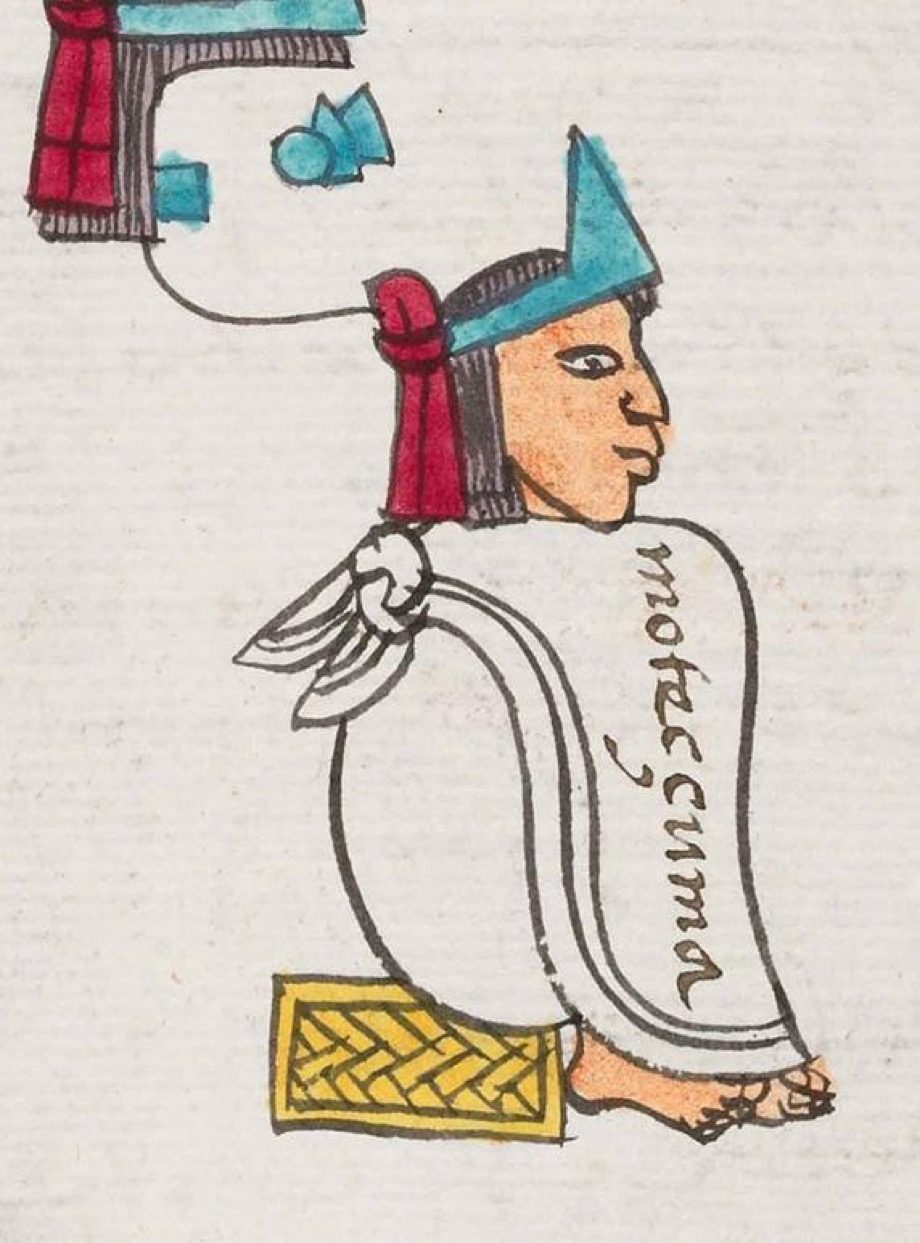
Moctezuma II in the Codex Mendoza (folio 15v)
The Man Who Was Given Seventeen Years and Remembered for Two
He ruled the largest state in the Americas for eighteen years, and history has compressed him into a single gesture: a king standing on a causeway, handing flowers and gold to strangers he should have destroyed. That image is not neutral. It was drawn by the men who took his city, and then redrawn by the survivors of that city writing under those same men’s supervision. Nearly everything we think we know about Motecuhzoma Xocoyotzin’s last twenty months — the omens, the trembling, the alleged surrender of an empire to a god he mistook for a Spaniard — reaches us through the winners. Any psychological reading of him has to be built with that fact held in the hand, not tucked away in a footnote.
Strip the last two years away and a different man appears, and this one is documented in Nahua administrative memory rather than conquest legend. In 1502 he inherited the throne from his uncle Ahuitzotl, a warrior-king whose reign had been an engine of expansion, and he immediately did something no frightened man does: he dismissed Ahuitzotl’s officials wholesale, replacing commoners raised on merit with men of birth, closing the palace to all but the high nobility, and rebuilding the tribute and provincial administration around a court that answered only to him. He campaigned for seventeen years. He absorbed towns, tightened the machinery of collection, and turned an empire held together by terror and habit into something closer to a state with a theory of itself. That is not the résumé of a passive man. It is the résumé of a systematizer with a long picture in his head.
Then something arrived that fit no picture at all. Reports came up from the coast of floating houses and bearded men — Grijalva in 1518, then Hernán Cortés in 1519 — and Moctezuma tried to find out what it meant before deciding what to do. He sent painters and priests and diviners, and gifts extravagant enough to function as tests. Read one way, that is a mind paralyzed by portents. Read another, it is a ruler stalling a small armed party while he gathers intelligence and declines to hand them the pretext of a battle. Both readings survive in serious scholarship, and the evidence does not settle between them. What it does support is the shape of the process: interpretation first, symbolic management second, force last.
Moctezuma II was an INFJ — a dominant-Ni ruler who governed by reading meaning into the long arc of things, and who met the one event without precedent by trying to interpret it rather than strike at it.
The Long Picture Behind the Purge
The accession purge of 1502 is the cleanest window into how Moctezuma’s mind worked, because it was gratuitous. Ahuitzotl’s administrators were competent; the empire was solvent; nothing forced a housecleaning. Moctezuma cleared them out anyway and replaced them according to a principle — that the state should be staffed by the nobility, trained in the calmecac, formed by the same ritual education as the ruler himself. He was not settling scores. He was imposing a design, and a design of a specifically Ni kind: an image of what the polity ought to be, pursued against the grain of a working arrangement, on a timescale measured in decades rather than campaigns.
The same instinct shows in what he did to access. He restricted who might enter the palace, who might look at him, who might speak in his presence, and layered the office of tlatoani in a formality that his predecessors had not required. It is easy to read this as vanity. It reads better as a man who understood authority in Tenochtitlan to be a symbolic system, and who deliberately raised the pressure inside it — making the ruler less a first warrior among many than a fixed point around which the cosmos and the tribute rolls were both organized. Dominant Ni does exactly this: it converges on one interpretation of what a thing fundamentally is, then bends the institutional world to match.
And it explains the response to the coast. A ruler whose whole method is to locate the pattern behind events will, when handed events with no pattern, keep searching rather than swing. Whatever the later chroniclers did to the material, the behavior they describe — diviners summoned, priests questioned, painters sent to record the ships — is coherent with a man who had spent seventeen years insisting that things have a meaning and that governing means finding it. The tragedy of Ni is that its confidence is retrospective: superb at reading a world with precedent, helpless in front of a world without one.
Governing the Order, Not Merely the Territory
What separates Moctezuma from the cold strategist he is often mistaken for is that his reforms addressed the coherence of the whole social body, not merely the security of his own position. The nobility he elevated came with obligations as well as privileges; the ritual calendar he maintained was expensive, exacting, and binding on him personally. He fasted, he bled himself, he performed. A ruler optimizing purely for control does not spend that much of his own body on ceremony.
Gift-diplomacy is the auxiliary function in its purest working form. The famous treasures sent down to the coast were not naïve tribute; in Nahua statecraft, lavish gifts placed the recipient in a defined relationship and obliged a response. Moctezuma was doing what Fe does — establishing the social frame, assigning the newcomers a role, testing what kind of beings they were by watching how they behaved inside a structure of obligation. That the Spanish read gold and concluded weakness is a failure of translation as much as of nerve, and La Malinche, standing between the two systems, is the only person in the story who could see both sides of the misunderstanding at once.
It is also Fe that explains the final, awful scene, in whichever version one accepts. Held in his own palace, stripped of everything but voice, he was brought to a rooftop to speak to a city in revolt — and he went. The Spanish account has him killed by his own people’s stones; Nahua-derived accounts suggest his captors disposed of him once he had stopped being useful. Both versions agree on the premise: that Moctezuma believed, to the last, that he could still address his people and be heard, that the bond between tlatoani and city was real enough to hold under any strain. It was not. But the belief is diagnostic.
The Diviner’s Method
Beneath the vision and the ceremony ran a genuinely analytical habit, visible in the administrative record. The tribute system Moctezuma inherited was a patchwork; what he built was closer to a taxonomy — provinces classified, obligations specified, collection routed through officials whose loyalty he could audit. He cared how the machine worked internally, not only what it produced. That is tertiary Ti doing real labor: systematizing, sorting, insisting on clean categories.
Applied to the Spanish, the same faculty produced the endless questioning. What are they? What do they eat, what do they want, do they die? The interrogations and the painted reports were an attempt to build a working model of an unknown quantity before committing to a policy toward it. There is a version of this story — Matthew Restall argues something close to it — in which Moctezuma is not bewildered at all but conducting a deliberate program of collection and containment, drawing the strangers into his capital where they could be observed, hosted, and, if it came to it, contained. On that reading the fatal error was not superstition but a theorist’s overconfidence in his own model.
Ti in the tertiary position is like that: powerful enough to build the framework, not sovereign enough to notice when the framework has stopped describing reality. Moctezuma kept refining his interpretation of the Spanish long past the point where any interpretation could help him. His nephew Cacamatzin, who argued for expelling them by force and was arrested for it, had the cruder theory and the better one.
The Blind Spot at the Causeway
Moctezuma was not a coward and not unmilitary — he had led men, and campaigns ran throughout his reign. But the inferior function is not about incapacity; it is about which register a mind reaches for last. Faced with roughly five hundred Spaniards on his coast, he reached for meaning, ritual, gifts, and information, and he reached for the immediate physical fact — a small hostile force, far from home, destroyable now — only when it had ceased to be small. The window in which the landing could have been ended by simple violence was open for months, and it closed while he was still deciding what the landing was.
Nor did he read the concrete political terrain. Tlaxcala had never been conquered; it sat inside his empire as an unfinished sentence, and Cortés turned it into an army within weeks of landing. The resentments of tributary towns were a material resource lying in plain sight. Moctezuma had spent seventeen years perfecting the symbolic architecture of empire while its load-bearing walls were held together by grievance.
When the physical world finally forced itself on him, it did so all at once and in the worst form: Pedro de Alvarado’s massacre of unarmed celebrants at the Toxcatl festival, a city in arms, and a captive king with no instrument left but his voice. Inferior Se does not fail gradually. It arrives as a catastrophe that was visible to everyone else for a year.
Why INFJ Over INTJ or ISFJ
Why not INTJ?
The reforming, restructuring, decades-long-design side of Moctezuma reads INTJ cleanly, and if the reign had ended in 1518 the case would be strong. What breaks it is what he optimized for. An INTJ’s Te would have treated the ritual calendar as an instrument and the omens as noise, and would have measured the Spanish question in the only terms that mattered — force, logistics, allies, timing — regardless of what the portents implied. Moctezuma instead spent his own body on ceremony, subordinated policy to correct interpretation, and staked everything on a relationship of obligation with men who recognized none. The reforms were about the coherence of the sacred and social order, not the efficiency of an apparatus. That is Fe under Ni, not Te.
Why not ISFJ?
The dutiful custodian reading — a man following inherited protocol, receiving guests as custom required, keeping the calendar because the calendar was kept — fits the caricature of paralysis better than it fits the record. An ISFJ steward does not begin his reign by dismantling his predecessor’s entire administration and rewriting who may hold office. Si conserves precedent; Moctezuma overturned it deliberately in the service of an idea about what the state should become. And in 1519 he did not fall back on protocol — the sources, biased as they are, describe searching, anguished, novel deliberation, a man trying to generate an interpretation where no precedent existed. That is Ni under strain, not Si on rails.
The honest caveat belongs here rather than in the margins. The Florentine Codex was assembled a generation after the conquest by Nahua informants working under a Spanish friar; the omen cycle it preserves has the marks of a people’s retrospective attempt to make an unbearable defeat intelligible, and the Spanish chroniclers had every incentive to depict a king who yielded rather than an empire that was taken. The typing offered here rests mainly on the seventeen documented years — the purge, the reorganization, the ritual intensification — and treats the final twenty months as consistent with that profile rather than as its proof. Held that way, INFJ is the best available reading of a man whose interior we can only approach through the testimony of those who destroyed him.
Connected Figures
Further Reading
- Fifth Sun: A New History of the Aztecs — Camilla TownsendRebuilds the conquest from Nahuatl-language sources and dismantles the 'paralyzed by omens' Moctezuma.
- When Montezuma Met Cortés — Matthew RestallArgues Moctezuma was collecting and containing the Spanish, not surrendering to them.
- Conquest: Montezuma, Cortés, and the Fall of Old Mexico — Hugh ThomasThe fullest narrative account of the campaign, exhaustively sourced from both sides.
- Florentine Codex, Book 12 — Bernardino de SahagúnThe Nahua-informant account of the conquest — and the origin of the omen cycle, biases included.
- The Broken Spears — Miguel León-PortillaThe classic anthology of Indigenous accounts of the fall of Tenochtitlan.
