 Historical Figure MBTI
#727 · 5-31-26 · The Conquest of Mexico
La Malinche
Interpreter · Diplomat · The Conquest's Voice
c. 1500 — c. 1529
11 min read
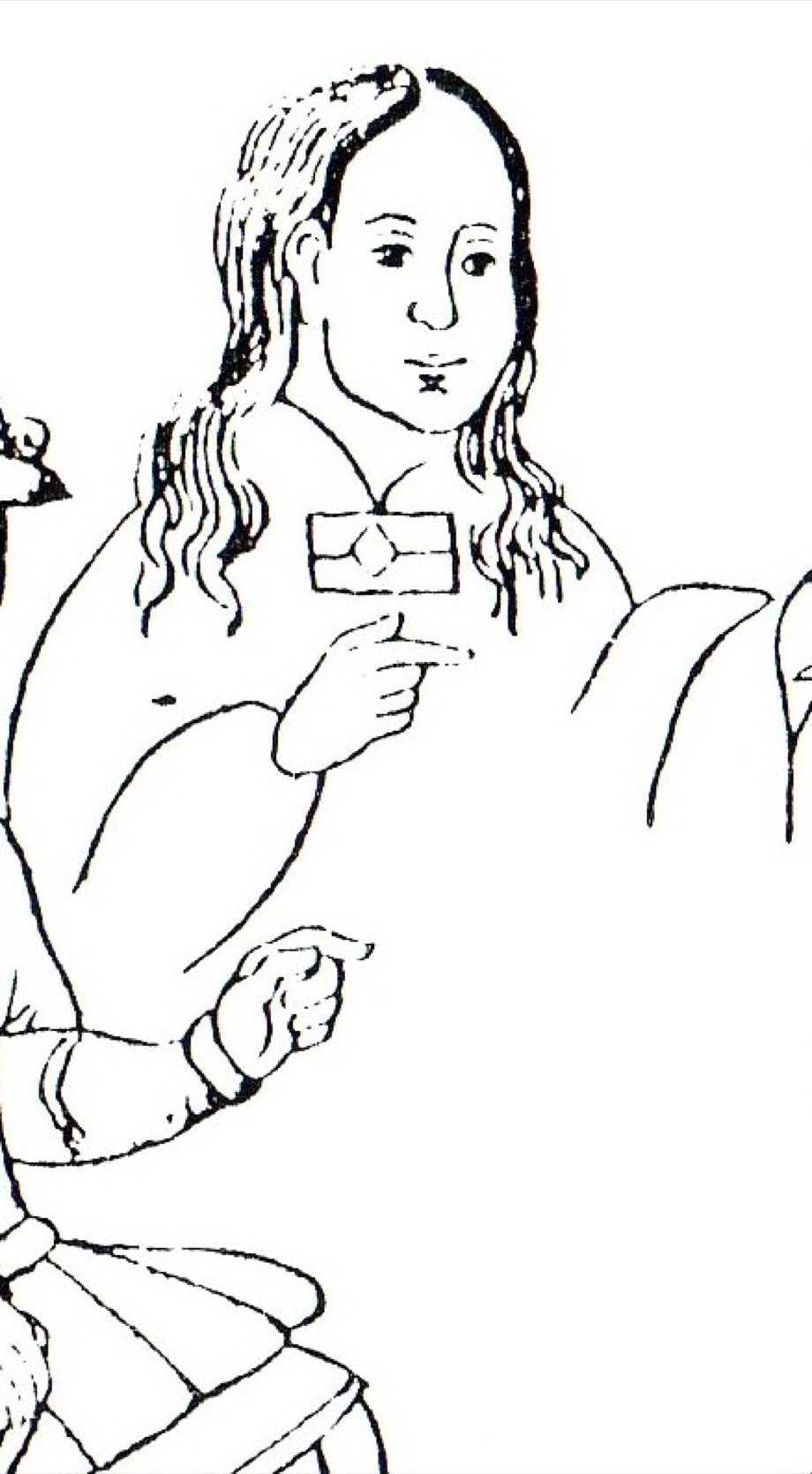
La Malinche, Lienzo de Tlaxcala
The Woman Who Was the Sentence
In the Nahua painted histories of the conquest, she is almost always there, and she is almost always talking. The Spaniards stand in armor and say nothing the page can show. Moctezuma's lords stand in feathered cloaks and say nothing the page can show. Between them stands a young woman with the scroll-glyph of speech curling out of her mouth — sometimes larger than the men on either side of her. The tlacuilos who drew those scenes understood something the Spanish chroniclers only half admitted: that for two years the conquest of Mexico happened inside one person's mouth. Everything Cortés meant to say to Mesoamerica had to pass through her, and everything Mesoamerica said back had to pass through her again. The Nahuas did not call the expedition's leader Cortés. They called him Malintzin — her name, borrowed, as though the man were an appendage of the voice.
She was born around 1500 to a Nahua noble family near Coatzacoalcos, and then, by an account she herself apparently gave, she was disposed of: sold or given away as a child after her father's death, possibly to clear an inheritance for a half-brother. She grew up enslaved among Yucatec Maya speakers in Tabasco, and so acquired a second language the way a hostage acquires a second life. In 1519 the Chontal Maya, having lost a battle they had not wanted, handed the Spaniards twenty women as tribute. She was one of the twenty. Baptized Marina, she was handed off to one of Cortés's captains as casually as a bolt of cloth. Within weeks she was the most strategically important person on the expedition.
What makes her the hardest typing call in this entire cluster is that her genius was a genius of people — reading a room of hostile nobles, drawing a conspiracy out of a frightened woman in Cholula, keeping two civilizations talking to each other long enough for one to destroy the other. That looks like extraverted feeling. It is not. Every documented move she made bends toward a private, long-range calculation about her own survival and standing — not toward harmony as an end in itself. She was a strategist using persuasion as her instrument, never a harmonizer using strategy as hers.
La Malinche was an INTJ — dominant introverted intuition reading a collapsing world for the one narrow path through it, and walking it without once looking back for permission.
Reading the Shape of a World Before It Broke
The first thing she saw, and saw before anyone on either side, was that Mesoamerica was not one thing. The Spaniards arrived believing they faced an empire. The Mexica believed they governed one. Malintzin, who had been passed between a Nahua nobility and a Maya servitude and had listened at the edges of both, understood that the Triple Alliance was a lattice of resentments held together by tribute and terror — and that a small armed party could be threaded through the gaps if someone knew where the gaps were. The Tlaxcalan alliance, the courting of Cempoala, the constant sorting of which lord hated which lord: this is the expedition's actual strategy, and it is built out of information only she possessed and only she could interpret.
Cholula in 1519 is the clearest case. Bernal Díaz reports that an elderly noblewoman of the city, mistaking Marina for a woman of her own class and wanting to spare her, offered to shelter her — even to marry her to her son — because the city intended to kill the Spaniards. Malintzin did not flee, did not warn Cortés first and lose the thread. She played the part: expressed interest, asked about the arrangements, drew the plot out in detail, and only then carried it whole to Cortés. That is not warmth. That is a person holding a false face steady for as long as the intelligence takes to complete itself, because she had already seen where the information would land. The massacre that followed was the Spanish answer, not hers — but the timing, the certainty, the closed loop of it all belongs to a mind that runs scenarios forward and waits for the one it predicted.
Ni's signature is not prophecy but singularity: one interpretation of events crowding out all others and then organizing behavior around it. From 1519 onward she behaves as though the outcome were already known — as though the empire that had sold her and enslaved her was a structure with a fault line running through it, and her task was simply to stand on the right side when it went. She never hedges. In two years of documented conduct there is no recorded moment of her reconsidering the bet.
Making Herself the Only Working Machine
When she arrived, translation was a rickety two-link chain. Jerónimo de Aguilar, the shipwrecked priest who had spent eight years among the Maya, could move Spanish into Yucatec; she could move Yucatec into Nahuatl. Every sentence passed through two mouths and two sets of assumptions, and Aguilar was a mediocre instrument — a man who had learned a language by accident and had no feel for the political register of what he was relaying. Malintzin fixed the system by eliminating the redundancy in it. She learned Spanish, fast, and within roughly a year she was translating alone. That is not a linguistic feat so much as an organizational one: she identified the bottleneck in the enterprise she had been dropped into, and then removed it by becoming the whole apparatus herself.
What she did with that position is pure auxiliary Te — building leverage into a structure and then operating it. She was not merely rendering words; every Spanish chronicler who watched her describes her framing, warning, threatening, and negotiating on Cortés's behalf and often ahead of him. She managed the sequencing of embassies to Moctezuma. She handled the tone of the Tlaxcalan negotiations, where a wrong word meant annihilation. She could be blunt to the point of cruelty when bluntness worked: the surviving accounts of her speaking to the Cholulans and later to the defeated Mexica are hard, efficient, and entirely without appeal to sentiment. Her instrument was language; her method was engineering.
And she monetized it. By the time Cortés married her to Juan Jaramillo in 1524, she was not a captive being disposed of a second time — she was a woman who converted indispensability into land, a legitimate Spanish husband, encomienda income, and legal standing in a colony where almost no indigenous woman had any. Te does not ask whether the arrangement is dignified. It asks whether it holds. Hers held.
The Loyalty That Was Only Ever to Herself
The word "traitor" assumes a nation to betray, and she had none. The polity that might have claimed her allegiance had already used her as currency; the Mexica state that "malinchismo" now accuses her of selling out was, to a Coatzacoalcos noblewoman sold into Tabasco, the machine that made such sales normal. Fi in the tertiary position is not warm and it is not expansive. It is a small, hard, private center — a set of commitments held without argument and without any felt need to justify them to a community. Hers appears to have consisted of exactly this: she would not be property again, and what she made would not be taken.
That center explains the choices that look coldest. She bore Cortés a son, Martín, and then watched Cortés hand her to another man and eventually take the boy to Spain — and she did not, so far as any source shows, resist. She accompanied Cortés on the ruinous 1524–26 march to Honduras, the expedition on which Cuauhtémoc, the last Mexica emperor, was hanged from a ceiba tree on a charge that Bernal Díaz himself thought unjust. She was there. She translated. There is no record of protest. A dominant-Fe personality in that position leaves a trace — an intercession, a rupture, a remembered scene of appeal. She leaves none.
It would be dishonest to read that silence as either villainy or emptiness. Fi under catastrophic constraint often looks like stone from outside: the values are real, but they are not for sharing, and they do not include a duty to the collective that never included her. What she protected, she protected absolutely — her freedom, her standing, her children, the small perimeter she had built out of nothing. Outside that perimeter she made no promises. This is the most unsettling thing about her, and flattening it in either direction is how she gets turned into a myth.
Composure in the Middle of the Killing
Inferior Se in an INTJ shows up as an odd, unhurried steadiness in physical chaos — the body simply kept out of the way while the mind continues its work. The chroniclers noticed it and could not stop remarking on it. Bernal Díaz, who spent decades trying to describe her, keeps returning to the same detail: that she never showed fear. Through the running battles with Tlaxcala, through the massacre at Cholula, through the night the Spaniards were driven out of Tenochtitlan across the causeways with men drowning under the weight of looted gold, she kept translating. Whatever else that is, it is not the reaction of a person whose attention lives in the immediate physical world.
The cost of an inferior function is that it goes unattended until it turns on you, and hers did — in the ordinary way, through the body. She lived through the smallpox that emptied Tenochtitlan and killed Cuitláhuac; she survived the Honduras march that broke stronger men; and then she was simply gone, dead around 1529, likely of illness, before she was thirty. The woman who had made herself the indispensable machinery of an empire's fall left no deathbed scene, no last words, no monument. The record of her physical life is thin to the point of vanishing.
Why INTJ Over ENFJ
Why not ENFJ?
The ENFJ case is genuinely strong and deserves better than a wave of the hand. Her documented talent was reading people and moving them — coaxing a conspiracy out of a Cholulan noblewoman, holding hostile Tlaxcalan lords in conversation, managing the register of an emperor's court. That is the Fe skill set, exercised at a level almost nobody in this era matched. But Fe is not a skill; it is a value orientation, and its possessor treats the harmony and morale of the group as an end worth costs. Malintzin's persuasion consistently served a private endgame she never submitted to anyone for approval, and she spent group cohesion freely — Cholula, Tenochtitlan, Honduras — whenever her position required it. The affect the sources record is not warm; it is flat, controlled, and instrumental. An ENFJ leaves behind people she carried. She leaves behind a result.
The distinction matters because it is exactly where her legend goes wrong in both directions. Read her as an Fe-dominant and she becomes either the seductress who charmed a continent into ruin or the tender intermediary trying to soften a catastrophe — the villain and the saint, both of them stories about a woman defined by her effect on others. Read her as Ni-Te and a third figure appears: a person who was never permitted a community to be loyal to, who calculated in silence, and who used the only asset anyone had ever left her with. That she was extraordinarily good at people does not make her a people person. It makes her a strategist whose terrain happened to be human.
Connected Figures
Further Reading
- Malintzin's Choices: An Indian Woman in the Conquest of Mexico — Camilla TownsendThe essential modern biography — reconstructs her agency from Nahuatl-language sources without excusing or condemning her.
- When Montezuma Met Cortés — Matthew RestallDismantles the standard conquest narrative and restores the indigenous politics she was actually navigating.
- The True History of the Conquest of New Spain — Bernal Díaz del CastilloThe eyewitness who could not stop writing about her — the source for Cholula, and for the repeated insistence that she never showed fear.
- La Malinche in Mexican Literature: From History to Myth — Sandra Messinger CypessTraces how a translator became malinchismo, and how Chicana writers took the name back.
