 Historical Figure MBTI
#718 · 5-29-26 · The Conquest of Mexico
Hernán Cortés
Conquistador · Improviser · Architect of New Spain
1485 — 1547
11 min read
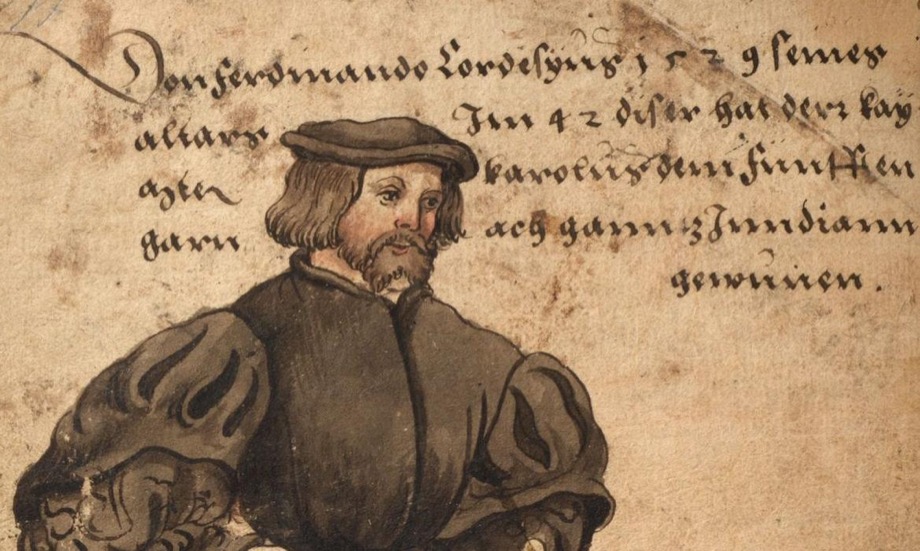
Portrait of Hernán Cortés (anonymous, c. 1525)
The Man Who Founded a City to Escape an Arrest Warrant
In the spring of 1519, on a stretch of fever-ridden dune near what is now Veracruz, a thirty-four-year-old notary's clerk from Extremadura performed one of the strangest legal maneuvers in the history of empire. Hernán Cortés was, at that moment, a criminal. His commission to explore the Mexican coast had been revoked by the governor of Cuba, Diego Velázquez de Cuéllar, before the fleet even cleared harbor; every hour Cortés spent on the mainland deepened the charge of mutiny. He did not appeal. He did not negotiate. He founded a town — the Villa Rica de la Vera Cruz — appointed a town council out of his own officers, resigned his now-void commission into that council's hands, and had the council immediately reappoint him captain-general in the name of the Crown. Velázquez's jurisdiction dissolved into thin air, because Spanish municipal law recognized a chartered town as answering directly to the king. A patch of sand and a sheet of paper had turned a fugitive into a royal officer.
Nothing about that move was military. It was a joke played on a legal system by a man who had spent two unfinished years at Salamanca and a decade as a colonial notary and knew exactly where the seams in the fabric were. And it is the single most characteristic act of his life — more characteristic than any battle, more characteristic even than the ships he destroyed a few weeks later. Cortés did not out-general the Mexica; the Tlaxcalans and the smallpox did much of that. What he did, over and over, at a speed that left every rival administrator flat-footed, was re-describe his situation until the situation became survivable. Arrest warrant becomes charter. Mutiny becomes loyalty. Guest becomes captor. Rout becomes siege.
Bernal Díaz del Castillo, who marched with him and adored him, records a man forever talking — arguing with priests, coaxing sullen soldiers with a joke and a promise, reading a room of Totonac chiefs he had met an hour earlier and finding the exact grievance that would turn them into allies. Matthew Restall, who is far more skeptical of the legend, arrives at a strangely similar portrait: an improviser and a self-mythologizer whose famous Cartas de Relación are less reportage than a brief for the defense, composed in real time by a defendant who never stopped needing one.
Cortés was an ENTP — dominant Extraverted Intuition, whose weapon was never the sword but the reframe: the ability to look at a closed situation and find the one unconsidered angle that reopened it.
The Angle Nobody Else Had Looked For
Extraverted Intuition is the function that refuses to accept the frame it is handed. Given a board with no legal move, it does not calculate harder within the rules; it asks whether the rules are the rules. The Veracruz charter is the purest specimen. Every other captain in the Indies understood the relationship between a governor and his expedition as fixed — Velázquez financed, Velázquez commanded, Velázquez could recall. Cortés saw a third party nobody had brought into the room: the king, four thousand miles away, to whom a chartered municipality reported directly. He did not break the law. He invoked a different law, and in doing so invented himself a new employer.
He kept doing it. When the fleet's Velázquez loyalists planned to slip a ship back to Cuba, he stripped and beached the remaining vessels — the "burning of the boats" that was neither a burning nor a plan, but an improvisation that converted a mutiny risk into an army with no reverse gear and, incidentally, gave him a hundred idle sailors to add to his ranks. When Pánfilo de Narváez landed at Veracruz in 1520 with an arrest force larger than Cortés's entire army, Cortés did not fortify. He marched to meet it, raided the camp at night in a rainstorm, took Narváez prisoner in minutes — and then spent the real effort on the part that mattered, buying Narváez's men with gold and stories until the arrest expedition became reinforcements. The threat had been reclassified as a supply convoy.
Above all he read the Mexica empire not as a monolith to be conquered but as a structure of resentments to be levered apart. Totonac towns groaning under tribute; Tlaxcala, unconquered and encircled and bitter; Texcoco split by a succession quarrel that Ixtlilxochitl II was happy to resolve in Spanish company. Where a conventional commander counted the enemy's warriors, Cortés counted the enemy's enemies — and found that the largest army in Mesoamerica was already standing inside the empire, waiting for somebody to give it a pretext. This is Ne's signature: not superior force, but the discovery of a latent possibility that everyone else had walked past.
The Cold Machinery Behind the Trick
Intuition supplies the angle; Introverted Thinking makes it hold. What distinguishes Cortés from every other adventurer with a bright idea is that his improvisations were built with a lawyer's joinery. The Veracruz maneuver was not a bluff — it was technically sound enough that the Crown, years later, could not simply void it. He sent the Cartas de Relación to Charles V not as dispatches but as pleadings, each one constructing a chain of reasoning in which every act of insubordination is reframed as loyal service rendered under difficult conditions. He shipped the royal fifth ahead of any verdict on his conduct, correctly reasoning that a treasury in possession of gold is slower to prosecute.
The same detachment governed his treatment of people. Taking Moctezuma II hostage inside his own palace, in a city of a quarter-million surrounded by causeways that could be cut at will, is on its face lunacy. As a piece of logic it is exact: the empire was a tributary machine that ran through a single sacral office, and control of the office was control of the machine at a fraction of the cost of fighting for it. For six months, absurdly, it worked. Cortés governed the Mexica through the man he had imprisoned, collecting tribute in the emperor's name, precisely because he had reduced a civilization he barely understood to a diagram of load-bearing parts.
Ti also explains his coldness when the diagram required it. He hanged his own men for conspiracy without visible hesitation. He accepted the destruction of Tenochtitlan — a city he had described to his emperor with genuine wonder — because the siege arithmetic of 1521 said that a causeway city could only be taken by filling the canals and razing the blocks behind him. The wonder and the demolition sat in the same head without friction. That is not cruelty of the appetitive kind; it is a mind that solves the problem as posed and does not let the sentiment attached to it enter the calculation.
Coalitions Built in a Language He Could Not Speak
The conquest was a diplomatic campaign punctuated by battles, and the diplomacy ran on Cortés's tertiary Extraverted Feeling — real, potent, and entirely unsentimental. He was, by every account including hostile ones, magnetic: he kept a starving, terrified, mutinous army together for two years by argument, ceremony, shared risk, and an unerring sense of what a given man needed to hear. When the Tlaxcalans fought him to a standstill and then chose alliance, it was because he grasped what they wanted — not gold, not conversion, but the destruction of Tenochtitlan — and made himself the instrument of a grievance three generations old.
None of it would have functioned without La Malinche, and their partnership is the clearest window into how his Fe operated. He could not hear a word of Nahuatl. Every nuance he responded to — the hesitation in a lord's phrasing, the faction inside a delegation, the warning at Cholula — reached him through her judgment before it reached his. What he supplied was the capacity to act on it instantly and in public: the gesture, the embrace, the theatrically staged mass, the calibrated show of outrage. He was reading a room he could only see, and the reading was good enough that Nahua accounts often name the pair as a single actor.
But tertiary Fe is warmth in service of the frame, not a governing value, and it failed exactly where a mature feeling function would have held. He tolerated Pedro de Alvarado, a man whose brutality he understood perfectly and used anyway, until Alvarado's massacre at the Templo Mayor detonated the uprising that nearly killed them all. He accepted Tlaxcalan devotion for years and then, secure, treated its leaders as subjects. The charm was genuine and the loyalty it purchased was genuine; neither ever became an obligation he felt bound by once circumstances changed.
The Long Petition
The inferior function is where a life goes wrong, and Cortés's went wrong precisely at the point where improvisation stopped being useful and administration began. He conquered an empire in twenty-eight months and then spent twenty-six years losing the argument about what he had conquered. Made governor of New Spain in 1522, he was stripped of civil authority within four years, subjected to a residencia investigation, outflanked by royal audiencia officials and by the surviving allies of Velázquez and Narváez, and reduced to the ornamental Marquessate of the Valley of Oaxaca. He was extraordinary at seizing a situation and mediocre at holding one.
Inferior Introverted Sensing shows in the pattern of the failure. Detail, precedent, bookkeeping, the patient maintenance of a routine — these were the weapons his enemies used against him, and he had no answer to them. His accounts were a shambles; the gold of the Noche Triste vanished into recriminations that followed him for decades; his expeditions to Honduras and Baja California were expensive intuitions that produced nothing. The Crown's bureaucrats did not defeat him with a better idea. They defeated him with files.
And in the end the inferior function turned nostalgic, as it does. The last chapter of his life is a man in Spain, wealthy and irrelevant, rehearsing 1521 to anyone who would listen and drafting petition after petition to Charles V for the recognition he believed the record entitled him to. The apocryphal scene has him forcing his way onto the emperor's carriage; asked who he is, he answers that he is the man who gave His Majesty more provinces than his ancestors left him cities. Whether or not it happened, it is the right ending: the great reframer, out of angles at last, reduced to reciting the same unanswerable fact.
Why ENTP Over ENTJ
Why not ENTJ?
The conqueror's obvious type is the commander's, and Cortés is not one. An ENTJ leads with Extraverted Thinking: a long-horizon objective, an organization built to reach it, and institutions left standing afterwards — the pattern of Cesare Borgia, who systematically dismantled the Romagna's petty lords toward a design he had drawn years in advance. Cortés had no design. He sailed with a trading commission, invented a city to keep himself out of irons, took a hostage because the hostage was standing there, and only settled on the destruction of Tenochtitlan after Tenochtitlan had thrown him out of it. Above all, an ENTJ's decisive advantage is exactly the thing Cortés never managed — the durable apparatus. He built nothing that outlasted his personal presence, and lost New Spain to the men who were better at paperwork than he was.
The distinction is visible in how each type handles a catastrophe. On the Noche Triste of June 1520 Cortés lost perhaps two-thirds of his Spaniards, all his artillery, and most of his gold on the Tacuba causeway; a commander in the Te sense would have been ruined, because the plan was the asset and the plan was gone. Cortés had no plan to lose. Within weeks he was back in Tlaxcala turning a rout into a story about betrayal that his allies could accept, ordering thirteen brigantines built inland and carried in pieces over the mountains, and reconceiving the whole war as a naval siege of a lake city — a reframe, not a recovery. Then he took ninety-three days to strangle a metropolis, fighting Cuitláhuac's successor Cuauhtémoc street by street, while smallpox did what he could not.
An INTP shares his Ti and would have built the same elegant legal fiction, but would never have stood on a beach selling it to four hundred armed men; the persuasive, coalition-hungry, theatrical extraversion is not incidental to Cortés, it is the delivery system. ENTP is the type that gets the whole man: the improviser who is most dangerous in the moment his position collapses, and least impressive in the years when nothing is collapsing at all.
Connected Figures
Further Reading
- Conquest: Montezuma, Cortés, and the Fall of Old Mexico — Hugh ThomasThe standard narrative account, exhaustive on the Spanish sources and the politics of Velázquez's revoked commission.
- The True History of the Conquest of New Spain — Bernal Díaz del CastilloThe eyewitness memoir of a foot soldier who admired Cortés and resented his glory-taking in roughly equal measure.
- When Montezuma Met Cortés — Matthew RestallA revisionist dismantling of the surrender legend that reads Cortés as improviser and self-mythologizer rather than master strategist.
- Cartas de Relación — Hernán CortésHis five letters to Charles V — indispensable and thoroughly self-serving, best read as legal briefs written by the defendant.
- Fifth Sun: A New History of the Aztecs — Camilla TownsendThe conquest reconstructed from Nahuatl-language sources, restoring agency to Tlaxcala, Texcoco, and the Mexica themselves.
