 Historical Figure MBTI
#719 · 5-29-26 · The Conquest of Mexico
Pedro de Alvarado
Golden Captain · Conqueror · The Templo Mayor Massacre
c. 1485 — 1541
6 min read
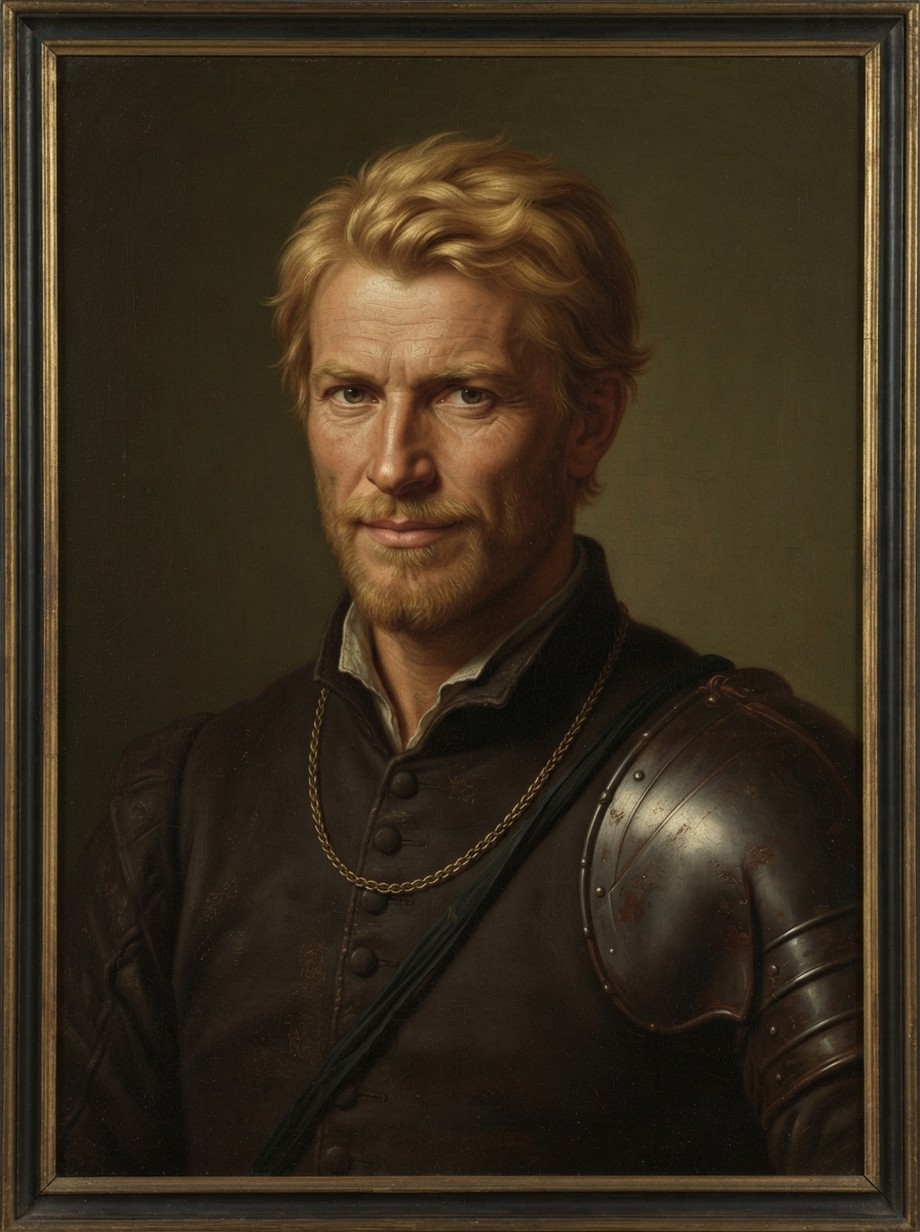
AI-assisted Portrait of Pedro de Alvarado
The Sun That Burned
The Nahua called him Tonatiuh — the Sun. Golden-haired, sunburned bronze by the Caribbean glare, he moved through the conquest of Mexico the way a man moves through a room he already owns: fast, loud, magnetic, entirely certain that whatever he did next would work out. Bernal Díaz, who marched beside him from Cuba to Tenochtitlan and on into the Guatemalan highlands, remembered him as gallant and well loved by his men — and, in the same breath, as a man whose temper needed no more provocation than a rumor to turn savage.
Both descriptions point to the same psychology. Alvarado was an ESTP, a creature of the immediate moment who reasoned his way to justification only after he had already acted. Left in command of Tenochtitlan while Cortés marched to intercept a rival expedition, he ordered the massacre of unarmed Mexica nobility at the Toxcatl festival on evidence so thin it barely survived contact with his own men's testimony. Three years later, governing Guatemala in his own right, he burned K'iche' lords with the same reflexive violence. Cortés built an empire through patience and calculation. Alvarado simply moved, and let the wreckage explain itself afterward.
Alvarado did not plan the massacre at the Templo Mayor so much as he arrived at it — an ESTP's Se-driven certainty that the moment demanded action, dressed up afterward in the language of preemption.
The Leap and the Sword
Se dominance in Alvarado was not the patient sensory awareness of careful scouts or craftsmen — it was pure kinetic reflex, the instinct to act on whatever the body registered in the instant it registered it. During the Toxcatl festival in May 1520, with Cortés away confronting Pánfilo de Narváez, Alvarado watched hundreds of unarmed Mexica nobles dance inside the walled courtyard of the Templo Mayor and decided, on the spot, that their gathering concealed an ambush. He gave no order to investigate further; he sealed the exits and set his men on the crowd with steel. The uprising it triggered nearly annihilated the entire Spanish expedition.
The same reflex produced the campaign's most famous image of physical nerve. Weeks later, retreating from Tenochtitlan on the night the Spanish called La Noche Triste, Alvarado reached a gap in the causeway where a bridge had been destroyed and the water ran deep with bodies and cargo. Without breaking stride he planted a lance in the wreckage and vaulted the gap — the Salto de Alvarado, still marked by street names in Mexico City today. It is the same mind at both ends: no deliberation, just a body that trusted itself to solve the problem directly in front of it.
In Guatemala, commanding his own expedition, that same immediacy scaled into a style of conquest built on speed and terror rather than negotiation — forced marches and a willingness to burn captured lords alive whenever he judged that fear would move faster than diplomacy.
A Thin Case, Built Fast
Alvarado's Ti never functioned as a brake on Se — it functioned as its lawyer. Called to account for Toxcatl, he produced a rationale on the spot: the Mexica were arming for revolt, the gathering was cover, his men struck first only because the danger was imminent. The argument was coherent and almost entirely unsupported by what his own soldiers described under questioning — a crowd of dancers, not warriors, sealed unarmed inside a courtyard. That is Ti auxiliary in a violent extravert: fast, confident reasoning deployed after the act to make the act look considered.
The same pattern recurs in Guatemala, where his letters frame each atrocity as tactically necessary — burning the K'iche' lords at Q'umarkaj was, in his telling, a proportionate response to an ambush plot, not terror meant to break resistance before it could organize. He was a genuinely capable tactician, reading terrain and exploiting cavalry with real skill. But the logic served the sword, not the reverse.
The Sun's Warmth
None of this made him hated, at least not at first. Fe tertiary gave Alvarado a real, working charm — the Nahua who named him Tonatiuh were not being ironic; his golden hair and bright temper genuinely read as something solar. Díaz's chronicle, unsparing about the violence, is equally consistent about the loyalty Alvarado inspired: generous, sociable, the kind of captain soldiers wanted beside them.
That same warmth built alliances the empire depended on. Alvarado took as consort doña Luisa Xicotencatl, daughter of a leading Tlaxcalan lord — a bond that cemented the Tlaxcalan alliance and that he carried with him into the Guatemalan campaigns. Fe simply never functioned as an ethical compass; it told him how to be loved by his own circle, and had nothing to say about the nobles dancing at Toxcatl, who were never inside it.
Why ESTP Over ISTP
Why not ISTP?
The Ti-first reading is tempting — Alvarado rationalized his violence with fast, structured logic, and he was a genuinely capable tactician. But ISTP is quiet and self-contained, its Se turned inward toward solitary competence. Alvarado was never solitary; he needed men around him, loved being loved by them, and built his career on alliance and charisma as much as on the sword — a Fe tertiary an ISTP simply doesn't carry. He led from the front of a crowd, not from the edge of one.
What separates Alvarado from Cortés, his commander, is instructive too. Cortés orchestrated alliances and betrayals with a chess player's patience — a dominant intuitive playing a long game. Alvarado never played a long game; he read the room in front of him and acted immediately. That is Se in its purest form, and it explains both his greatest feat of physical nerve and his single worst decision, because for an ESTP dominant, they are not really two different faculties at all.
Connected Figures
Further Reading
- The True History of the Conquest of New Spain — Bernal Díaz del CastilloAn eyewitness soldier's account of Alvarado's charm, his temper, and the Toxcatl massacre.
- Conquest: Montezuma, Cortés, and the Fall of Old Mexico — Hugh ThomasThe definitive modern narrative of the campaign, including Alvarado's command decisions.
- When Montezuma Met Cortés — Matthew RestallRevisionist history that complicates the standard telling of the massacre and its causes.
