 Historical Figure MBTI
#723 · 5-30-26 · The Conquest of Mexico
Cuitláhuac
Tenth Tlatoani · Liberator · Eighty Days
c. 1476 — 1520
6 min read
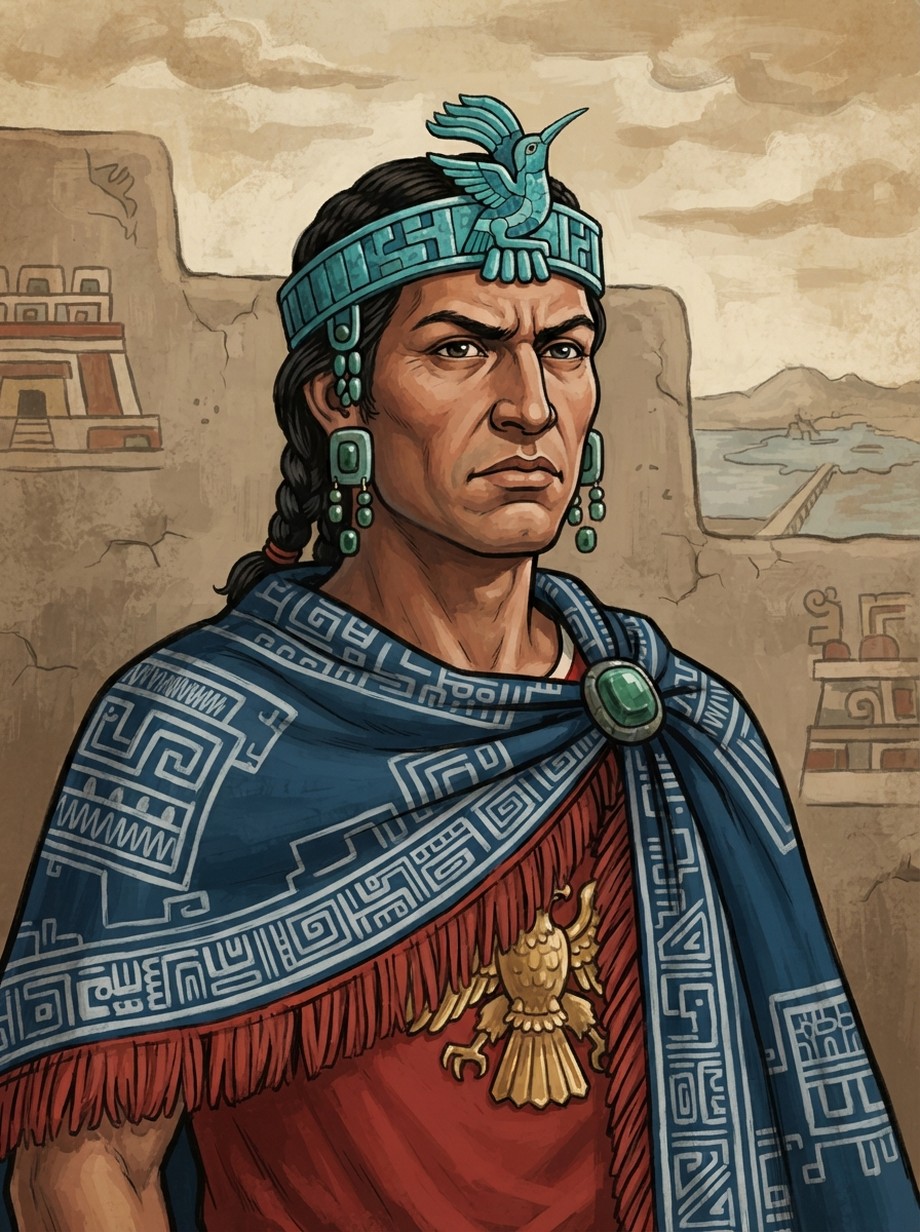
AI-assisted Portrait of Cuitláhuac
Eighty Days, No Hesitation
Cuitláhuac took the throne of Tenochtitlan in the worst week the city had ever seen. His brother Moctezuma II was dead — stoned by his own people or murdered by his captors, the sources disagree — and the Spanish garrison that had occupied the palace for six months was still barricaded inside it, starving and desperate. Cuitláhuac had spent those six months as a hostage alongside Moctezuma, watching a ruler who preferred delay to confrontation try to out-wait a problem that only grew. He was released, or slipped free, in the chaos after the Toxcatl massacre — Pedro de Alvarado's slaughter of unarmed nobles during a religious festival — and by the time the Mexica council elected him tlatoani, he had already made up his mind about what came next.
What came next was fast. Within days, Cuitláhuac had organized the assault that drove the Spanish out of the city entirely — the retreat the Spanish would remember as La Noche Triste, the Night of Sorrows, in which Cortés lost most of his men, his horses, and his artillery fleeing across the causeways in the dark. It was the decisive military reversal of the entire conquest, and it happened almost immediately after Cuitláhuac took power, as if the plan had been sitting ready for months while someone else refused to give the order.
Cuitláhuac is ESTJ — a Te-dominant ruler who read Moctezuma's paralysis as a solvable problem and solved it in a matter of days.
The Obvious Thing, Done Fast
Every account of Cuitláhuac's brief reign describes the same pattern: identify the correct action, then take it, without the deliberation that had defined his brother's final months. Moctezuma had spent the Spanish occupation testing accommodations, granting audiences, and calculating what generosity might buy him. Cuitláhuac inherited the same crisis and answered it with a single organized assault that emptied the city of its occupiers in one violent night. There is no record of him debating whether resistance was wise. The debate, as far as the sources show, had already happened in his own head, and by the time he held power he was simply executing a plan.
The urgency didn't stop with the Spanish retreat. He moved immediately to rebuild what the siege had damaged — the causeways breached during the fighting, the defensive works around the city's approaches — and to reassert Mexica authority over tributary city-states that had begun hedging their loyalty during Moctezuma's drift. Diplomatic overtures went out to wavering allies in the same weeks the physical rebuilding started; Cuitláhuac was running military repair and political repair on parallel tracks, treating both as the same emergency. That is Te at its most legible: not strategy for its own sake, but the fastest correct route from a broken situation to a defended one, pursued without a wasted month.
Precedent, Not Improvisation
Nothing Cuitláhuac did to defend Tenochtitlan was new. As the former ruler of Ixtapalapa and a battle-tested noble in his own right, he knew how the Mexica had fought and administered before — how causeways were held, how tribute obligations bound the valley's city-states together, how a siege was supposed to be met. His response to the crisis of 1520 was to restore that known system rather than invent a new one: rebuild the defenses the way they had been built, reassert the tribute relationships the way they had always run, and lean on institutional memory instead of untested improvisation.
That reliance on precedent is also why his reign reads as a correction rather than a revolution. He wasn't reimagining Mexica statecraft under pressure — he was reinstalling it, on the theory that the system Moctezuma had let erode was sound and only needed a ruler willing to enforce it again.
A Conviction Never in Doubt
What set Cuitláhuac apart from his brother wasn't intelligence or information — both men saw the same Spanish threat — it was certainty. From the moment of the Toxcatl massacre onward, Cuitláhuac appears to have held one settled position: accommodation was the wrong strategy, and resistance was the right one. He didn't arrive at that conviction through deliberation once he took power; the sources suggest he held it the entire time he was a captive alongside Moctezuma, unstated and unshaken, waiting only for the authority to act on it.
That is Fi running underneath a Te-dominant reign — not a public performance of values, but a private, load-bearing certainty that didn't need to be re-litigated once circumstances changed. It's also, in the end, what makes his death so abrupt a loss. Smallpox, carried into the valley by a member of Narváez's expedition, killed him roughly eighty days into his rule, before the fortifications he'd ordered could be tested against the siege that was still coming.
Why ESTJ Over ISTJ
Why not ISTJ?
An ISTJ reading of Cuitláhuac would emphasize his fidelity to precedent and undersell how outward-facing his crisis response actually was. He didn't quietly restore procedure from behind the scenes — he organized a citywide military assault within days, then pushed diplomatic overtures out to wavering tributary states in the same breath. That is Te directing action into the world, not Si managing it from a comfortable remove. The precedent-mindedness is real, but it served an assertive, externally-executed correction, not an internally-focused maintenance of the status quo.
ESTJ fits because the sequence of Cuitláhuac's reign runs Te first, Si second: decide and act, then draw on known structures to make the action durable. An ISTJ in his position might have shored up the defenses Moctezuma left standing without ever ordering the offensive that expelled Cortés in the first place. Cuitláhuac's first move was the assault. Everything after it — the rebuilding, the diplomacy, the reassertion of tribute — was the auxiliary function catching up to a decision the dominant function had already made.
Connected Figures
Further Reading
- Fifth Sun: A New History of the Aztecs — Camilla TownsendThe definitive modern account, drawing on Nahuatl-language sources to reframe Cuitláhuac's reign as a near-successful counteroffensive.
- Conquest: Montezuma, Cortés, and the Fall of Old Mexico — Hugh ThomasA detailed narrative history of the conquest, including the Noche Triste and its immediate aftermath under Cuitláhuac.
- Florentine Codex, Book 12 — Bernardino de SahagúnThe primary Nahua-language account of the conquest, compiled from indigenous informants a generation after the events.
