 Historical Figure MBTI
#732 · 6-1-26 · The Conquest of Mexico
Cuauhtémoc
Last Tlatoani · Defender · Ninety-Three Days
c. 1500 — 1525
7 min read
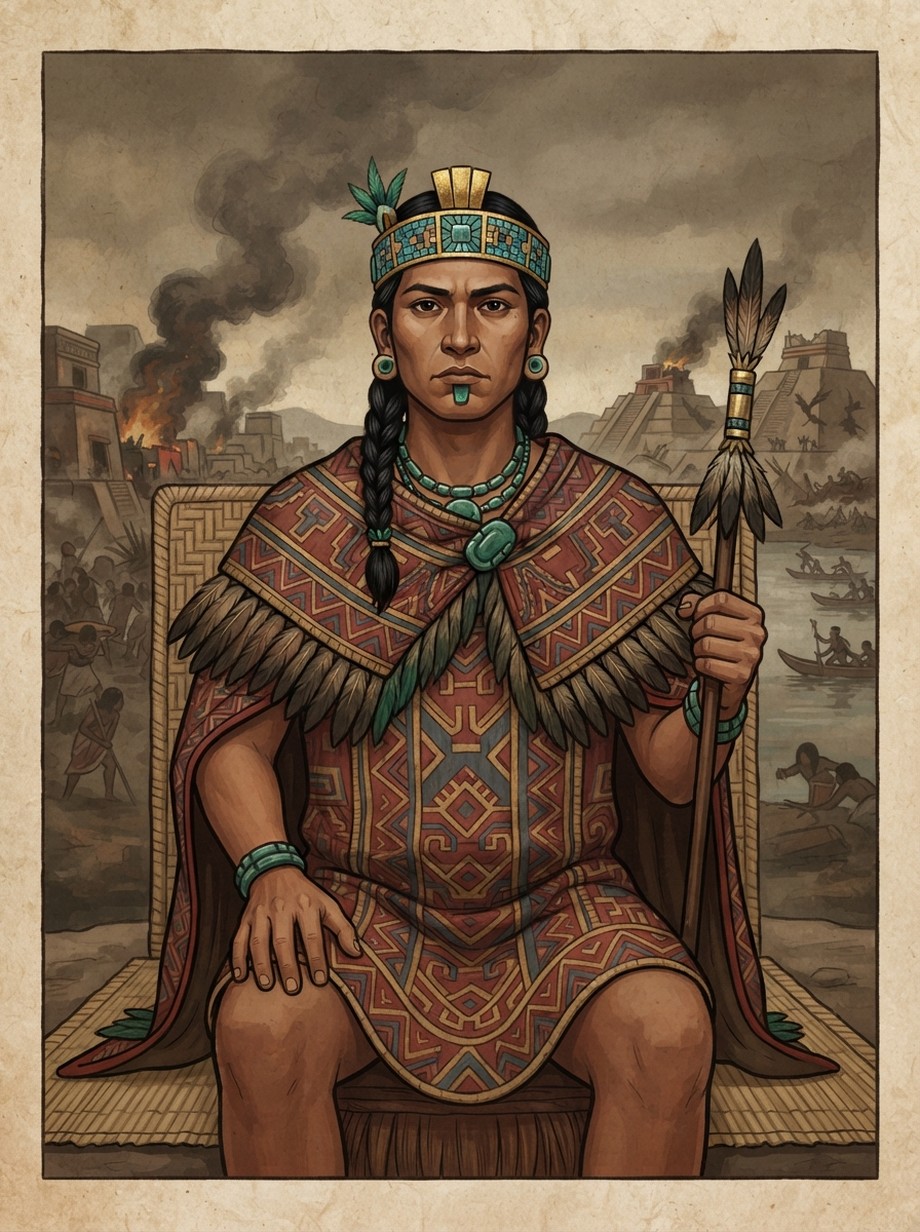
AI-assisted Portrait of Cuauhtémoc
The Man Who Would Not Stop
He inherited a losing position and refused, for ninety-three days, to concede it. Elected tlatoani of Tenochtitlan at roughly twenty-five, after smallpox carried off his predecessor Cuitláhuac within months of that man's own accession, he took command of a capital hollowed out by an epidemic no one in Mesoamerica had a name for, in a valley where the tributary towns were defecting week by week. There was no plan available that ended in victory. He fought anyway, house by house and canal by canal, until the city he was defending had been dismantled around him.
The temptation is to read this as tragic genius. The sources do not support it. Cuauhtémoc invented very little; he fought the siege the way Mexica commanders had always fought, from the causeways and the canals. What distinguished him was not imagination but a refusal to be moved. Cortés sent surrender terms repeatedly, through La Malinche, and he declined them all — not with rhetoric, so far as anyone recorded, but by simply continuing. When it ended, and his captors burned his feet with oil to make him give up gold that had mostly already sunk into the lake, the one line the tradition preserves from him is a flat rebuke to a fellow prisoner burning beside him: am I on a bed of roses? Endurance stated as a matter of fact. That sentence is the whole psychology.
Cuauhtémoc is an ISTJ — a dominant Si defender whose greatness lies not in what he devised but in what he would not relinquish.
The City as Memory — Si — dominant
Cuauhtémoc was a son of Ahuitzotl, raised inside the Mexica ruling house at the height of its confidence, and everything he did in 1521 drew on that inheritance rather than departing from it. He fought the war Tenochtitlan had been built to fight: an island city reachable only by narrow causeways, defensible by breaking the bridge-spans and swarming the exposed columns from canoes. When the Spanish forced a causeway, the bridges came out behind them; when they took a street, the houses along it were stripped so the ground gave no cover. Not innovations — the standing repertoire, applied with unusual consistency and unusual stamina.
Dominant Si is a memory of concrete particulars, and it shows in his handling of legitimacy as much as his tactics. He married Isabel Moctezuma, daughter of Moctezuma II, less as a romance than as a splice: an insistence that the line continued unbroken, that the office he held was the same office. A more inventive mind might have asked whether the tribute system itself — the source of every grievance that Ixtlilxóchitl II and the Tlaxcalans were converting into allied troops for Cortés — could be bargained away for defections. Cuauhtémoc did not ask. He defended what he had been given exactly as he had received it, and what he was defending was part of why he lost.
Ninety-Three Days of Administration — Te — auxiliary
A siege is a logistical problem before it is a heroic one, and Cuauhtémoc ran his like a quartermaster. Cortés cut the Chapultepec aqueduct early; food came in only by canoe at night, through a cordon of brigantines. For three months a population swollen with refugees had to be fed, armed, rotated through the fighting line and kept from breaking, while dysentery worked through it. That the defense held at all is an administrative achievement before it is a tactical one.
Auxiliary Te is executive rather than visionary: it organizes what exists toward a stated end and measures itself by whether the thing got done. He fortified in depth, so each captured street cost another assault. He counter-attacked the brigantines with massed canoes and staked submerged pilings in the shallows to gut their hulls — a practical countermeasure to a specific instrument, arrived at by watching what the instrument did. What he never did was gamble: no decisive field battle, no single stroke, which is what strategic ambition reaches for when attrition runs against it. He simply raised the price of every subsequent yard, on the implicit theory that a sufficiently expensive conquest might not be worth completing.
A Bed of Roses — Fi — tertiary
Tertiary Fi is a private, unnegotiable interior standard — a line held without explanation and often without benefit. Cuauhtémoc's is visible in the negative space of his record: the surrender offers he never answered, the treasure he would not name, the absence of any bid to save himself. Cortés wanted him alive and would have paid for cooperation; the path to a comfortable client-kingship was open and had recent precedent, since Moctezuma II had walked partway down it. Cuauhtémoc did not walk down it at all.
His one surviving sentence, spoken while his feet burned, was addressed not to his torturers but to the lord of Tacuba beside him who was begging for release: am I on a bed of roses? No appeal to gods, ancestors, or posterity — only a man stating a fact about shared conditions and declining, on that basis, to make the noise expected of him. Fi at its most characteristic is a conviction held so far inside that it presents as understatement. And none of it reads as ambition: no boasting, no cult of personality, no attempt to found anything. He had been handed an office and a city and understood himself to owe both an absolute duty — which is why the four hostage years afterward, crippled and decorative, read as worse than the siege. The siege at least had a duty in it.
The Doors He Never Tried — Ne — inferior
Inferior Ne is the weakest thing in the stack, and in Cuauhtémoc it is nearly invisible — which is itself the evidence. The Spanish force was small; its power lay almost entirely in the coalition it had assembled out of Mexica enemies, and coalitions of that kind are fragile. Possibilities were on the table: tribute bargained away to peel off Texcoco, an approach to Tlaxcalan factions uneasy about their new partners, an evacuation of the court to fight a long war from the mainland, an alliance with the Tarascans westward. None was seriously attempted.
Instead he held the island, and when the island became untenable he did not reconceive the war — he tried to leave by canoe on the last day and was taken on the water. That was flight, not strategy, and too late to be either; a mind fluent in alternatives would have been on the mainland weeks earlier, court and claim intact. The whole shape of the defense — magnificent, exhausting, terminal — is what happens when a superb Si-Te apparatus meets a problem solvable only by imagination and responds by doing the known thing harder and longer than anyone believed possible.
Why ISTJ Over ENTJ
Why not ENTJ?
The young war-leader making a doomed last stand invites the commander archetype, and ENTJ is the obvious candidate — Ni-Te reading the strategic field, restructuring the position, playing for a future the present does not yet contain. That is precisely what Cuauhtémoc never did. An ENTJ facing an unwinnable siege moves the problem: negotiates to fracture the Indigenous coalition, relocates the court, converts a lost capital into a long war on better ground. Cuauhtémoc produced no alternative frame at all — only an extraordinary refusal to abandon the one he had. And ENTJ's outward force leaves rhetoric behind it; from three months of command we have essentially one recorded sentence, and it is a deflection.
The distinction is between designing a resistance and embodying one. Cuauhtémoc's achievement was not conceptual but durational: he took a city broken by epidemic, an office emptied of its tribute base, and a doctrine devised for a world that no longer existed, and made all three last ninety-three days past the point of reason. That is an ISTJ's kind of greatness — measured in what survives pressure rather than in what it invents.
Connected Figures
Further Reading
- Fifth Sun: A New History of the Aztecs — Camilla TownsendReconstructs the conquest from Nahuatl-language annals rather than Spanish chronicles; the essential corrective on how the Mexica understood their own defeat.
- Conquest: Montezuma, Cortés, and the Fall of Old Mexico — Hugh ThomasThe fullest narrative of the campaign in English, with the siege of Tenochtitlan traced day by day.
- The True History of the Conquest of New Spain — Bernal Díaz del CastilloEyewitness testimony from the ranks, including the capture on the lake and a soldier's discomfort at Cuauhtémoc's execution.
- When Montezuma Met Cortés — Matthew RestallDismantles the mythology that has accreted around the conquest's key encounters, Cuauhtémoc's last words included.
- The Broken Spears: The Aztec Account of the Conquest of Mexico — Miguel León-Portilla, ed.Indigenous accounts of the siege and the fall, assembled from the Florentine Codex and related sources.
