 Historical Figure MBTI
#730 · 5-31-26 · The Conquest of Mexico
Bernal Díaz del Castillo
Foot Soldier · Chronicler · The True History
c. 1496 — 1584
6 min read
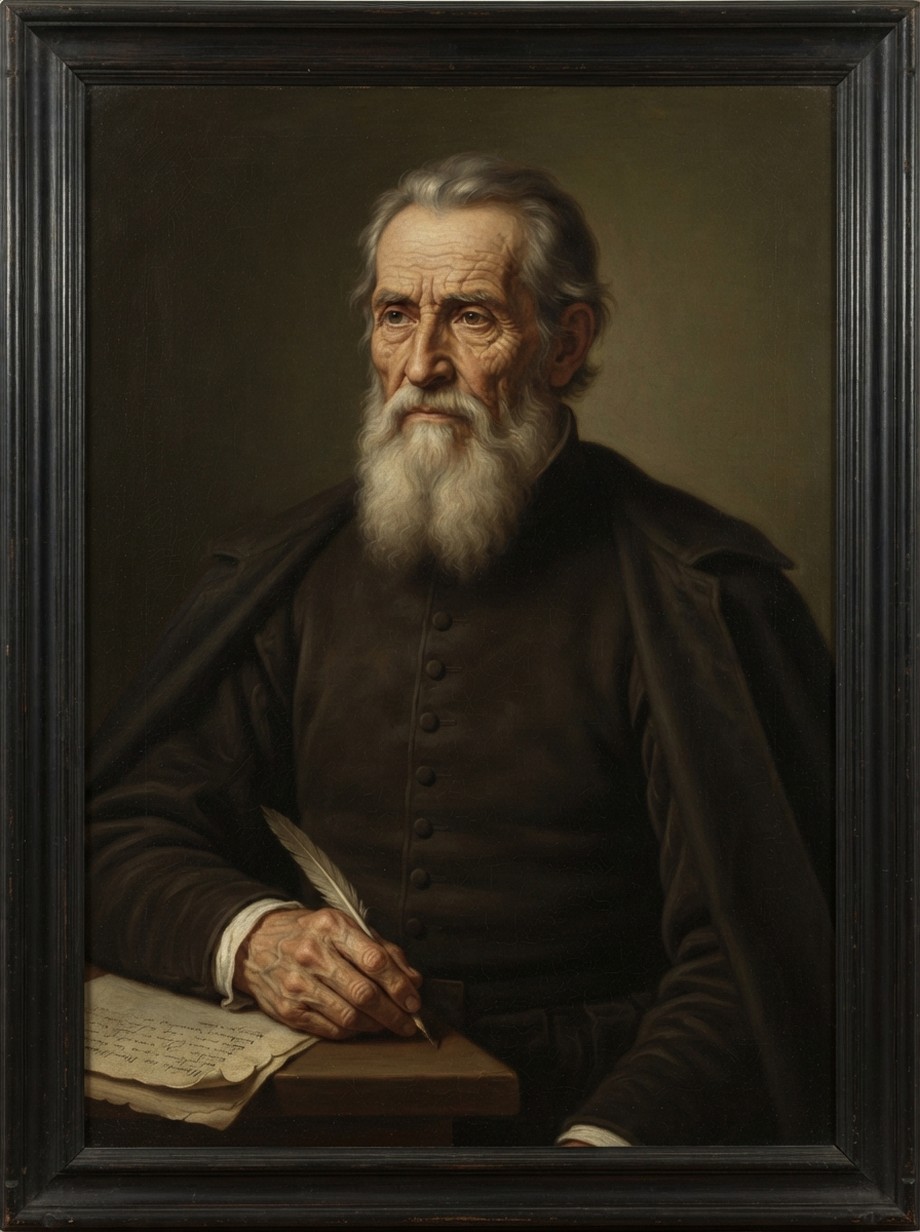
AI-assisted Portrait of Bernal Díaz del Castillo
The Soldier Who Refused to Be Forgotten
Bernal Díaz del Castillo fought his way across Mexico as one anonymous pikeman among hundreds, and for forty years he let the official histories tell the story without him. Francisco López de Gómara, who had never set foot in the New World, wrote his chronicle as a monument to Hernán Cortés — a single genius directing history while the men who bled for him dissolved into background scenery. Díaz, old and half-blind in Guatemala, could not let that stand. What he produced instead, the Historia verdadera de la conquista de la Nueva España, is not a general’s memoir. It is a foot soldier’s ledger of who was actually there — hundreds of names, recalled decades later, town by town, skirmish by skirmish, death by death.
That act of correction is the whole man. Díaz did not dispute Gómara’s facts because he had a rival theory of the conquest; he disputed them because Gómara had erased the people Díaz had marched beside, and erasure was a wrong he was psychologically incapable of letting pass. He was an ISFJ, built around a memory so exact it could still summon, in his seventies, the particular look of a particular plaza forty years gone — and around a loyalty so total that defending his comrades’ place in history became the last great campaign of his life.
Díaz’s ISFJ Si did not merely remember the conquest — it cross-examined every rival account of it against a store of lived, granular detail that no armchair chronicler could match.
A Warehouse of Forty-Year-Old Detail
What makes the Historia verdadera historically indispensable is not its argument but its texture. Díaz remembers what towns smelled like, what causeways looked like at dawn, what Moctezuma’s attendants wore, which soldier said what before which battle, and — obsessively — who among his companions died and where. This is dominant Si operating at the scale of a national archive: a mind that stores lived sensory experience with such fidelity that, writing in old age, he could reconstruct a campaign chronology more granular than any account produced by men who had actually kept notes at the time.
It is also why he wrote at all. Si does not merely retain the past; it treats accurate retention as a form of duty, and duty violated is what set him to the desk. Gómara’s history, in Díaz’s eyes, was not just flattering — it was wrong, factually wrong, in ways Díaz could correct because he alone still carried the true version in his head. He names the soldier who first sighted land, the interpreter who mistranslated a crucial phrase, the exact number of horses at a given crossing. The pedantry is the point: Si’s loyalty is to what actually happened, and forty years had not loosened its grip.
Even his prose habits betray it. He circles back constantly to correct himself against earlier drafts of memory — "as I have said," "as I will relate further on" — building the book less like a narrative arc than a soldier’s inventory, checked and rechecked against what he is certain he witnessed.
Writing for the Men Who Had No One Else to Speak for Them
Si supplied the material; Fe supplied the motive. Díaz was not settling a private grievance about his own overlooked heroism — though he wanted credit too — he was defending a community. He wrote to restore hundreds of ordinary soldiers, most of them dead, to a story that official Spain had already compressed into a single heroic name. "I say again that I, myself, am a true conquistador," he insists at one point, but the sentence is never really singular — it stands in for every foot soldier the chronicles had quietly written out.
This is Fe’s collective register: harmony not with an abstract public, but with a specific in-group whose honor Díaz felt personally obligated to uphold. He catalogues who fought bravely, who was wounded, who deserved better than a footnote, functioning less as historian than as a company scribe settling accounts on behalf of the dead. Even his criticisms of Cortés — and there are many, sharper than Gómara ever allowed — are calibrated to this same loyalty: not to diminish the commander out of spite, but to redistribute credit to the men beside him.
Cross-Examining the Official Record
Díaz’s tertiary Ti shows up as method rather than theory — a soldier’s instinct for internal consistency, applied line by line against Gómara’s account. He does not simply assert that the official history is wrong; he builds his case detail by detail, naming discrepancies, supplying counter-evidence, effectively cross-examining a text he considers unreliable. It is closer to legal argument than literary rivalry: this soldier was not where you claim he was, this battle did not unfold the way you describe, and here is why I know.
That methodical insistence on getting the facts right — even at the cost of a less flattering, less tidy narrative — is what separates Díaz from a mere partisan chronicler. He is willing to record Spanish cruelty, tactical blunders, and his own fear in ways that undercut the propaganda value of his book, because precision mattered to him more than the polish Gómara had supplied.
Why ISFJ Over ESFJ
Why not ESFJ?
An ESFJ chronicler would have led with the community’s honor as an outward campaign — organizing testimony, rallying fellow veterans, writing for an audience he actively courted. Díaz did the opposite: he wrote alone, late in life, in relative isolation in Guatemala, and the record-keeping came first, the social defense second. His Fe served an internal store of remembered fact rather than the reverse — the mark of an introvert whose dominant function is retention, not engagement.
The Historia verdadera reads like the work of a man settling his own internal ledger before he could rest, not a public campaigner rallying support. That order — Si first, Fe in its service — is what makes him ISFJ rather than his more extraverted cousin type.
Connected Figures
Further Reading
- The True History of the Conquest of New Spain — Bernal Díaz del CastilloThe essential primary source — Díaz's own eyewitness rebuttal, written to correct the official chronicles.
- Conquest: Montezuma, Cortés, and the Fall of Old Mexico — Hugh ThomasA comprehensive narrative history that draws heavily on Díaz's testimony.
- When Montezuma Met Cortés — Matthew RestallA revisionist account that interrogates the reliability and mythology of eyewitness sources like Díaz's.
