 Historical Figure MBTI
#753 · 6-5-26 · The Portuguese Indian Ocean
Catarina de Áustria
Queen of Portugal · Regent
1507 — 1578
6 min read
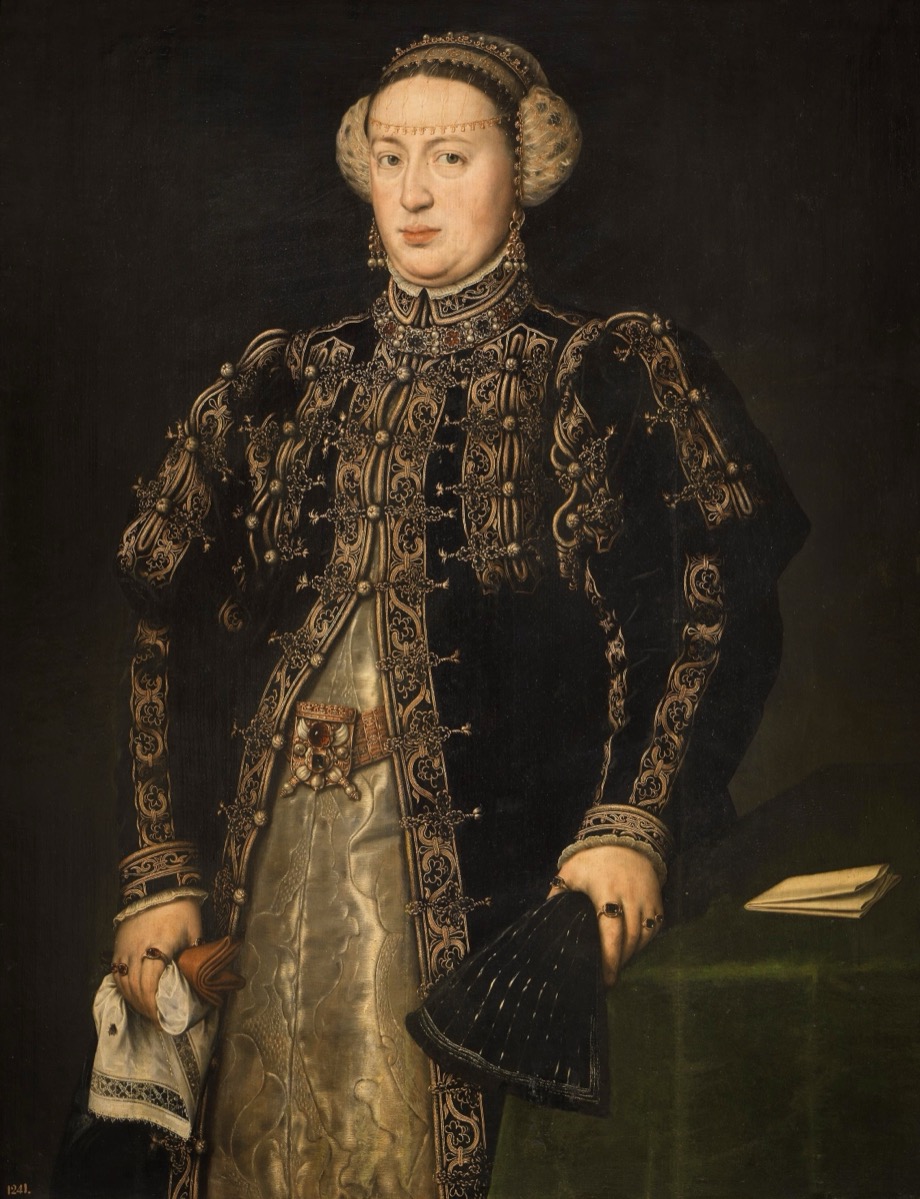
Portrait of Catarina de Áustria
A Life Built From What Was Taken
Catarina de Áustria was born in 1507 at Torquemada, in Castile, four months after her father died. Philip the Handsome had dropped dead of fever at twenty-eight, and his widow, Joanna of Castile, never recovered — the grief tipped into the derangement history remembers as "Juana la Loca," and mother and posthumous daughter were shut away together at Tordesillas for the better part of two decades. Catarina grew up inside that locked house, her only fixed companion a woman who could not reliably be trusted with a child, until her brother, the future Emperor Charles V, had her extracted into a normal court.
In 1525 Charles married her to João III of Portugal, the same year his own bride crossed the border the other way — a double Habsburg-Aviz knot binding the two crowns for a generation. The marriage produced nine children in eighteen years; all nine died before their parents did, most in infancy. When João died in 1557, the throne passed to a three-year-old grandson, Sebastian, and Catarina — the woman who had buried every child she bore — became regent of an empire stretching from Brazil to the Moluccas. She governed capably for five years, then gave the regency up rather than fight for it, and died in 1578, months before Sebastian marched the Portuguese army into the Moroccan desert and lost it, himself included, at Alcácer-Quibir — sparing her, by two years, the fall of the kingdom she had held together to her nephew Philip II of Spain.
Catarina de Áustria was ESFJ, dominant Fe: she ruled the way she had learned, as a girl locked away with a mother who could not hold anything together, to value most — by holding people, one relationship at a time, for as long as she honestly could.
A Kingdom Run Like a Household
Catarina's power was never institutional; it ran on maintained relationships, and she maintained an extraordinary number of them at once. She corresponded with Charles V for decades, and after his abdication with her nephew Philip II, in a stream of letters that functioned as the real machinery of Habsburg-Aviz relations — her diplomacy was, almost without exception, family diplomacy, person to person rather than office to office. As regent she did not command the Portuguese nobility so much as manage it, faction by faction, favor by favor, holding a naturally fractious court together through attention rather than authority.
That instinct also made her one of the great collectors of the Renaissance. As the India carracks came in loaded with exotica, Catarina assembled a Kunstkammer — Chinese porcelain, Sinhalese ivories, Brazilian featherwork — deliberately, as a form of address. A collection like hers said something about Portugal's reach to every ambassador who saw it, and said it more persuasively than a treaty could, because it was personal: a gift given, a curiosity produced for the right visitor at the right moment.
She ran the court as she ran the correspondence — by placing people and making herself the node every request passed through. It worked for as long as the relationships held, and was, as 1562 would prove, the whole of her authority, with nothing behind it once those bonds came under attack.
Guarding What Was Already Won
Catarina's regency, 1557–1562, was a project of preservation, not ambition. She did not launch conquests or reorganize the empire; she kept the India revenues flowing, held the administrative machine João III left her running on schedule, and worked to keep the Spanish alliance intact without letting Portugal be absorbed by it — continuity, applied with real discipline, at a moment when a less careful regent could have let the overseas empire drift.
The same instinct shaped how she treated her grandson. Sebastian was the last surviving thread of a line that had produced and lost nine children, and Catarina tried to raise him as a careful custodian of the crown rather than the crusading mystic he became. She kept steering him even after losing the regency in 1562 — writing, advising, being ignored — while the boy grew fixated on a holy war in Morocco she had spent her political life trying to keep the kingdom away from.
The Clean Break
What makes Catarina more than a competent placeholder is the 1562 resignation itself. A faction gathered around her brother-in-law, Cardinal Henry, pressed to take the regency from her, and rather than dig in against a court that had turned on her, she read the position clearly and let it go. She had kept the empire's finances sound and the succession intact for five years; she judged, correctly, that a regency sustained by relationship could not survive the relationship breaking, and declined to pretend otherwise for the sake of a title.
Why ESFJ Over ESTJ
Why not ESTJ?
An ESTJ regent governs by office and procedure — command that persists whether or not the people underneath it are personally loyal. Catarina's authority was never that durable, because it was never institutional: it lived in letters, marriages, patronage, and presence, and it evaporated the instant the court faction around Cardinal Henry turned, despite her having governed competently for five years. An ESTJ who lost that fight would have contested it on procedural grounds; Catarina read the relational ground shifting under her and stepped off it.
The clearest evidence is what she left behind. An ESTJ regent's legacy is administrative — reformed offices, settled precedent. Catarina's most durable legacy is a collection, assembled as a personal statement of Portugal's reach and given away, piece by piece, to the people whose favor she needed — Fe logic, not Te, no less real for depending on people rather than an office.
Connected Figures
Further Reading
- The Story of Süleyman: Celebrity Elephants and Other Exotica in Renaissance Portugal — Annemarie Jordan GschwendThe essential study of Catarina's collecting and its political uses.
- A History of Portugal and the Portuguese Empire, Vol. 1 — A. R. DisneyCovers her regency within the broader arc of the Portuguese Indian Ocean state.
- Foundations of the Portuguese Empire, 1415–1580 — Bailey W. Diffie & George D. WiniusStandard account of the empire's administration during her lifetime.
- A Consciência de um Império — Giuseppe MarcocciExamines Portuguese imperial self-understanding across the sixteenth century.
- Cultural Links between Portugal and Italy in the Renaissance — Kate Lowe (ed.)Context for the courtly and artistic culture Catarina's patronage belonged to.
