 Historical Figure MBTI
#754 · 6-6-26 · The Age of Exploration
Ruy Faleiro
Cosmographer · Magellan's Partner
c. 1470s — 1523
3 min read
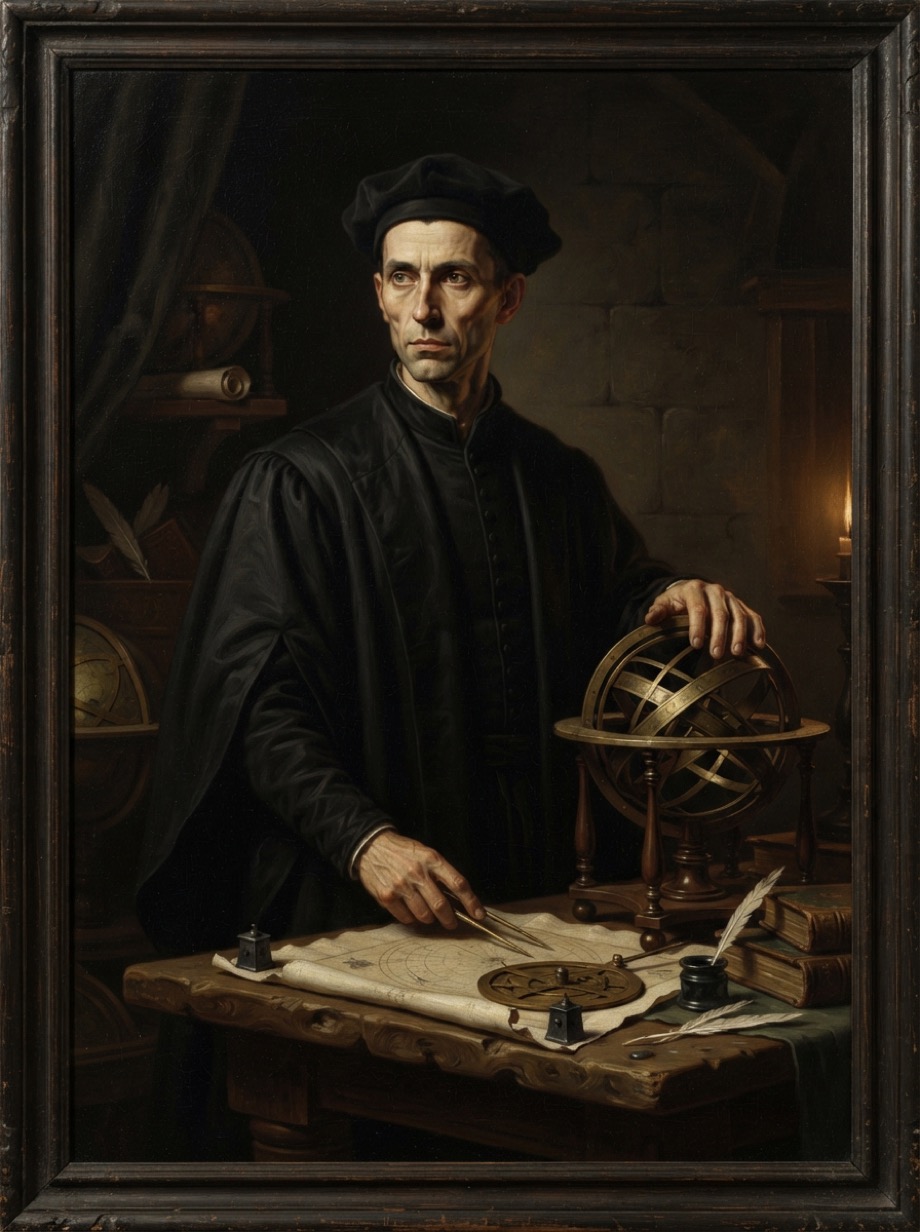
AI-assisted Portrait of Ruy Faleiro
The Half of the Voyage That Stayed Home
Ruy Faleiro was a Portuguese astronomer, cosmographer, and mathematician who, in 1517, left Portugal for Spain in the company of a disaffected naval officer named Ferdinand Magellan. Together they pitched King Charles V a scheme that sounds absurd until you remember it worked: sail west, around the bottom of a continent nobody had yet gotten around, and reach the Spice Islands from the wrong side of the map, staying legally on Spain’s half of a line the pope had drawn through the Atlantic. The capitulation Charles signed on 22 March 1518 named the two men joint captains-general of the fleet, with equal shares in whatever it found. History remembers one of them.
It remembers Magellan because Magellan sailed. Faleiro’s side of the partnership was not seamanship — it was the argument. He supplied charts and, more consequentially, the claim that he had solved the determination of longitude at sea, the one unsolved problem on which the whole scheme’s legality turned: only by fixing a ship’s east–west position could anyone say which side of the Tordesillas line the Moluccas actually fell on. His method, built on lunar distances and magnetic variation, was wrong — the problem would not yield to anyone for another two and a half centuries — but it was fluent enough, and dense enough with instruments and tables, to move a king who could not check the mathematics himself.
An INTP’s characteristic delusion is trusting a model because it is elegant, not because it is tested — Faleiro built two: the plan that got the fleet funded, and the arithmetic that would have sunk it.
By the time the five ships were ready to leave Seville, Faleiro was on none of them. The sources disagree about why, probably because it was all of it at once: he was behaving erratically, Castile was uneasy trusting two Portuguese-born captains over a Spanish fleet, and Magellan, now sole commander, did not argue to get him back. The official explanation was that Faleiro was needed at home to plan further voyages — an appointment that came to nothing. Juan de Cartagena took a post of quasi-independent authority in the fleet that historians have read as filling the space Faleiro left; it was Cartagena who led the mutiny at Port San Julián.
Psychological Verdict
What the record allows is a silhouette rather than a full profile, but the silhouette is clear: a systematizer, at home with instruments and tables and the closed logic of a model, for whom internal consistency mattered more than contact with the world. That is INTP thinking pushed past its evidence — Faleiro trusted his own calculations with a confidence nothing empirical supported, and never seems to have registered the gap. It is the same cast of mind that got the voyage funded: an elegant, self-consistent argument, delivered with total conviction, that was wrong on its one load-bearing claim. He was the theorist’s occupational hazard made flesh — right about nearly everything except the thing everything else depended on.
Connected Figures
Further Reading
- Over the Edge of the World — Laurence BergreenThe fullest narrative account of the Magellan expedition, including Faleiro's role in securing it.
- Magellan — Tim JoynerA scholarly biography that untangles the Faleiro partnership and its collapse.
- Straits: Beyond the Myth of Magellan — Felipe Fernández-ArmestoA revisionist account of the voyage's planning and politics.
- The European Discovery of America: The Southern Voyages — Samuel Eliot MorisonPlaces the Faleiro-Magellan scheme in the wider context of Iberian exploration.
- Longitude — Dava SobelExplains why the problem Faleiro claimed to have solved remained unsolved for another two centuries.
