 Historical Figure MBTI
#755 · 6-6-26 · The Age of Exploration
Ferdinand Magellan
Navigator · The Strait · The First Circumnavigation
c. 1480 — 1521
9 min read
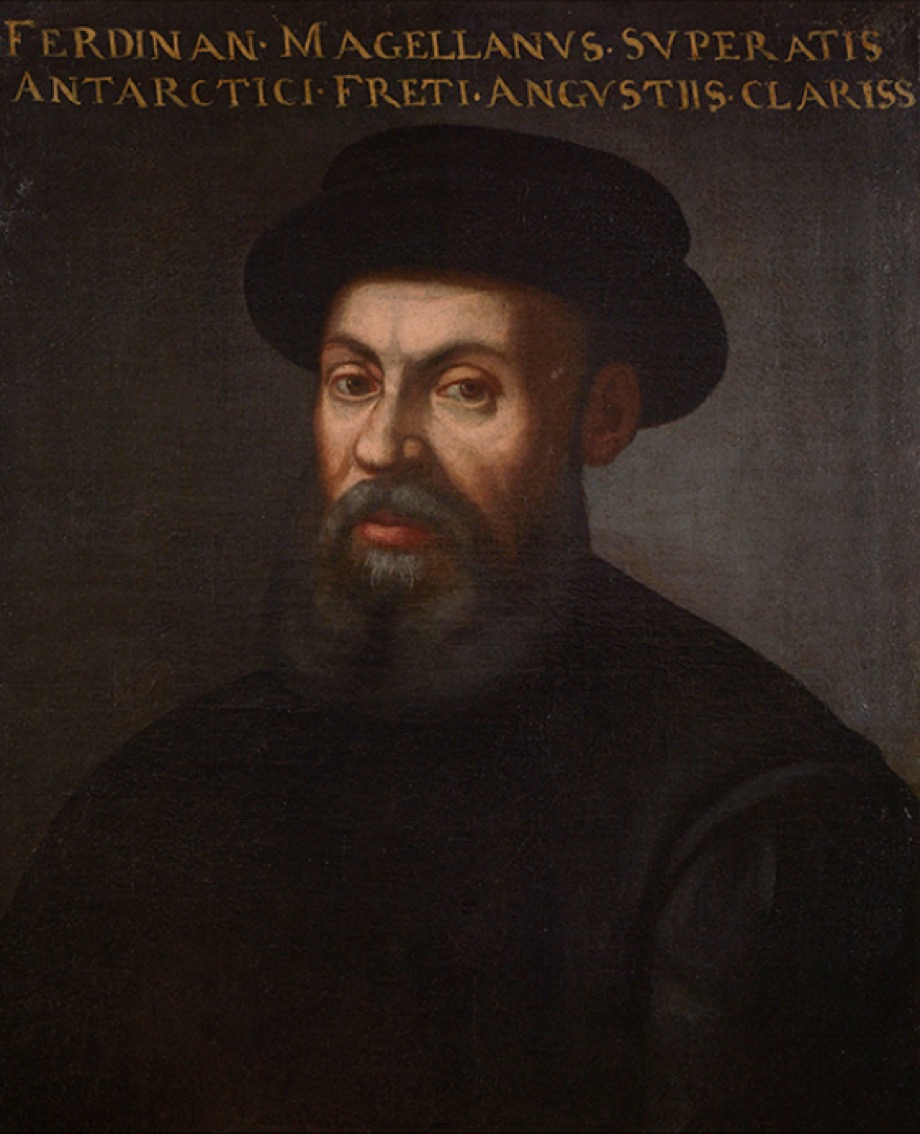
Portrait of Ferdinand Magellan
The Man Who Was Right About the Strait
He limped. That is the first thing the men who signed aboard noticed about their captain-general — a lance wound taken in Morocco had left one knee ruined, and the short, dark, close-mouthed Portuguese who came down to Sanlúcar de Barrameda in September 1519 did not look like a man carrying a new shape of the world in his head. He was not liked, and he did not try to be. His Castilian captains, appointed partly to watch him, thought him a foreigner with a grudge and an unprovable theory. Within eight months he would behead one of those captains, quarter the corpse on the Patagonian shore, and maroon another on an empty beach to die slowly — and he would still be right.
The theory was double, and only half of it was true. First: that the American landmass had a way through it — a strait somewhere in its southern reaches, opening into the ocean Vasco Núñez de Balboa had seen from a hill in Panama in 1513. Second: that beyond that ocean the Spice Islands would prove to lie on Spain’s side of the meridian the Treaty of Tordesillas had drawn through an unmeasured world. The first was a hypothesis with no evidence behind it. The second was false. He held both with the same certainty, and staked on them his nationality, five ships, roughly 270 men, and his life.
He got the true half right, and it rearranged the earth. He also never circumnavigated the globe and never meant to — he wanted a westward trade route to the Moluccas and expected to come home the way he had gone. He was wrong about the ocean’s width by an order of magnitude, wrong about the treaty line, and wrong on the last afternoon of his life about sixty men in surf. What he had was not accuracy but a picture that would not dissolve under contradiction.
Magellan was an INTJ — a dominant Ni that built a passage no chart supported, and spent every other faculty he owned forcing the world to admit it was there.
The Strait That Was Not on Any Chart
Introverted intuition does not gather evidence and then conclude. It arrives at the conclusion whole, and conscripts the evidence afterwards. Magellan had spent seven years in the East — Almeida’s fleet, the great sea-fight at Diu in 1509, the storming of Malacca in 1511 under Afonso de Albuquerque — and had come home with charts, rumours, a slave from Malacca, and a conviction that outran all three. He believed there was a door in the southern half of America. Nobody had sailed it. Nobody had drawn it. Juan Díaz de Solís had gone looking in 1516, mistaken the estuary of the Plate for it, and been killed on its shore.
The tell is how the conviction behaved under pressure. Manuel I refused him and released him to serve whom he liked; he crossed to Seville in 1517, married into the Portuguese expatriate colony there, and with the cosmographer Ruy Faleiro sold the scheme to a nineteen-year-old Charles V. Then came eighteen months of Casa de Contratación obstruction, Portuguese sabotage, a riot on the Seville waterfront over which flag flew from his mast, and the quiet assumption that a Castilian would eventually replace him. Through all of it the picture did not move. Bartolomé de las Casas, who saw him at court, recorded that Magellan carried a well-painted globe on which he traced his intended route — and had deliberately left the strait itself blank, so that nobody could take it from him. It was blank because it did not exist yet outside his head.
Then the coast tested him for a year. Every bay and river-mouth that might open, closed. They wintered at Puerto San Julián in the cold and the mutiny, lost the Santiago on a reconnaissance, and pushed on. On 21 October 1520 they raised a headland he named Cabo de las Vírgenes, and behind it the water went on going west and stayed salt. Thirty-eight days to thread it — channels, williwaws and dead ends, fires on the southern shore that gave Tierra del Fuego its name. Mid-passage the San Antonio, the largest ship and the one carrying most of the provisions, turned and ran for Spain. He came out the far side with three ships and the certainty confirmed. Everything else he had believed was about to be punished.
The Machinery Built Around One Idea
A vision with nothing under it is a daydream. What made Magellan dangerous was the apparatus he built to carry his: written sailing instructions issued before departure, a fixed order of station with the Trinidad always leading, a code of lantern signals, and a nightly salute at which every ship took the next day’s course from the flagship. He rationed by ledger and commanded by decree — and declined to tell his captains how far he meant to go, an omission they regarded, with justice, as a breach of the royal instructions that told him to take counsel.
At Easter 1520, in the freezing anchorage at San Julián, three of his five ships rose and demanded that he either turn for home or navigate by consultation. Magellan answered with cold operational theatre: a boat sent to the Victoria carrying a letter and six armed men, the rebel captain knifed in the throat while he read it, the ship taken from inside and the harbour mouth sealed by the two vessels still loyal. The mutiny collapsed within a day. Then came the arithmetic: Gaspar de Quesada beheaded and quartered, the pieces set on poles as a standing exhibit; some forty men condemned and promptly reprieved, because the fleet could not be sailed without them. Punishment calibrated exactly to what the mission could afford.
The subtlest cruelty was reserved for Juan de Cartagena, the Crown’s own inspector and the man the King had placed beside him as a check. Cartagena could not simply be killed; so Magellan put him ashore on a barren stretch of Patagonian coast with a priest, a little wine and biscuit, and sailed away. It removed the obstacle, kept the blood off the record, and left the survivors watching two men grow small on a beach. Extraverted thinking does not need to enjoy this. It needs the fleet to keep moving south.
The Private Ledger of What He Was Owed
Underneath the machinery ran something none of it could argue with. Magellan came home from the Indies wounded, limping, and trailing an accusation of trading with the enemy at Azamor; he asked Manuel I for a modest increase in his court allowance and for a command, and was refused. He asked again, and was told he might serve whomever he pleased; by the chroniclers’ account he knelt to kiss the King’s hand and the hand was not given. Magellan then did the thing that defines him more precisely than the strait: he formally renounced his nationality, a deliberate legal act, and took the idea to Portugal’s only rival. To Lisbon it was treason. To him it was a settled private accounting of a debt unpaid — and Fi keeps that ledger on terms it never submits for review.
The same interior fixity ran through his religion, which was inflexible and entirely sincere. He named the passage the Strait of All Saints and put up crosses on hills across the Pacific. And in the will he drew at Seville before sailing there is a clause that says everything: on his death, his slave Enrique of Malacca, taken at the sack of Malacca in 1511 and carried around the earth as his interpreter, was to be freed outright and given ten thousand maravedís. It was a private moral obligation nobody else recognised. When Magellan died, his brother-in-law refused to honour it and told Enrique he was still a slave.
That refusal probably destroyed what was left of the expedition: within days Enrique and Rajah Humabon had arranged a banquet ashore at which some two dozen surviving Spanish officers were killed. The one clause in which Magellan’s conscience overrode the ordinary brutality of his century was the clause his own men refused to execute, and they died for it.
The Beach He Could Not Read
The Pacific nearly finished them first: ninety-eight days from the strait to Guam without fresh food, across an ocean whose width nobody had guessed and which they crossed by improbable luck almost without touching an island. Biscuit powdered with worms, ox-hide soaked overboard for days and then grilled, rats sold between the men for half a ducat, gums swelling over the teeth until men could not eat. He held the fleet together through it. Then, in the Philippines in the spring of 1521, he was handed an easy situation and destroyed it in a fortnight.
At Cebu he converted Rajah Humabon, his queen, and — by Pigafetta’s count — some hundreds more, burning idols and setting up a cross. But Lapulapu, a chief on the little island of Mactan across the channel, would not submit, and Magellan decided the new god required a demonstration. Humabon offered a thousand warriors. Magellan refused them, and asked the Cebuanos instead to sit in their boats and watch how Christians fought.
This is where an INTJ dies. He took roughly sixty men, in armour, against a force Pigafetta put at fifteen hundred. The reef would not let the boats near, so they waded two crossbow-shots through shallow water — out of range of the ships’ guns, which was the entire reason the guns were there. Ashore, everything the plan had ignored asserted itself at once: the ground, the numbers, the fact that men in breastplates have unarmoured legs. The Mactanese aimed low. A bamboo lance took him in the face, a cutlass opened his leg, and they finished him with spears in the surf while his men ran for the boats. It was 27 April 1521. The man who had seen a strait across an unmapped hemisphere could not read a beach he was standing on. Inferior Se is not clumsiness; it is a blind spot in the immediate physical present, and it opens widest exactly when the vision demands a gesture.
Why INTJ Over ISTJ
Why not ISTJ?
The case is real and deserves stating plainly: the punishing literalism about orders and station-keeping, the written instructions, the ledgers, the silence, the endurance across seven years in the Indies and ninety-eight days of starvation. That is an ISTJ profile in every particular but the decisive one. Si-dominance reasons from a stored body of verified precedent and defers to it. Magellan had no precedent to be faithful to: the strait was on no chart because no European had seen it, and the ocean beyond had been glimpsed once, from a hilltop, by a man on foot. He generated the model himself and held it against the evidence — bay after bay that opened and closed — for a year. And Si does not renounce its own nationality for an idea it cannot demonstrate.
The archive’s cleanest control is one deck over. Vasco da Gama is the ISTJ Portuguese captain: he sailed a route assembled out of eighty years of accumulated Portuguese fact, executed it with terrifying exactness, and was violent in the service of instructions rather than of a picture. Gama’s gift was retention; Magellan’s was projection. Magellan’s worst error is diagnostic: the Moluccas were not on Spain’s side of the Tordesillas line, and Faleiro’s longitude arithmetic could not have shown that they were. He believed it because it belonged to the picture. Si errs by trusting the record too much; Ni errs by trusting the vision. Every one of Magellan’s errors is the second kind.
Connected Figures
Further Reading
- The First Voyage Around the World, 1519–1522 — Antonio Pigafetta (trans. R. A. Skelton or Theodore J. Cachey Jr.)The eyewitness account, written aboard by a man who worshipped Magellan — the source everything else is built on.
- Straits: Beyond the Myth of Magellan — Felipe Fernández-Armesto (2022)The revisionist corrective: sceptical, source-critical, and unsentimental about what Magellan actually intended and achieved.
- Over the Edge of the World — Laurence Bergreen (2003)The best narrative telling of the voyage — vivid on the mutiny, the strait and the Pacific crossing.
- Magellan — Tim Joyner (1992)A meticulous, document-driven biography that reconstructs the Portuguese years and the Seville negotiations in detail.
- The European Discovery of America: The Southern Voyages, 1492–1616 — Samuel Eliot Morison (1974)A sailor-historian's assessment of the navigation itself, by a man who retraced much of the route by sea.
