 Historical Figure MBTI
#760 · 6-6-26 · The Age of Exploration
Lapulapu
Datu of Mactan
c. 1491 — c. 1542
6 min read
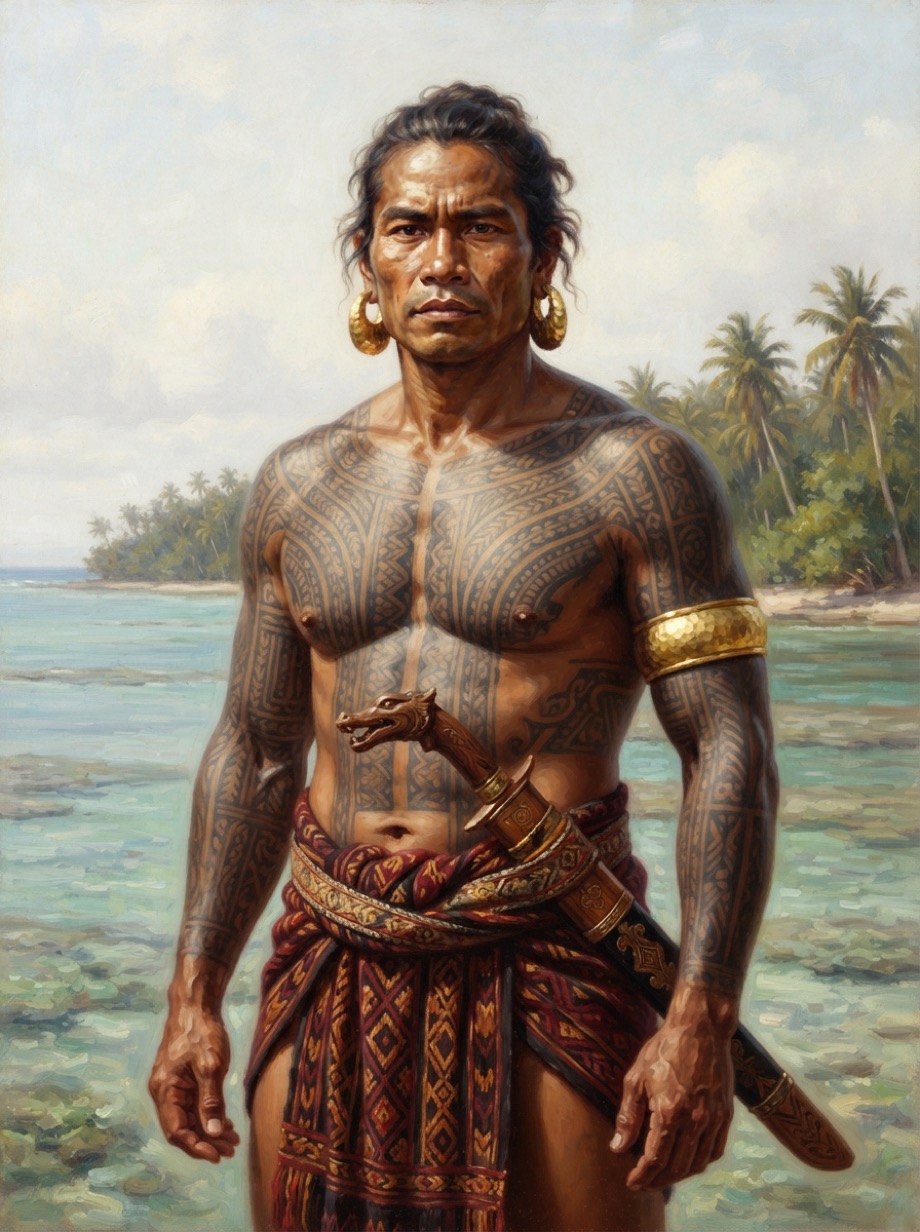
AI-assisted Portrait of Lapulapu
The Beach He Chose Not to Give
Ferdinand Magellan had crossed an ocean no European had named, converted a rajah on the island of Cebu, and concluded the rest of the Visayas would fall the same way — by persuasion where possible, demonstration where not. Off the small island of Mactan on the morning of 27 April 1521, a datu whose given name does not survive in any document from his own lifetime showed him he was wrong. Almost nothing certain is known about Lapulapu: not his birth year, not his religion, not even the settled spelling of his name, which appears in the sources as Çilapulapu. What is known, in unusual detail, is the one morning he is remembered for — because the man he killed had a chronicler on the beach who could not stop describing it.
Magellan had offered Rajah Humabon of Cebu a thousand or more warriors to bring against the holdout datu. He refused them; he wanted the Cebuanos to watch what Christian steel could do to men armed with spears, and crossed the strait at dawn with some fifty armored men and no local support at all. Lapulapu had well over a thousand fighters, a reef he knew by the hour, and a tide no foreigner could read. He used all three. By the time the fighting ended, eight Spaniards lay dead in the shallows, Magellan among them, and the Philippines had recorded its first defeat of a European force — inflicted by a man who left almost no other trace on history at all.
Lapulapu was an ESTP, an Se-dominant reader of ground and moment who did not out-plan Magellan so much as out-see him, in real time, on a beach Magellan never should have tried to cross.
The Reef at Low Tide
The entire battle is a study in ground and timing, and Lapulapu controlled both. Antonio Pigafetta records that the Spanish arrived off Mactan in darkness and waited for morning to land — a delay the Mactan side used, whether by design or by simply refusing to be drawn into a night fight on unfamiliar terms. When the Spanish finally came ashore, the tide was low and the reef flat around Mactan stretched out for hundreds of yards, too shallow for Magellan's boats to close on the beach. His men had to climb out and wade — through water, over coral, in full armor — long before they were in range of anything. The ships' guns, the one advantage that might have decided the fight in minutes, never came into play at all; they could not reach the shore.
What followed was not a stand-off but a hunt for the gap. Pigafetta describes the Mactan warriors deliberately aiming below the Spanish cuirasses, at the legs the armor did not cover — which is exactly where Magellan was struck, first by an arrow, then by a bamboo spear that brought him down for good. This is not the behavior of a force reacting in panic. It is the behavior of fighters who had sized up an armored enemy, identified the one part of him that was not armored, and gone straight for it the moment the enemy was close enough, tired enough, and wet enough for it to matter.
What Steel Could Not Cover
Underneath the improvisation was a working model of exactly what made the Spanish dangerous — guns, armor, ship's cannon — and exactly where each one failed him. Lapulapu never let the Spanish fight on the terms that made those advantages count. He did not meet them at night, when confusion would have favored the side with firearms. He did not let them land where the boats could support the men on foot. He did not sue for terms, take Humabon's mediation, or withdraw inland to avoid a fight he could lose; he stood on a beach he had already read and forced Magellan to cross it on foot, disarmed by his own equipment before a single spear was thrown.
It would be easy to call this pure analysis and stop there, but the record does not support a thinker working from a distance. The tide, the darkness, the charge and the retreat were read and answered inside the fight itself, not planned days in advance in the way a dominant Ti mind prefers — hold back, build the model, then commit. Lapulapu's intelligence shows up as improvisation under fire: an analytic structure in service of a man who was, first and foremost, standing in the water reading what was happening in front of him.
Why ESTP Over ISTP
Why not ISTP?
The case for ISTP is not nothing — the reading of Spanish armor, the exploitation of the unarmored leg, is genuine tactical analysis, and Ti runs through the whole engagement. But the sequence matters. A dominant Ti mind builds the model first and commits once it is satisfied; what the sources show instead is a man whose decisive quality was reading the moment as it arrived — the tide as it stood that morning, the charge as it broke, the retreat as it opened up — with the analysis serving the moment rather than preceding it. And Lapulapu did not evade, stall, or withdraw to fight on better terms later; he stood on an open beach and let an armored, gun-carrying enemy come to him. That is an appetite for direct confrontation an introverted thinker rarely shows.
The distinction is not academic, because it is the only thing about Lapulapu that the evidence can actually support. There is no surviving account of his private reasoning, no record of counsel taken beforehand, no window into temperament beyond the eighty or so minutes Pigafetta describes. What that window shows is a man operating inside a fast, physical, high-stakes situation with total command of its terrain — which is the signature of dominant Se married to a sharp, reactive Ti, not a strategist who happened to fight well.
Connected Figures
Further Reading
- The First Voyage Around the World, 1519–1522 — Antonio Pigafetta (trans. Theodore J. Cachey Jr.)The only eyewitness account of the battle, and the source for nearly every detail known about the events on Mactan.
- Barangay: Sixteenth-Century Philippine Culture and Society — William Henry ScottThe essential scholarly reconstruction of the pre-colonial Visayan world Lapulapu belonged to.
- Waiting for Mariang Makiling: Essays in Philippine Cultural History — Resil B. MojaresTraces how Lapulapu was made into a national symbol long after the thin historical record could support it.
- Over the Edge of the World — Laurence BergreenA narrative account of Magellan's voyage, including the approach to and battle of Mactan.
- Straits: Beyond the Myth of Magellan — Felipe Fernández-ArmestoA skeptical reassessment of Magellan's voyage and its outsized legend, Mactan included.
