 Historical Figure MBTI
#759 · 6-6-26 · The Age of Exploration
Enrique of Malacca
Interpreter · Enslaved · Malacca to Mactan
c. 1495 — after 1521
6 min read
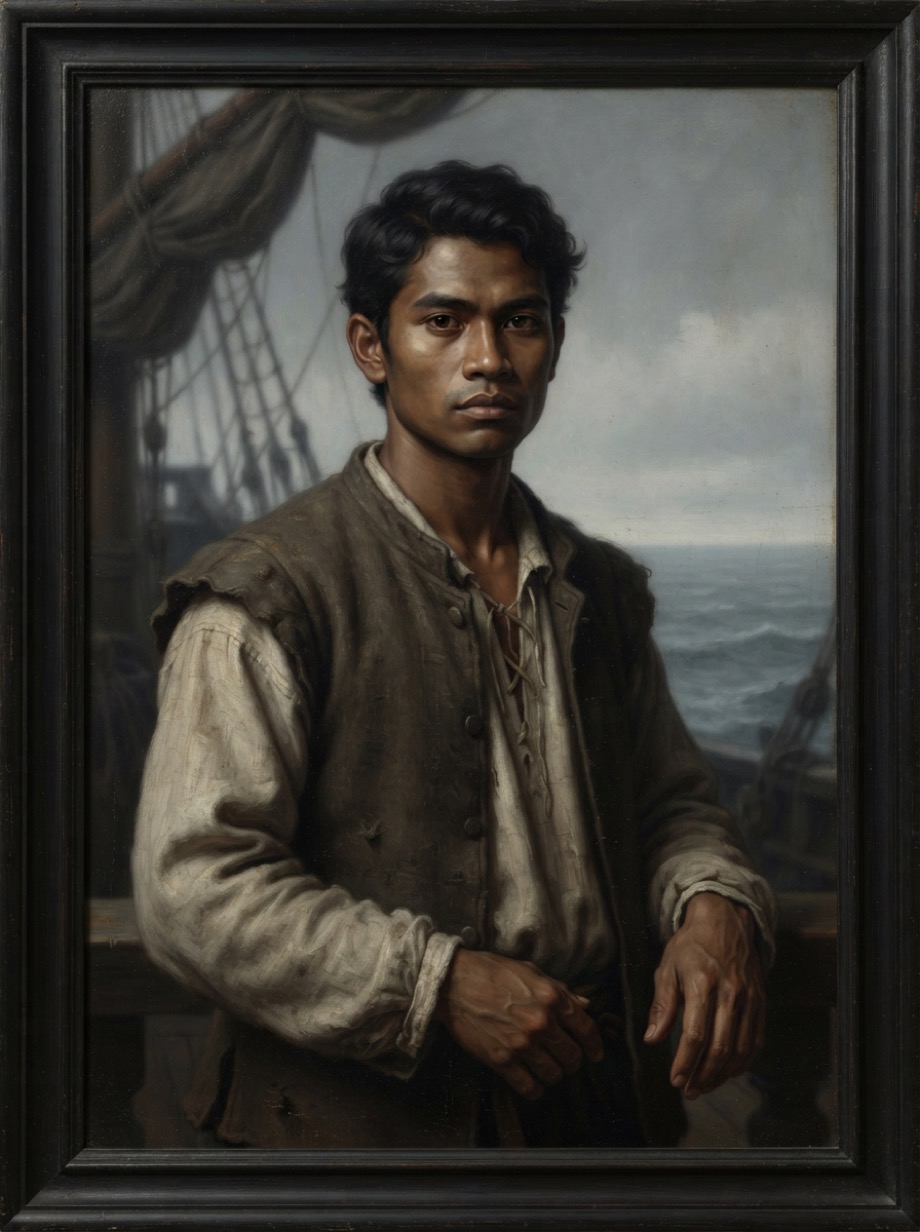
AI-assisted Portrait of Enrique of Malacca
The Interpreter Who Stopped Interpreting
When Afonso de Albuquerque’s fleet stormed Malacca in 1511, the Portuguese carried off cargo, captives, and — in Ferdinand Magellan’s baggage — a young man soon baptized and given the name Enrique. For the next eight years, through Magellan’s service in Morocco, his fall from favor, his defection to Spain, and the fitting-out of five ships at Sanlúcar de Barrameda in 1519, Enrique remained his property: page, servant, interpreter. He is remembered, so far as the record allows, as an ISTP — a mind organized around private, exacting analysis, expressed in the one medium anyone let him use: other people’s languages.
Where Enrique came from is not settled, and this entry says so rather than choosing a side for a tidier story. Pigafetta, the Venetian chronicler who is nearly the sole surviving source for his life, calls him a native of “Zamatra, formerly called Taprobana” — Sumatra. Magellan’s own will calls him a native of Malacca. Filipino and Malaysian scholars have argued the question for decades, and the stakes are real: if Enrique was born in the Philippines, his landing there in 1521 closed a circle around the earth and made him, not Juan Sebastián Elcano, the first person to circumnavigate the globe. If he was born farther west, the circle closed only if he ever reached home again — which nothing confirms. Both claims rest on the same handful of sentences, and neither can be proven from them.
Enrique’s ISTP mind treated language as continuous inference, not repetition — and at the end, the one thing he was ever allowed to decide for himself was to stop.
The Grammar of Strangers
Interpretation is not repetition; it is continuous inference about what a stranger means, made in real time with no safety net. By 1521 Enrique had spent a decade doing exactly that — moving between Malay, the trade language of the Strait he had been taken from, and the Portuguese and Spanish of the household that owned him — and the expedition depended on his getting it right. A wrong inference in a foreign court could cost the fleet its water, its welcome, or its officers’ lives.
The clearest evidence of that mind at work comes at Limasawa, in the Philippines, in March 1521, after the ships had crossed the entire Pacific. Pigafetta records Enrique calling out to men in a passing canoe — and the men answering him. It is the first moment any European expedition is recorded hearing, from the far side, the language of a place it reached by going the wrong way around the world, and Pigafetta’s own astonishment on the page is the astonishment of men grasping what they had just done. That exchange was not luck; it was trained analysis meeting its object. Nothing suggests he performed warmth for its own sake — what the record credits him with is precision, for men who blamed him first if it went wrong.
Ballast and Deck
Before he ever boarded a ship bound for the Moluccas, Enrique had spent years as a working member of Magellan’s household through Morocco, Lisbon, and Seville — the unglamorous labor of keeping a minor Portuguese courtier functional across three countries and one disgrace. That decade of hands-on, adaptive competence is the ground the rest of his life stands on.
The Pacific crossing killed men outright — scurvy, starvation, the eating of sawdust and ox-hide off the yards — and Enrique survived it as a working body, not a passenger. At Cebu, at Limasawa, at every landing where survival depended on someone stepping first into a canoe or a rajah’s hall and reading the room immediately, Enrique was that someone: practical, present-tense competence, exercised on behalf of men who owned him and took the credit.
The Conclusion No One Invited
In his will, drawn up at Seville before departure, Magellan freed Enrique conditionally: on Magellan’s death, Enrique was to be manumitted and paid ten thousand maravedís. Magellan was killed at Mactan on 27 April 1521. Wounded, Enrique went to the surviving officers under Duarte Barbosa and asked for the freedom he had been promised. Barbosa refused, abused him, and told him he remained a slave, to be shipped back to Magellan’s widow in chains.
Days later, at a banquet given by Rajah Humabon on Cebu, some twenty-six Spanish officers, Barbosa among them, were killed. Pigafetta, who was not present, blamed Enrique for conspiring with Humabon — but Humabon had his own reasons, and the man reporting the story had every reason to want a traitor rather than a betrayed ally who had simply stopped protecting his abusers. Whether Enrique plotted anything is unknowable. What is certain is only this: a man promised freedom was told he would be property again, and he was never recorded again. Read as Ni, it is not a wound expressed but a single, cold inference about where his interests now lay — drawn once, acted on completely.
Why ISTP Over ISFP
Why not ISFP?
The case is real: sensitivity to people, survival by constant adaptation, atmosphere read correctly at every landing, a final act that looks like a wound finally expressed. But what the sources credit Enrique with is analytical and technical, not aesthetic or values-driven — his function was modeling meaning across languages under pressure, not feeling his way through a room. His last recorded act reads less like a Fi outburst than a conclusion drawn: a cold assessment that the men who had betrayed him were no longer his problem.
ISFP would explain the empathy visible at the edges of the record. It does not explain the record’s center of gravity: a man whose documented value lay in getting inferences right, and who, when the promise made on his behalf was broken, simply stopped supplying them.
Connected Figures
Further Reading
- The First Voyage Around the World, 1519–1522 — Antonio Pigafetta (trans. Theodore J. Cachey Jr.)The primary account — and the only source for both the Limasawa exchange and the accusation against Enrique.
- Over the Edge of the World — Laurence BergreenA narrative history of Magellan's voyage that gives Enrique's role its full weight.
- Straits: Beyond the Myth of Magellan — Felipe Fernández-ArmestoA skeptical, careful reassessment of the voyage's mythology, including the Enrique question.
- The First Man Around the World Was a Filipino — Carlos QuirinoThe classic statement of the Filipino claim to Enrique's origin — cited here as a position in an unresolved debate, not settled fact.
- Waiting for Mariang Makiling — Resil B. MojaresTraces the historiography of the Enrique-as-first-circumnavigator claim within Philippine nationalist memory.
