 Historical Figure MBTI
#758 · 6-6-26 · The Age of Exploration
Juan de Cartagena
Inspector General · Mutineer
fl. 1519 — 1520
4 min read
Portrait of Juan de Cartagena
The Man Who Read the Commission Correctly
Juan de Cartagena was a Castilian of good standing, widely described in the sources as a nephew — and widely understood to mean an illegitimate son — of Juan Rodríguez de Fonseca, Archbishop of Burgos and the most powerful administrator of Spain's overseas empire. On the strength of that connection, Charles V appointed him veedor general — inspector general — of the Armada de Molucca and captain of the San Antonio, the fleet's largest ship, holding the formal standing of conjunta persona, joint person, with the expedition's Portuguese commander, Ferdinand Magellan. That title was not honorary. Cartagena's reading of it was that the crown, wary of handing five ships and the treasury's money to a foreign captain it did not fully trust, had built him in as a formal check on Magellan's authority — and that Magellan was obliged to consult him on the fleet's course.
Magellan refused. He would not explain his route, took the fleet down the African coast rather than west without saying why, and when Cartagena pressed him at a captains' conference and then withheld the customary salute and address owed a supreme commander, Magellan had him seized and stripped of his command on the spot. Cartagena was, on the documentary record, correct that Magellan was concealing the shape of the voyage — he had also concealed its true length from the crown that funded it.
An ESTJ certainty runs through the whole affair: authority lives in commissions, offices, and the chain of command — and by that standard, Cartagena was not wrong.
Psychological Verdict
Cartagena's few surviving acts describe a mind organized around structure rather than instinct — an ESTJ signature. He did not challenge Magellan on a hunch or a personal grievance; he challenged him by citing his commission, convening the captains formally, and insisting on the courtesies and consultations his office was owed. That is a man who understood power as something documented and delegated, exercised through office rather than through the will of whoever happens to be standing on the quarterdeck. It made him rigid at the worst possible moment: he escalated a procedural dispute into an open confrontation without any apparent fallback if the confrontation failed, and it failed completely. His catastrophe was not a flaw in his logic — it was that he was serving under a man for whom authority lived nowhere but in the objective. Magellan did not argue back within Cartagena's framework of offices and precedent; he simply seized him, because he held the ships and the loyalty of enough of the crews to make the argument irrelevant.
Marooned, So No One Would Have to Answer for a Killing
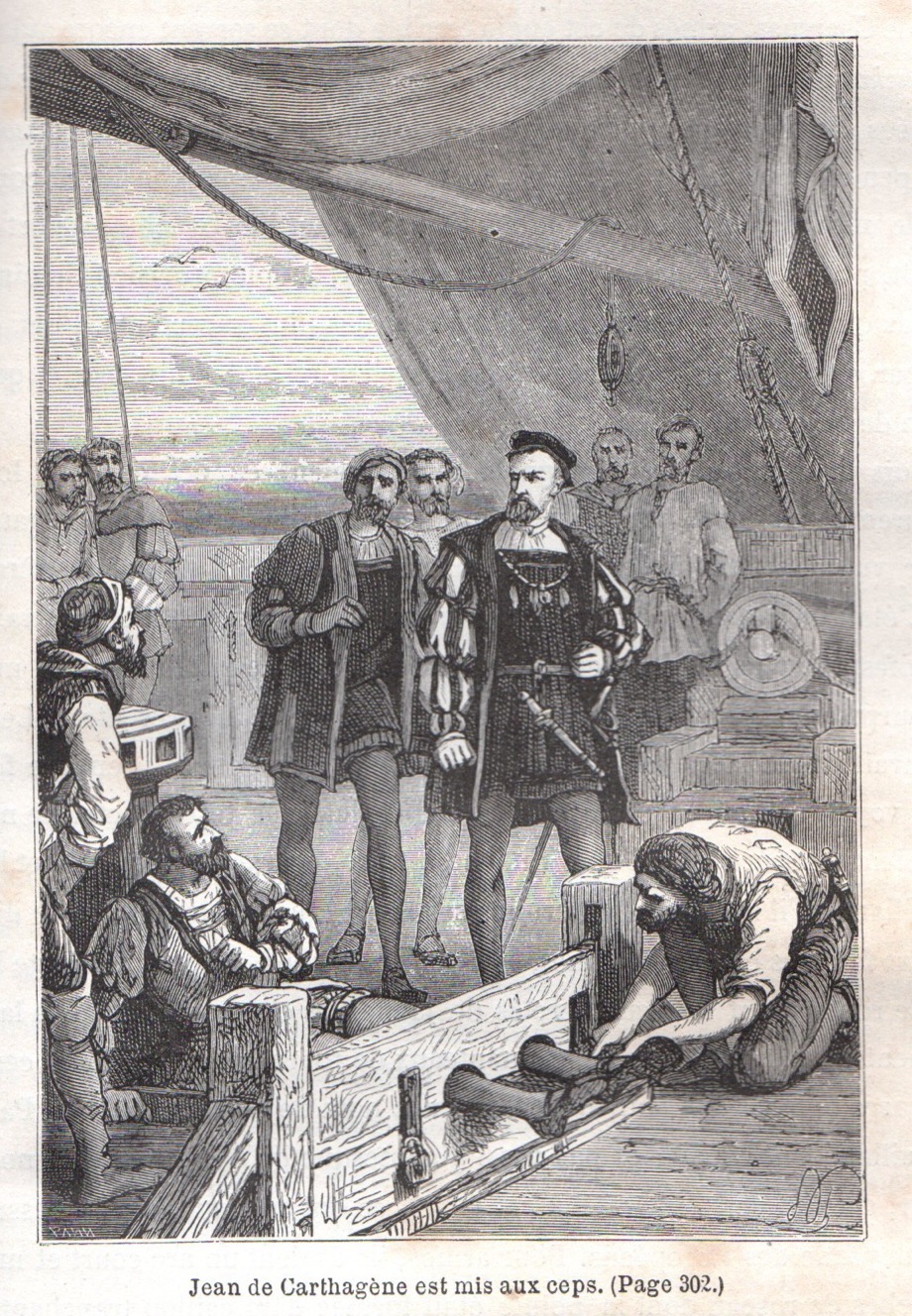
Demoted but not disposed of — his patron made that impossible — Cartagena spent the brutal Patagonian winter of 1520 under guard while the fleet wintered at Puerto San Julián on half rations, with no strait found and the crews close to starving. On Easter Sunday, 1 April 1520, he joined captains Gaspar de Quesada and Luis de Mendoza in seizing three of the five ships. Magellan crushed the mutiny with a decisive, almost surgical nerve that Cartagena's rule-bound temperament had no answer for: Mendoza was stabbed to death in a small-boat boarding, Quesada was beheaded and quartered, and the bodies were displayed to the rest of the fleet as a lesson.
Cartagena could not simply be executed alongside them — Fonseca's shadow still covered him — so Magellan chose a legal maneuver that produced the same result more slowly. In August 1520, as the fleet made ready to sail on, he was put ashore at San Julián with a mutinous priest, Pedro Sánchez de la Reina, and a small ration of ship's biscuit and wine. Neither man was ever seen again; a later Spanish expedition that searched the coast found no trace of either. The mutiny is conventionally told as treachery against a visionary commander. Read without that frame, it was a chartered royal officer, holding an explicit commission to oversee the voyage, attempting to remove a foreign captain who had concealed his route, wintered his crews into starvation, and refused to answer to the authority the king had placed over him. Magellan proved right about the strait a few weeks later — but Cartagena had no way of knowing that in April, and being vindicated afterward was not a defense Magellan offered at the time.
Connected Figures
Further Reading
- The First Voyage Around the World, 1519–1522 — Antonio Pigafetta (trans. Theodore J. Cachey Jr.)The primary eyewitness account — read critically, since Pigafetta's sympathies lie entirely with Magellan.
- Over the Edge of the World — Laurence BergreenA narrative account of the circumnavigation, including the San Julián mutiny and marooning.
- Straits: Beyond the Myth of Magellan — Felipe Fernández-ArmestoThe most sympathetic modern reading of the mutineers' case against Magellan's command.
- Magellan — Tim JoynerA detailed operational history of the voyage and its command struggles.
- The European Discovery of America: The Southern Voyages — Samuel Eliot MorisonSituates the mutiny within the broader navigational and political history of the expedition.
