 Historical Figure MBTI
#736 · 6-2-26 · The Portuguese Indian Ocean
Vasco da Gama
Navigator · Viceroy of India · The Cape Route
c. 1460s — 1524
8 min read
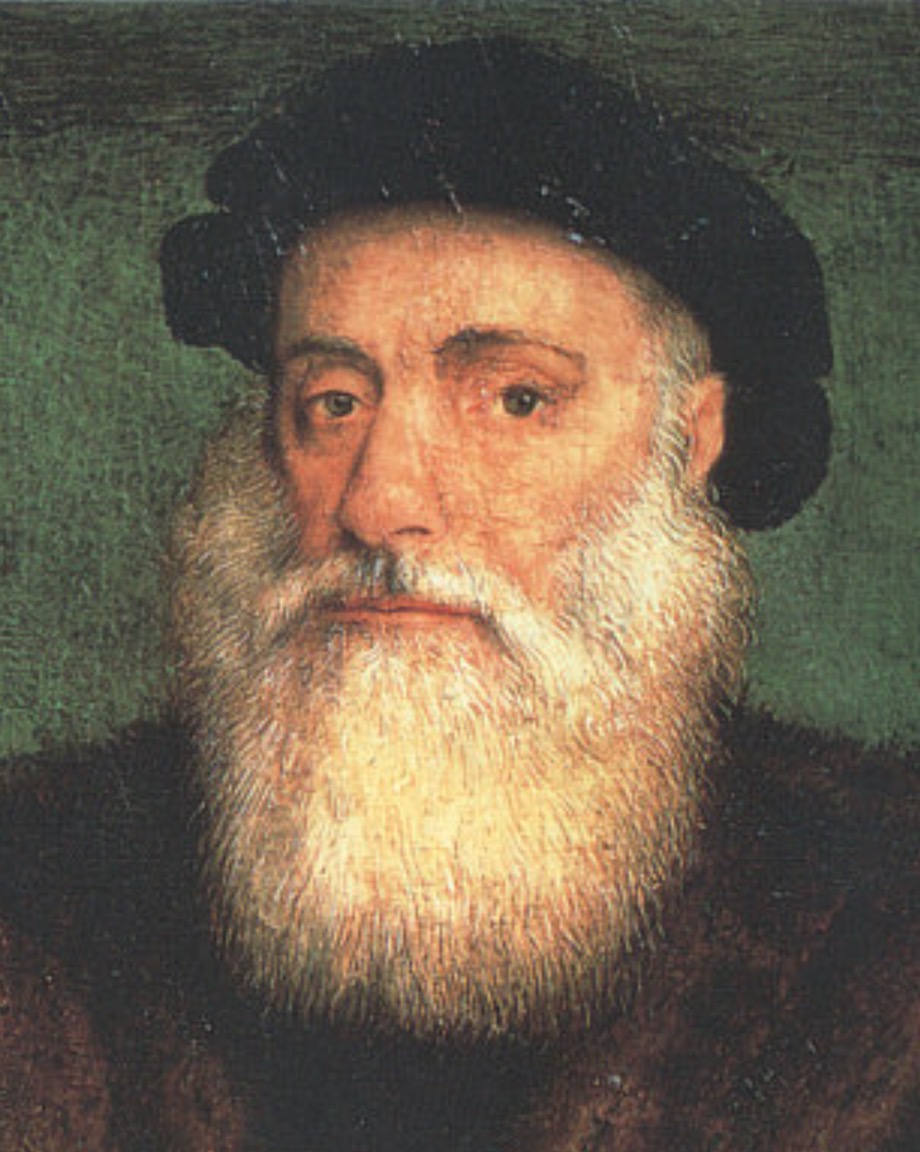
Portrait of Vasco da Gama
The Man Who Took His Orders Literally
He was not the best sailor Portugal had, nor the best diplomat, nor the most senior captain available in 1497. He was chosen anyway, over men with longer service and better connections, and the chroniclers who tried afterwards to explain why could only circle the same quality: he would do exactly what he was told, for as long as it took, and nothing would move him off it. Every previous commander sent down the African coast had come back early with a reason. Vasco da Gama went out for two years and three months and came back having done the thing itself.
What he opened was not a trade route in the sense the word usually carries. The Indian Ocean already had one — among the oldest commercial systems on earth, moving Gujarati cotton and Malabar pepper between a dozen polities that had worked out, over centuries, how to shift enormous value across open water without navies. Gama arrived with four ships, a bundle of Atlantic barter goods and a royal instruction; when the system declined to reorganise itself around the instruction, he went home, came back with a war fleet, and enforced it. The Estado da Índia — the first armed maritime empire — begins in that gap.
The archive holds better strategists and far better sailors. It holds nobody who so completely resembles an instrument. Gama did not improvise, did not revise, did not appear to reconsider anything between 1497 and his death at Cochin on Christmas Eve 1524 — which is why he succeeded where imaginative men failed, and why what he did in the Indian Ocean is among the ugliest records here.
Vasco da Gama is an ISTJ: dominant Introverted Sensing, the navigator of stored precedent, who carried eighty years of Portuguese sailing knowledge in his head, executed it without deviation, and then treated a royal letter as a standing order the entire ocean was obliged to obey.
The Volta do Mar — Si as Inherited Memory
The most impressive thing Gama ever did happened before he saw India, and it consisted almost entirely of not deviating. Leaving Cape Verde in August 1497 he turned away from the African coast and swung out into the empty South Atlantic — a wide arc west and south, out of sight of land for ninety-odd days, before catching the westerlies that carried him back east onto the Cape. The volta do mar was not his invention. It was the distilled residue of eight decades of Portuguese voyaging, the wind knowledge accumulated since Henry the Navigator’s captains first learned that the way home from Guinea ran through the open ocean rather than along the shore. What Gama supplied was the nerve to trust the stored pattern for three months with no confirming evidence whatsoever.
That is dominant Introverted Sensing in its most literal operation: remembered, verified detail trusted further than the present moment’s temptation to correct course. Every instinct on those ships said turn east, find the coast, take a bearing. Gama held the arc — Dias and Cão before him had touched land and turned home for reasons that were always sound — and raised Africa some hundred leagues short of the Cape. The achievement belongs less to genius than to fidelity.
The same faculty ran through the voyage as procedure: discipline intact through Mossel Bay and the hostile anchorage at Mombasa, into the alliance at Malindi, where a local pilot — heir to a navigational tradition far older than his own, and not, despite four centuries of romantic assertion, Ahmad ibn Majid — took him across to Calicut in twenty-three days. He raised a padrão at each landfall because the instruction said to. He kept the log, and he kept the register of grievances; five years later he came back with the account of 1498 itemised, and settled it.
Command by Compliance — Te Without a Court
Gama’s method of dealing with other people was a machine with two settings. Terms were offered; terms were accepted, or terms were imposed. There is no surviving instance of him negotiating in the ordinary sense — no concession traded, no face saved. When the ruler of Mozambique turned hostile he shelled the town on his way out; when he needed a pilot he took hostages first and made the request second. Hostage-taking was his default administrative instrument across both voyages, a mechanism for converting an uncertain human relationship into a compliance you could measure.
The second voyage of 1502 is that logic at full scale. He came back with roughly twenty ships and a mandate to make the Malabar coast accept the terms it had refused, and opened by demanding that the Zamorin expel every Muslim merchant from Calicut — a condition so impossible it can only be read as a formality preceding punishment. He bombarded the city. He seized fishing boats and merchant crews, hanged and dismembered the captives, and sent the severed hands, ears and noses ashore with a note advising the Zamorin to make curry of them. He then extracted treaties from Cochin and Cannanore, whose rulers had watched, and left a patrol squadron under his uncle Vicente Sodré to license shipping that had moved freely for a thousand years. Every step follows mechanically from the one before. None of it required imagination, and none of it was done in anger.
But notice what auxiliary Te does not build. Gama systematised violence and nothing else: no institution, no strategic memorandum, no faction, no school of officers. The cartaz pass system, the fortress chain, the doctrine of holding the chokepoints — all of that is Afonso de Albuquerque, a man who thought about the ocean as a shape to be reorganised; Gama thought about it as a list of instructions to be enforced. Sent out as Viceroy in 1524 to purge the corruption that had grown up in Portuguese India, he stripped officials of salaries and perquisites, cancelled abuses and began punishing — auditing rather than governing — then died within three months, leaving no structure and no successor he had trained.
The Mîrî — Fi as a Ledger of Grievance
In late September 1502, off Cannanore, Gama’s fleet intercepted the Mîrî, a large Calicut ship returning from Mecca with several hundred people aboard: merchants, their wives, their children, pilgrims coming home from the hajj. He stripped it of cargo, refused an enormous ransom, refused the offer to load his ships with spices, refused — according to Thomé Lopes, who served in the fleet and was sickened by what he saw — to spare even the children the women held up over the rail. He had the ship fired. The passengers put it out and fought the boarders with tiles and bare hands; the burning took the better part of a week before the Mîrî went down with almost everyone aboard. Twenty or so children were taken off to be baptised.
This is where a type profile reaches for euphemism, and it should not. The Mîrî was not a battle, not a panic, not a subordinate exceeding orders, and nothing in the strategic situation demanded it — it was a decision held in place across several days by a man under no threat who declined every chance to stop.
Tertiary Introverted Feeling is the most dangerous part of this stack because it does not look like feeling at all. It is a sealed internal register of honour, insult and debt, immune to counter-argument because it was never argued into existence. Gama had been humiliated at Calicut in 1498 — his gifts mocked, his person detained, his sovereign’s dignity, as he saw it, spat upon. He had lost his brother Paulo on the return. Portuguese men had been killed at the factory in 1500. Every item sat in the ledger for four years. Fi does not forget and does not compromise; when it acts, it acts with the totality of something that believes itself simply, morally correct. Gaspar Correia — writing decades later, and not always reliable — adds that a Brahmin envoy suing for peace was mutilated before being sent back to his master. Nothing suggests Gama ever considered himself to have done wrong.
Hats, Honey and Wash-Basins — Ne as a Missing Sense
In May 1498, admitted to the Zamorin of Calicut — sovereign of the richest pepper port on earth, whose harbour took in gold, silk and Chinese porcelain — Gama presented his gifts. The eyewitness journal attributed to Álvaro Velho lists them: twelve pieces of striped cloth, four scarlet hoods, six hats, four strings of coral, a case of sugar, two casks of oil, two of honey, and some wash-basins. The Zamorin’s factor laughed and said the poorest merchant from Mecca gave more; not even a gold trinket had been offered. Gama insisted he was an ambassador, not a trader. The audience curdled, he was effectively detained within days, and he left with nothing but a cargo of samples and a grudge.
This is inferior Extraverted Intuition in its plainest form: not stupidity, but the absence of any faculty for reading an unfamiliar situation as it is rather than as the stored template predicts. The goods in his hold were the goods that worked in Guinea and Benin, because Guinea and Benin were what eighty years of Portuguese experience contained. The same blindness produced the voyage’s other famous error: taken into a Hindu temple, the Portuguese prayed there, read the deities as saints and one figure as the Virgin, and concluded that the Malabar Hindus were lapsed Christians of a strange variety. Their categories admitted Christians and Moors, so what they found had to be one of the two.
Inferior functions erupt rather than develop, and Gama’s did. Unable to imagine an alternative arrangement, he reached for the only other thing the stack contained — force applied until the world matched the plan. Between 1498 and 1502 nothing in his understanding of the Indian Ocean appears to have grown; only the armament did. The catastrophic return crossing of 1498, begun against the monsoon and against local advice because the schedule said sail, cost three months at sea, between a third and half the men to scurvy, and his brother Paulo, dead at Terceira within sight of home. He had entered an ocean whose winds ran on a calendar every mariner on that coast knew by heart, and had not thought to ask.
Why ISTJ Over ESTJ
Why not ESTJ?
The Te case is genuinely strong — bombardment, tariffs, hostages, forced treaties, a viceroyalty spent auditing and punishing. But dominant Te leads by building external order and visible authority, and Gama built neither: no institution, no faction, no successors, no doctrine. He was silent, personally friendless, feared rather than followed, and vanished from public life for two decades between his second voyage and his 1524 appointment. His power was never constructed — it was delegated, arriving by royal warrant and lapsing when the warrant did. Si-lead explains the literalism and the four-year grudge; Te-auxiliary explains the enforcement without the empire-building a Te-dominant would have found irresistible.
The distinction is the difference between Gama and the man who completed his work. Albuquerque was political and endlessly persuasive; Gama never explains himself in the surviving record. He receives an instruction and returns a result, and between the two points there is nothing an observer can get hold of. Subrahmanyam, working from the documents, found a man far more grasping than the legend, pursuing his own titles, pensions and the lordship of Sines for a quarter-century with the same patient literalism he brought to the volta do mar. That is a person whose register of what is owed, once written, is never revised — which made him unstoppable across an unknown ocean, and capable of the Mîrî.
Connected Figures
Further Reading
- The Career and Legend of Vasco da Gama (1997) — Sanjay SubrahmanyamThe essential critical biography — separates the documented captain from four centuries of accumulated myth.
- A Journal of the First Voyage of Vasco da Gama (roteiro, c. 1500) — attrib. Álvaro VelhoThe anonymous eyewitness account of 1497–99, including the inventory of the gifts refused at Calicut.
- Conquerors: How Portugal Forged the First Global Empire (2015) — Roger CrowleyNarrative history of the Estado da Índia; unsparing on the Mîrî and the bombardment of Calicut.
- Trade and Civilisation in the Indian Ocean (1985) — K. N. ChaudhuriThe commercial world Gama sailed into, described on its own terms rather than Europe's.
- The Portuguese in India (1987) — M. N. PearsonHow a small maritime power imposed a licensing regime on an ocean it could not otherwise control.
- Os Lusíadas (1572) — Luís de CamõesThe epic that made Gama a national hero — the source of the version the documents contradict.
