 Historical Figure MBTI
#740 · 6-3-26 · The Portuguese Indian Ocean
Pedro Álvares Cabral
Commander of the Second India Armada · Landfall in Brazil
c. 1467 — c. 1520
6 min read
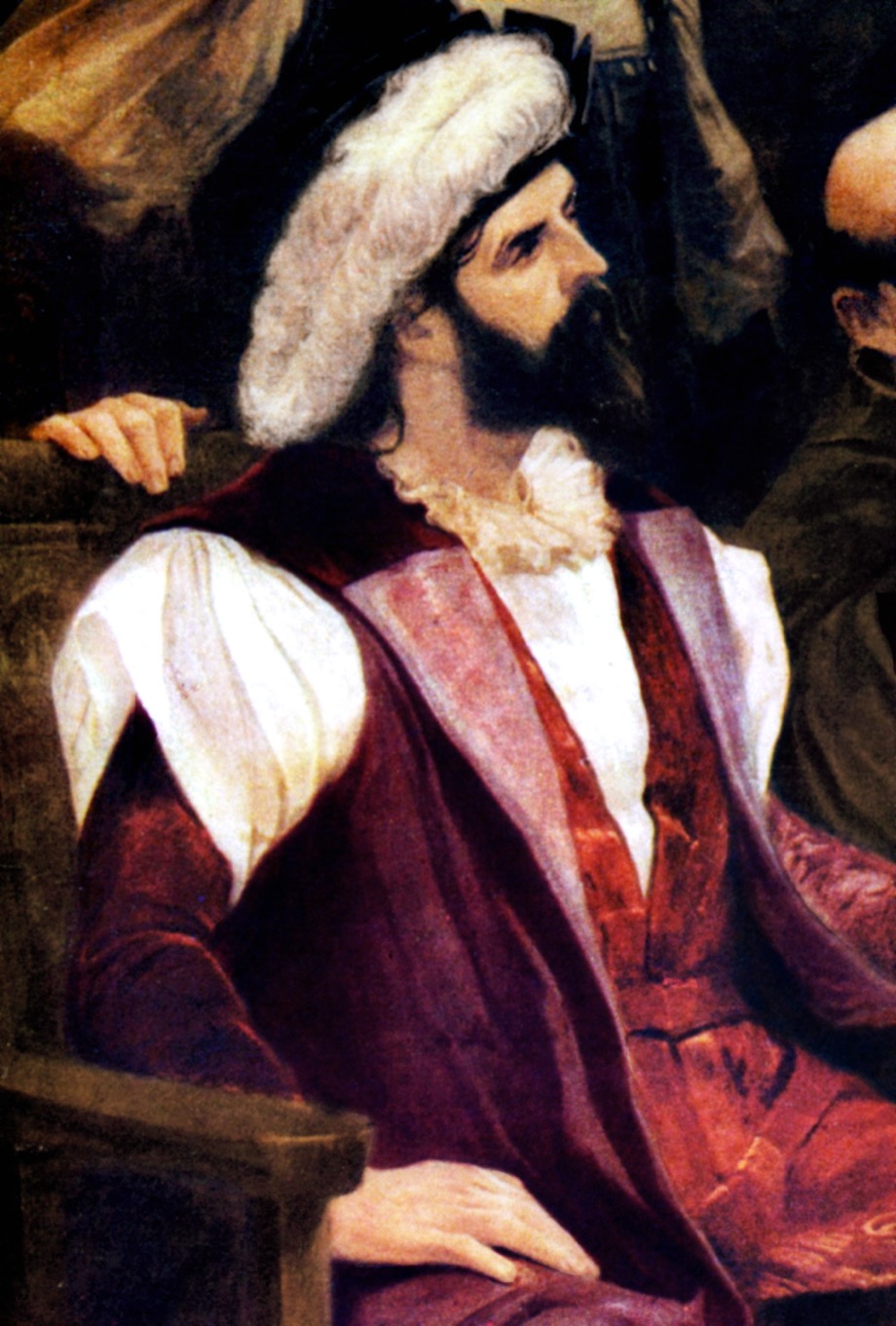
Portrait of Pedro Álvares Cabral
The Man Who Did Everything Asked of Him
In March 1500, Portugal handed a man with no prior command at sea the largest fleet it had ever assembled — thirteen ships, some twelve hundred men, written instructions for the second voyage to India. Pedro Álvares Cabral, minor Beira nobility from Belmonte, was chosen not for brilliance but for reliability: a fidalgo of the household, trusted, unlikely to improvise. He came home sixteen months later with four ships, a cargo that repaid the enterprise several times over, a new coastline on the crown's books, and a reputation that has never settled into greatness or failure.
Almost everything memorable about the voyage happened to him rather than because of him. The Brazilian landfall of 22 April 1500 was very probably the taught Atlantic swing — the volta do mar — carried a little wide, and his response to sighting Monte Pascoal reads like a checklist: water and wood, a cross, a name — the Island of the True Cross — and one ship detached to carry the news home. Then the Cape, and a storm that destroyed four ships in a day, among them the one carrying Bartolomeu Dias, who had first rounded that headland and now drowned off it. Then India, where a factory was massacred and Cabral answered with fire. He did every part of the largest job of his generation adequately, and no part of it with relish.
Cabral is the ISFJ at the helm of an empire — introverted sensing given the largest set of standing orders in Europe, and executing them exactly, including the parts that ended in fire.
Si — The Route as Given
Cabral's instructions were the accumulated memory of a decade of Portuguese seamanship — da Gama's outbound track, the seasonal timing, the diplomatic script for Calicut — and he treated them as scripture, following all of it more thoroughly than anyone yet had. That is the signature of dominant introverted sensing: not rigidity, but a settled confidence that the proven way is proven for reasons, and that stored precedent outranks a fresh idea.
The Brazilian landfall is the clearest case. The romantic version has him blown off course, or steering west on secret orders to test the Tordesillas line; the likelier version — the one his own behaviour supports — is that he sailed the taught arc wide, found land where nobody expected it, and did nothing adventurous with it. Ten days ashore, no probe inland, no survey; he filed the discovery into the existing system and sailed on. A man with a nose for the new does not leave a continent after ten days — but he does carry Pero Vaz de Caminha as scribe and let him write at length, and the resulting letter to Manuel I is the most patient document of first contact in Atlantic literature. That the commander's gift to world history should be a meticulous inventory is entirely in character.
Fe — Reading the Room He Was Standing In
What separates Cabral from da Gama is not gentleness — he was capable of terrible things — but attention. On the Brazilian shore he behaved with a restraint that was not the Portuguese norm: no captives seized, no display of arms beyond the ceremonial, an evident effort to work out what the people in front of him wanted. For interpreters he left two degredados — convicts — ashore to live among the Tupinambá and learn the language: a callous use of expendable men, and a recognition that the relationship would have to be built rather than taken.
At Calicut the same auxiliary shows in the pace. He negotiated with the Zamorin for roughly three months before anything broke, absorbing delay after delay from a court with every reason to stall. Da Gama's method was to state terms and let non-compliance be the other party's problem; Cabral's was to keep the conversation alive — which is why it lasted as long as it did, and why its collapse came as genuine shock. He handled his own captains the same way: fractious men of rank with their own patrons, and rather than simply ordering the retaliation he convened them and put it to conference. That is not the reflex of someone who believes authority is self-executing, but of someone who feels the temperature of a room as data.
Ti — The Cold Arithmetic After the Factory Burned
In December 1500 a mob — with, the Portuguese believed, the connivance of Calicut's Muslim merchant community and the tacit permission of the Zamorin — stormed the new factory and killed some fifty Portuguese, Caminha among them. Cabral's response was not rage but procedure of a colder kind. He seized ten Muslim merchant vessels in the roadstead, took their cargoes, killed or burned the crews aboard them, and bombarded the city for a full day. He burned men in their own harbour to make a point about contract enforcement — one of the founding atrocities of European empire in Asia.
What the tertiary function contributes is the shape of what came next. Having destroyed his position at Calicut, Cabral worked the map instead — south to Cochin, whose raja resented the Zamorin's primacy, then Cannanore on the same logic. In one season he converted a monopoly port he could not have into two rival ports that needed him, laying the architecture of the Portuguese pepper trade: the wedge that Afonso de Albuquerque would later drive all the way to Malacca and Hormuz.
Tertiary Ti surfaces exactly here: not as a habit of analysis but as a capacity, activated under pressure, to coldly re-derive what still works — and it arrives with none of the feeling that governed the three months before it.
Ne — No Appetite for the Unforeseen
Every improvisation on the voyage was forced on him — the storm off the Cape, the massacre at the factory, the need to find another supplier before the monsoon turned. He met each adequately and none of them eagerly; he never generated a possibility, he processed one. Set beside Columbus, who could not stop theorising about what a coastline might mean, the contrast is almost comic: Cabral touched an unknown continent and reported the weather.
The inferior function explains the ending. Manuel I named him to lead the 1502 armada, then gave the command to da Gama — the sources disagree on whether this followed a quarrel over precedence with Vicente Sodré, da Gama's kinsman, or simply a change of royal mind. Either way, Cabral's answer was total: no litigation, no faction, no petition. He left royal service altogether and spent his last two decades near Santarém, dying around 1520 in a silence so complete that his burial place was forgotten for three centuries. That is not the exit of a man with alternatives in his head. It is the exit of someone whose sense of himself was bound to one role in one institution, and who, when it was withdrawn, could not imagine a second version of his life.
Why ISFJ Over ISTJ
Why not ISTJ?
The two types share Si-dominance, and this cluster already holds the archive's exemplary maritime ISTJ: Vasco da Gama, who sailed the same route on the same instructions to the same port. The difference is entirely in the auxiliary. Da Gama enforced by Te — terms imposed, hostages taken as leverage, near-total indifference to how the room felt about it. Cabral read the room: three months of negotiation at Calicut, a working relationship with the raja of Cochin that outlasted his own career, a decision to retaliate put to conference rather than issued. And displaced from the 1502 command he answered with wounded withdrawal rather than the grievance-and-leverage campaign a Te auxiliary produces — an Fe injury, not a Te one.
The comparison isolates what people mean when they call Cabral the lesser man. He was not less capable than da Gama — his voyage was more profitable and more consequential. He was less willing. Te wants the outcome and will spend goodwill to get it; Fe reaches for force only once the relationship is already dead, which is exactly the sequence at Calicut and exactly why the violence there had the character of a system failing rather than a policy succeeding. Cabral was proportionate-minded inside a machine that made proportion impossible.
Connected Figures
Further Reading
- The Voyage of Pedro Álvares Cabral to Brazil and India — William Brooks Greenlee (ed.), Hakluyt Society, 1938The core documents in English translation — the anonymous narratives, the letters, the fleet lists. Everything else about Cabral begins here.
- Carta a El-Rei D. Manuel — Pero Vaz de Caminha, 1500The scribe's letter from Porto Seguro: ten days of first contact recorded with an attentiveness no other European landfall received.
- Conquerors: How Portugal Forged the First Global Empire — Roger Crowley, 2015Narrative history of the Indian Ocean armadas; unflinching about the violence at Calicut and its place in Portuguese strategy.
- The Portuguese Empire in Asia, 1500–1700: A Political and Economic History — Sanjay Subrahmanyam, 1993The corrective to European-centred accounts — reads the Malabar coast as a functioning political world Portugal blundered into.
- Foundations of the Portuguese Empire, 1415–1580 — Bailey W. Diffie & George D. Winius, 1977The standard institutional survey; best on why the crown chose commanders like Cabral and how the factory system was meant to work.
