 Historical Figure MBTI
#742 · 6-3-26 · The Portuguese Indian Ocean
Duarte Pacheco Pereira
Captain · Defender of Cochin · Cosmographer
c. 1460 — 1533
6 min read
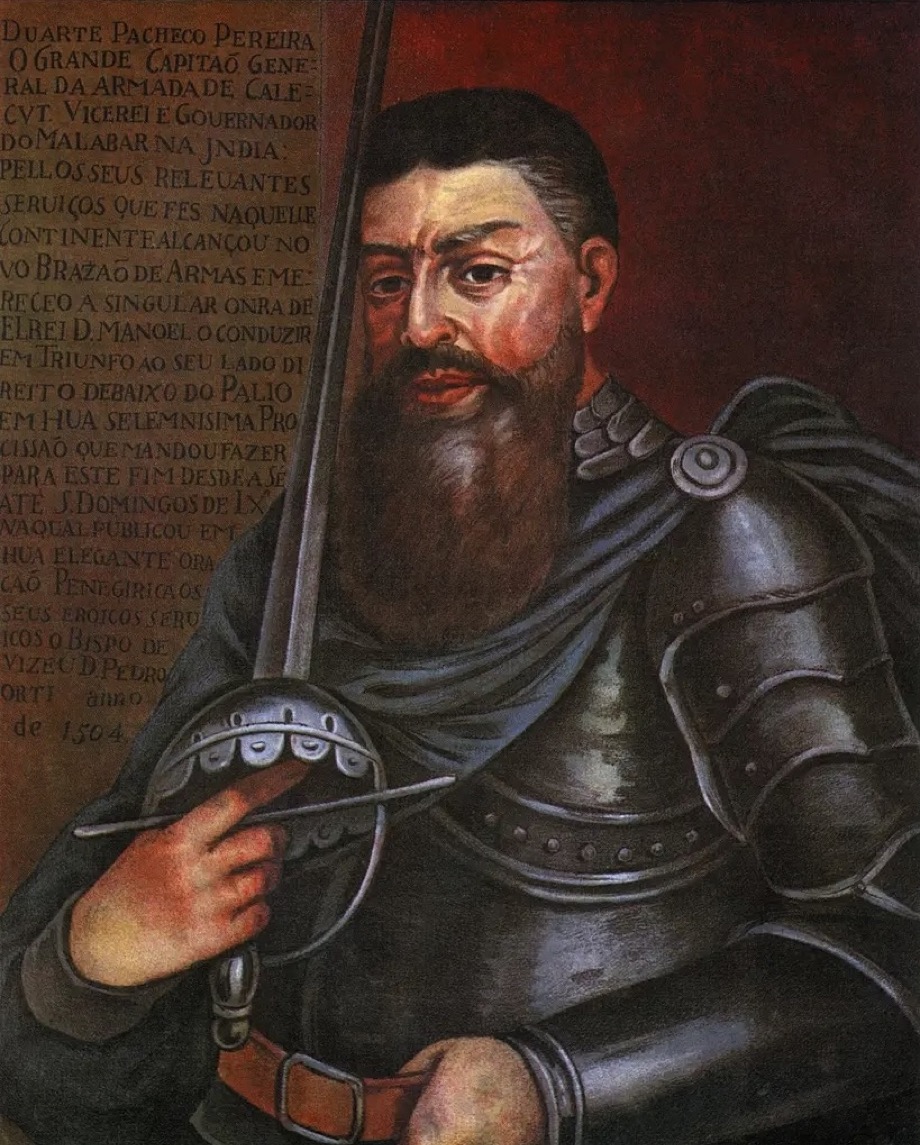
Portrait of Duarte Pacheco Pereira
The Man Who Held the Fords
In the spring of 1503, Vasco da Gama sailed home from India and left roughly a hundred and fifty Portuguese soldiers, a scatter of Malabar allies, and a handful of small ships at Cochin under the command of Duarte Pacheco Pereira. What he left them to face was the army of the Zamorin of Calicut, coming to erase the Portuguese foothold before it could take root. By the time the campaign ended, five months later, that army had been broken at a set of tidal channels no one else had thought to defend the way Pacheco defended them — at odds that later chroniclers, never agreeing with each other, put anywhere between twenty and fifty to one.
He arrived at that command already formed by two decades of exacting, unglamorous work: early Atlantic voyages, a shipwreck off Príncipe, a seat as technical adviser at the negotiations that drew the Tordesillas line, a berth on Pedro Álvares Cabral's 1500 armada, blown far enough west to sight Brazil. He later claimed, in a passage of his own writing that historians have never settled, to have reached that same coast in 1498 — two years before Cabral. The claim is disputed and unproven; what is not in dispute is the kind of mind that spent those years doing math with tides and coastlines until the answers came out right.
That mind was an ISTP's: a solver first, a soldier second, and — as the rest of his life would prove — nothing like a courtier at all.
Pacheco held Cochin the way an ISTP solves anything — not by doctrine or reinforcement, but by working the actual problem in front of him, with Ti, until it broke.
The Geometry of the Problem
Every account of the siege of Cochin describes the same insight, arrived at before a single arrow flew: the Zamorin's army, however large, could only reach the Portuguese positions by a handful of fords and channels, and those channels changed depth and current with the tide. Pacheco did not count spears. He worked out geometry — which crossings were passable at which hour, where a few dozen men could hold a point that ten thousand could not force — and built his defense around that calculation rather than the raw disparity of numbers. It was the same operation he performed with an ocean: reduce an unmanageable problem to the variables that actually determine it, and solve for those.
He wrote the operation down. The Esmeraldo de Situ Orbis, composed around 1505–08 and dedicated to Manuel I, is a navigational and cosmographical treatise — latitudes, tides, coastlines, sailing conditions along the African and Atlantic routes, recorded with the flat, functional precision of a man who expected other pilots to use it rather than admire it. It was not printed in his lifetime; it sat unpublished until 1892. That fact alone says something about the kind of achievement it was: not a bid for glory, which he could easily have made of it, but a private accounting of how the world actually worked, finished and set aside because the accounting itself was the point.
Where the chroniclers around him reached for providence and precedent, Pacheco's own writing reaches for soundings and observed currents. He reasoned from what he had measured, not from what he had been told — the thread running from treatise to tide table to the fords of Cochin without a seam.
Reading the Tide
Calculation only became a battle won because Pacheco could act on it in real time. Through the spring and summer of 1504 he moved his handful of ships and men from crossing to crossing as the Zamorin's forces probed for a way in, positioning them where the water itself, at that hour, made an attacker's numbers useless. He fought at the fords personally, repeatedly, adjusting to terrain and tide assault by assault rather than settling into one fortified line and waiting. It was improvisation under fire, sustained for months, against an enemy that could afford to fail a hundred times and only had to succeed once.
This was not siegecraft by the book; no book covered a hundred and fifty men holding a coastline against a regional power. Pacheco read the ground and the current the way a Se-dominant sense of the moment reads a room, and trusted that reading over any plan drawn up in advance.
When he returned to Lisbon in 1505, Manuel I received him as the man who had saved the entire Indian enterprise — and for a few years, that was exactly how Portugal remembered him.
Why ISTP Over ISTJ
Why not ISTJ?
An ISTJ holds a position by procedure — fortify, garrison, endure, and repeat what has worked before. Pacheco did none of that at Cochin: he re-derived the problem from the ground up, exploited a tidal window that shifted every day, and kept moving his men rather than digging in. The Esmeraldo reasons the same way, from direct observation of currents and coastlines rather than from compiled precedent or received authority. That is Ti and Se improvising against a live problem, not Si and Te executing a known one.
The distinction shaped his whole career. Pacheco was later handed something his type was never suited to — a colonial administration at Elmina, in 1519, that required the patient, faction-aware management he had never needed at the fords, and that his dominant Ti had no interest in faking.
Connected Figures
Further Reading
- Esmeraldo de Situ Orbis — Duarte Pacheco Pereira (c. 1505–08; trans. George H. T. Kimble, Hakluyt Society, 1937)Pacheco's own navigational and cosmographical treatise — the primary window into how he reasoned.
- Foundations of the Portuguese Empire, 1415–1580 — Bailey W. Diffie & George D. Winius (1977)The standard account of the imperial machinery Pacheco served and was later broken by.
- Conquerors: How Portugal Forged the First Global Empire — Roger Crowley (2015)A narrative history covering the Cochin siege and Pacheco's downfall at Elmina.
- The Portuguese Empire in Asia, 1500–1700 — Sanjay Subrahmanyam (1993)Places the Cochin campaign within the wider, contested politics of Portuguese India.
- Os Lusíadas — Luís de Camões (1572), Canto XThe epic that memorialized Pacheco and lamented his neglect by the country he saved.
