 Historical Figure MBTI
#741 · 6-3-26 · The Portuguese Indian Ocean
Pero Vaz de Caminha
Scribe · Author of the Letter on Brazil
c. 1450 — 1500
4 min read
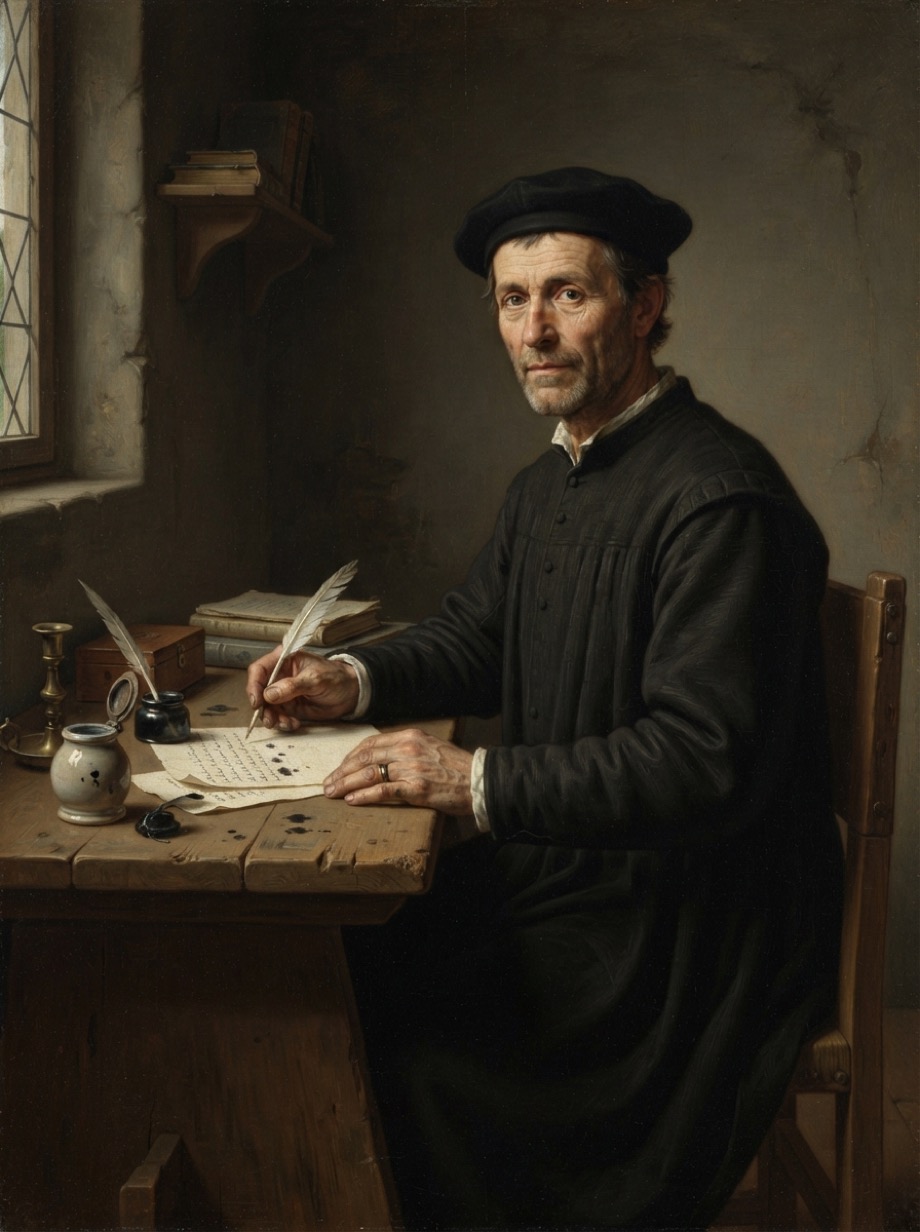
AI-assisted Portrait of Pero Vaz de Caminha
A Clerk Who Happened to Look
Pero Vaz de Caminha was aboard Pedro Álvares Cabral's fleet for one reason: he had been named scribe of the trading post the Portuguese meant to plant at Calicut, and a scribe was needed for the voyage there and back. He was not a chronicler, not a courtier, not a man of letters. He was a former master of the mint at Porto, a minor royal functionary with a pardon to beg for his exiled son-in-law, sailing east to do paperwork. Nothing about his post required him to notice anything at all.
On 22 April 1500, storms and ocean currents pushed the fleet far enough west to raise an unknown coast — the land that would become Brazil. Cabral anchored, sent men ashore, and spent nine days in wary, curious contact with the Tupinambá people before pressing on toward India. On 1 May, from Porto Seguro, Caminha sat down and wrote his king, Manuel I, a letter meant to accompany the fleet's official report home. It was not an official report. It was something stranger: an unhurried, undefended account of what he had actually seen, written by a man with no evident ambition to be remembered.
Caminha was an ISFP: a temperament built for exactly this — witness without agenda, sensation kept faithful to itself.
He is our best account of the Tupinambá on first contact because he was constitutionally incapable of writing a dull one. He notices the ornaments in their lips and ears, the paint on their skin, the frank curiosity with which they handled Portuguese cloth and found it strange. He records a man who fell asleep on deck among strangers, at ease in a way that startled the Portuguese. He notices that the visitors would not eat Portuguese food. He is candid, more than once, that he does not understand what he is looking at — and he says so instead of inventing an explanation. That refusal to fake certainty, that fidelity to the thing seen over the story that would flatter him, is the whole of his psychology on the page.
Psychological Verdict
Caminha reads as an ISFP because the letter is built entirely from immediate, ungeneralized sense-impression, filtered through a quiet private conscience rather than any official line to defend. His dominant Fi shows in the letter's tone — gentle, personal, uninterested in flattering the crown beyond what duty and self-interest required, closing with a plea for his son-in-law that no bureaucrat writing for the record would risk. His auxiliary Se is the letter's real engine: the bodies, the ornaments, the gestures, the texture of nine days rendered with a painter's patience rather than an administrator's summary. What is almost entirely absent is Te — Caminha draws no policy conclusions, proposes no strategy, offers the crown almost nothing usable except the single, damning aside that the greatest profit of this land would be the saving of its people's souls, a line later generations would read as the first sentence of a colonial project he did not live to see and could not have intended in its fullest, ugliest sense. He watched; he recorded; he did not build an argument. That is not a flaw in the document. It is the reason it survived as literature rather than as a memo.
The letter is gentle, and its gentleness is precisely what should unsettle a modern reader. It describes a first encounter with real tenderness and no recorded violence, and it is nonetheless the founding document of a colonization that would devastate the people it so carefully observed — including his flat, oft-quoted appraisal of the young women he watched go naked, “sua vergonha tão graciosa,” a line Brazilian readers have argued over for two centuries as the first note of a colonizer's gaze. Caminha did not choose that legacy. He wrote what he saw, sealed the letter, and sailed on toward Calicut, where he was killed within the year — a witness who never learned what his witnessing would become.
Connected Figures
Further Reading
- Carta a El-Rei D. Manuel sobre o Achamento do Brasil — Pero Vaz de Caminha (1500)The letter itself — the founding text of Brazilian literature.
- The Voyage of Pedro Álvares Cabral to Brazil and India — William Brooks Greenlee, ed. (Hakluyt Society, 1938)Includes a full English translation of Caminha's letter with source commentary.
- A Concise History of Brazil — Boris Fausto (1999)Places the letter's rediscovery in 1817 within Brazil's own nation-building.
- Foundations of the Portuguese Empire, 1415–1580 — Bailey W. Diffie & George D. Winius (1977)The wider context of Cabral's voyage and the Calicut factory Caminha died defending.
