 Historical Figure MBTI
#737 · 6-2-26 · The Portuguese Indian Ocean
The Zamorin of Calicut
Ruler of Calicut · Lord of the Spice Coast
r. c. 1495 — c. 1510
5 min read
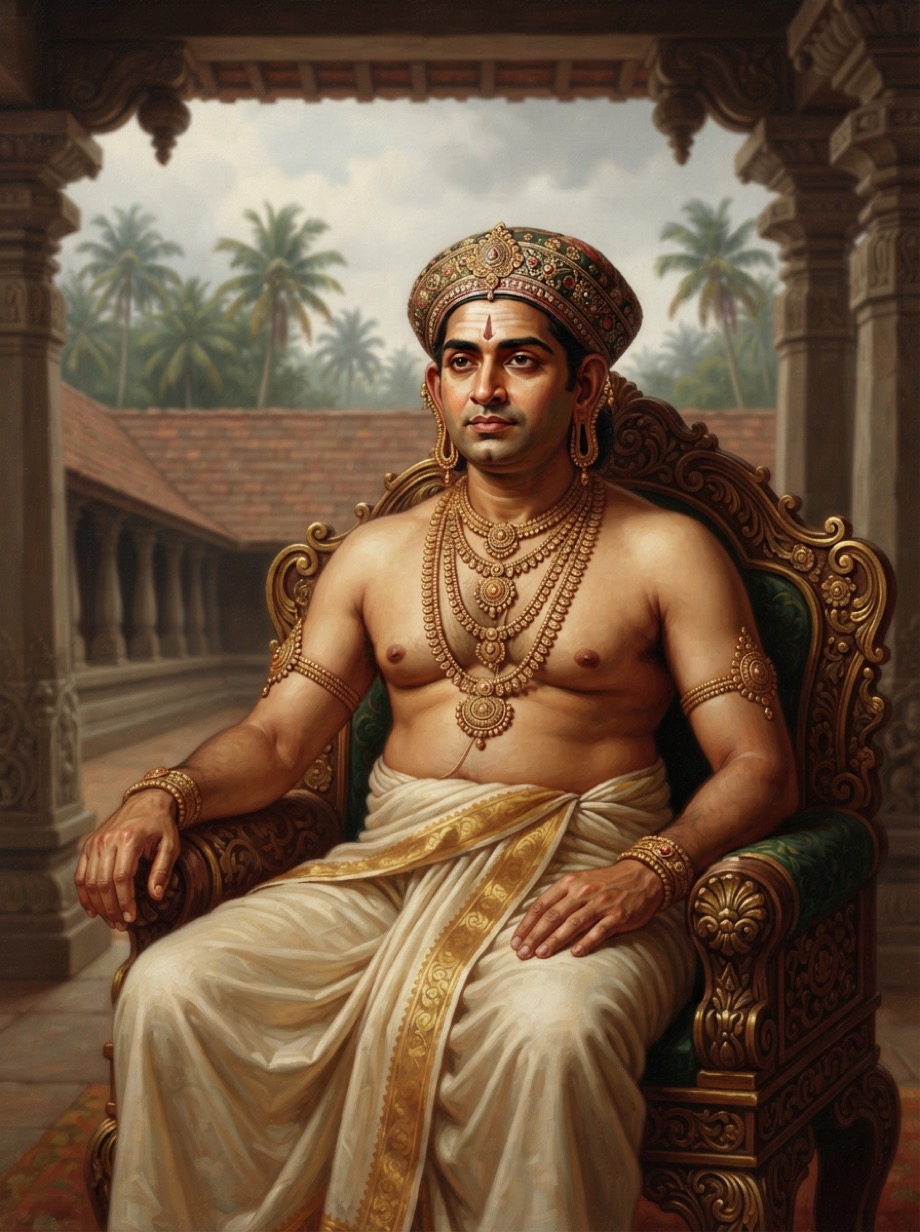
AI-assisted Portrait of The Zamorin of Calicut
The Office at the Mouth of the Pepper Trade
"The Zamorin of Calicut" is not a name. It is a title — Samudri Raja, "lord of the sea" — held in this period by a ruler of the Eradi lineage of Nediyiruppu, whose family had spent two centuries building the busiest spice market on earth. What follows profiles that office and the man who held it through the years that mattered most, 1498 to 1513, when Portuguese ships first anchored off Calicut and did not leave.
It has to be said plainly: almost everything we know of how this man spoke and decided comes from Portuguese chroniclers with a war to justify. Where the record is this one-sided, the honest move is to say so, not write around it. What survives even a hostile telling is institutional competence undone by a demand no institution built on precedent could grant. By every action attributed to him, the Zamorin governed like an ESTJ — a ruler who ran the richest free port on earth as a working system, and met his ruin through the very stability that had made Calicut great.
He taxed Gama because that is what you do to a foreign trader — he could not yet see that this one had not come to trade.
A Port Run Like a Machine
Calicut in 1498 was not a market town, it was an operating system. Arab, Gujarati, Chinese and Jewish merchants held warehouses side by side under one guarantee: trade here, obey the customs schedule, and the Zamorin's officers protect your goods and person regardless of flag or faith. Maintaining that guarantee — brokerage rules, weighing standards, tariff bands, dispute procedure — was the daily work of the office. This is Te governance in its purest form: authority as enforceable system, revenue as the measure of success.
It shows in how the Zamorin handled Gama. He did not receive the strange captain as an emissary of destiny; he processed him as a new arrival requiring assessment — audience, appraisal of goods, the customary tariff, same as any trader off any ship. When Gama's gifts turned out to be cloth, hats, sugar and washbasins — presents suited to a minor chief on the Guinea coast, not a court that moved thousand-ton pepper cargoes — the Zamorin's own merchants reportedly laughed aloud. The offense wasn't sentimental. It was a category error the system had no slot for.
The same logic drove the decades after: the Zamorin held Cochin and the lesser Malabar states as subordinates within a hierarchy he actively enforced, not merely inherited, going to war repeatedly to keep it intact once Portugal began courting Cochin as a rival port.
The Precedent That Could Not Imagine Its Own Ending
The free port had worked, unbroken, for generations. Every merchant community on the Malabar coast — the resident Mappila Arabs above all, who ran the Red Sea leg of the pepper trade — operated inside a system whose rules were, in effect, institutional memory. That stored repertoire, not innovation, was the Zamorin's real inheritance, and it is what a Si auxiliary supplies to a Te dominant: the accumulated precedent a ruler reasons from.
It is also what failed him. The Portuguese did not want a favorable tariff or a bigger warehouse. They wanted a monopoly — the exclusion of the Arab merchants who had traded Malabar pepper for centuries — enforced by arms if Calicut would not grant it by treaty. Nothing in the stored model of "how a trading partner behaves" contained that request, and by the precedent of every prior arrival at Calicut, it looked simply unreasonable. Calicut kept negotiating from a script the other side had already discarded.
What Surfaced Under the Bombardment
An inferior Fi in an ESTJ tends to stay submerged until the system itself is insulted — then surfaces as wounded, personal indignation. That is the register Portuguese sources describe after the gift audience, and the register of everything after 1502, when Gama returned, burned a ship of Mecca-bound pilgrims at sea, bombarded Calicut, and sent the Zamorin the severed hands, ears and noses of captured fishermen with a note attached.
What followed was not a ruler calculating odds: decades of war rather than submission, absorbing losses no cost-benefit accounting would have sustained. That refusal is the one place the record shows something other than administration — a personal line that would not be crossed.
Why ESTJ Over ISTJ
Why not ISTJ?
An ISTJ ruler puts precedent first and system second — a careful keeper of custom. The Zamorin instead actively ran and adapted a revenue machine, subordinated rival ports like Cochin under his own enforced hierarchy, and projected authority across the Malabar coast through repeated war. That is Te ordering the external world and drawing on Si for raw material, not Si governing with Te merely executing maintenance.
The failure was not one of imagination in general — he built and defended a complex, multi-ethnic economy for years. It was a failure at one unprecedented point: a partner who wanted not terms, but exclusivity. An ISTJ might never have built the machine that made Calicut worth conquering at all; an ESTJ built it, ran it, and could not conceive of the one demand it was never designed to survive.
Connected Figures
Further Reading
- Monsoon Islam: Trade and Faith on the Medieval Malabar Coast — Sebastian R. PrangeThe essential corrective to the Portuguese-eye view of Calicut and its rulers.
- The Career and Legend of Vasco da Gama — Sanjay SubrahmanyamThe definitive account of the 1498 contact and the Portuguese sources it rests on.
- Trade and Civilisation in the Indian Ocean — K. N. ChaudhuriThe economic structure of the pre-Portuguese Indian Ocean trading system Calicut anchored.
- The Portuguese in India — M. N. PearsonThe Estado da Índia's rise and how Cochin displaced Calicut as its regional hub.
- Tuhfat al-Mujahidin — Zayn al-Din al-Ma'bariA 16th-century Malabar Muslim account of the wars against the Portuguese, a rare non-European perspective.
