 Historical Figure MBTI
#747 · 6-4-26 · The Portuguese Indian Ocean
Malik Ayyaz
Governor of Diu · Slave-Born Admiral
d. 1522
5 min read
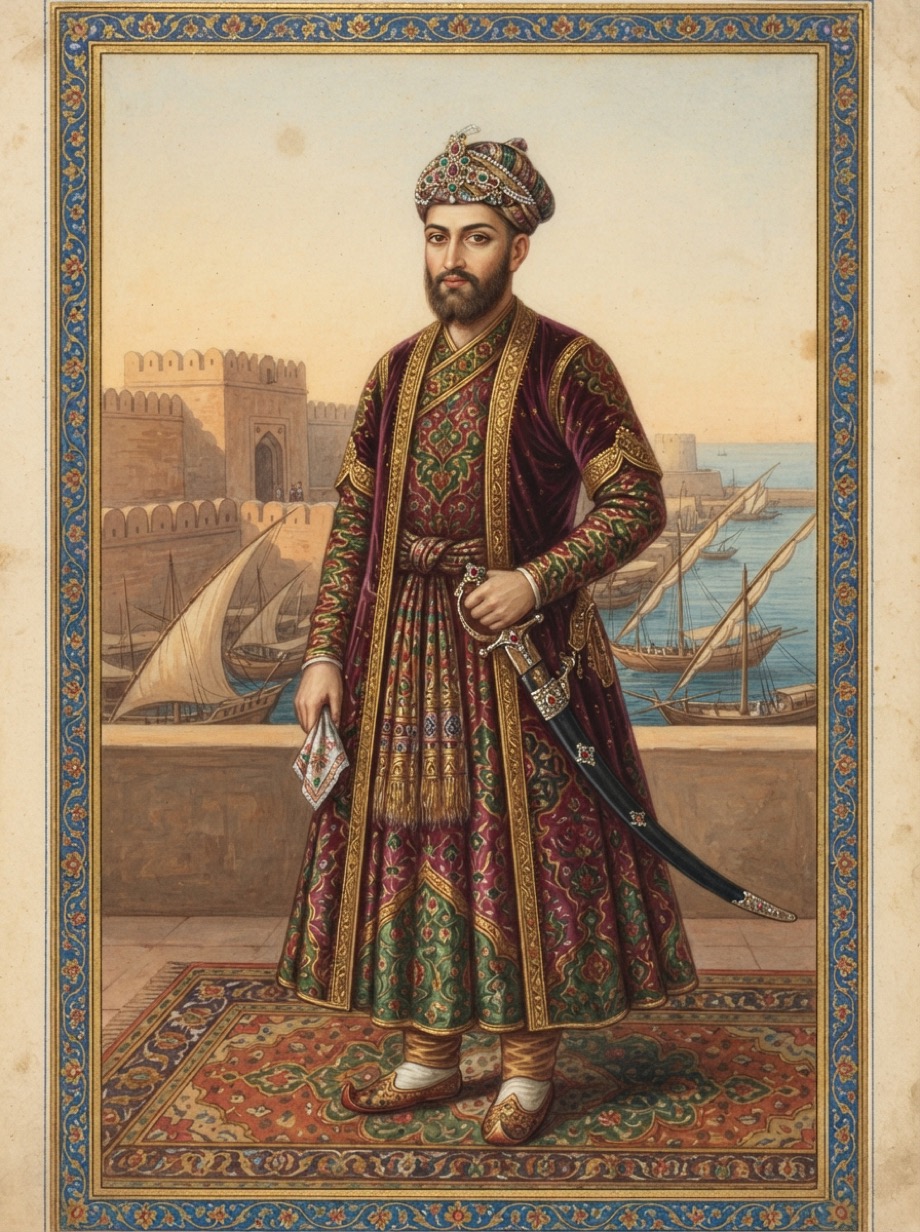
AI-assisted Portrait of Malik Ayyaz
The Man Who Would Not Be Anyone’s
The sources cannot agree on where Malik Ayyaz came from, and that disagreement is itself the first fact about him. Portuguese chroniclers called him Russian, or Georgian, or Dalmatian; Persian and Gujarati accounts are vaguer still. What is not disputed is that he arrived in Gujarat as a boy, enslaved, and entered the household of Sultan Mahmud Begada. The story told to explain his rise — that he shot down a bird that had irritated the sultan, and was freed and promoted on the strength of one arrow — is too tidy to be trusted whole, but it survives because it captures something true: he made himself indispensable fast, to whoever was watching.
By the first years of the sixteenth century that instinct had carried him to the governorship of Diu, a harbor he built into one of the richest ports on the western Indian Ocean — and into the single piece of coastline the incoming Portuguese wanted most and never took while he lived. Afonso de Albuquerque, who annexed Goa and seized Hormuz by force, spent years failing to pry Diu loose from a man who had no fleet to match his and no empire behind him. Ayyaz’s power was never military. It was the power of a person every faction needed intact more than they needed him defeated.
Malik Ayyaz was an ENTP, a dominant Ne improviser who read every shifting alliance for the option it still contained, and never let a single side own him long enough to make him theirs.
The Fleet That Didn’t Fight
The clearest window into Ayyaz’s mind is the Battle of Diu in February 1509, and what is strange about it is what he did not do. He brought his ships to join the Mamluk-led coalition against Francisco de Almeida’s fleet — nominally an ally of the Egyptian admiral Amir Husain, and of his own sultan’s interest in seeing the Portuguese driven from the coast. Then, as the battle turned, he is reported by most accounts to have held his squadron back and let Amir Husain’s fleet be broken without him. Portuguese chroniclers called it betrayal; it reads just as easily as a man declining to spend ships he would need afterward, on a fight he had already judged lost. Either way, Diu stood, and Ayyaz stood with it, on speaking terms with the winners.
That was not a single decision but a method. Ayyaz corresponded, more or less simultaneously, with the Portuguese crown, his own Gujarati sultan, the Mamluk court in Cairo, and — by reputation, if less documented — Ottoman power in the wider Muslim world. A dominant Ne user does not need to believe in any one of these relationships to maintain all of them; it needs to keep reading the field for which door is still open. Ayyaz treated every alliance as provisional, which is exactly why none of his enemies could afford to close the door on him first.
What Diu’s Walls Were Actually For
Underneath the improvisation was a colder arithmetic. Ayyaz fortified Diu on his own reading of what a Portuguese assault would require — walls, a harbor chain, a garrison sized not to win a war outright but to make conquest cost more than it was worth. That is the signature of auxiliary Ti: not building for glory, but pricing exactly what deterrence needs and stopping there. Diu did not have to be unconquerable. It only had to be more expensive to take than to leave alone, and for thirteen years after his death that calculation still held — Portugal did not seize the city until 1535.
The same logic ran through every alliance he kept open. Ayyaz did not correspond with the Portuguese, the Mamluks, and the Ottomans out of sentiment or indecision; he was pricing each relationship against what it actually delivered — trade access, a guarantee of neutrality, warning of an approaching fleet — and discarding nothing until something better replaced it. Where an ENTJ would have converted that same analysis into a single strategy and executed it, Ayyaz kept his conclusions private and his options plural. The calculation was never for show.
Prisoners, Clothed and Fed
After Diu, Ayyaz returned Portuguese prisoners well-treated — clothed, fed, and sent back with gifts rather than ransom demands — and kept up warm personal correspondence with Francisco de Almeida and, later, with the very Albuquerque who wanted his city. It is easy to read this as pure calculation layered onto the Ti underneath, and partly it was. But tertiary Fe in an ENTP often looks exactly like this: charm deployed with real skill, warmth that costs the giver little and buys enormous goodwill, courtesy used as a genuine tool of statecraft rather than a mask worn over indifference.
It worked because it was consistent. An enemy who had just watched his admiral’s fleet destroyed at Diu could still write to Ayyaz afterward as a known and even likable quantity — not a fanatic, not an unreadable stranger, but a man whose good manners were apparently as durable as his self-interest. That reputation for personal grace is a large part of why Albuquerque, for all his appetite for Gujarat, never found the pretext to take Diu by force while Ayyaz sat across the table from him instead of across a battle line.
Why ENTP Over ENTJ
Why not ENTJ?
An ENTJ in Ayyaz’s position would have picked a direction — bind Diu irreversibly to the sultan, or to Portugal, or to Cairo — and built an organization to drive that choice through. Ayyaz did the opposite for over a decade: he refused to let any single alliance become permanent, and treated indecision itself as an asset rather than a cost. He built no empire and commanded no army to rival Albuquerque’s. What he built was a position no one faction could safely remove — Ne generating the options, Ti pricing them, never Te executing a plan.
The distinction matters because Diu itself proves it. A Te-driven governor commits, and commitment creates a target; Ayyaz stayed soft at the center on purpose, and the softness outlasted every harder man around him. Diu only fell in 1535, thirteen years after the one man who knew how to keep it independent was gone.
Connected Figures
Further Reading
- Conquerors: How Portugal Forged the First Global Empire — Roger CrowleyThe fullest narrative account in English of Diu, Almeida, and Albuquerque's Indian Ocean campaigns.
- The Portuguese Empire in Asia, 1500–1700 — Sanjay SubrahmanyamThe standard scholarly framework for Portuguese-Indian relations, including Gujarat's role.
- Merchants and Rulers in Gujarat — M. N. PearsonThe essential study of Gujarati commerce and politics in this period, and Diu's place in it.
- The Ottoman Age of Exploration — Giancarlo CasaleSituates Diu within the wider Ottoman-Mamluk-Portuguese contest for the Indian Ocean trade.
- Décadas da Ásia — João de BarrosThe 16th-century Portuguese chronicle behind most of what is claimed about Ayyaz — read for its partisanship, not as neutral fact.
