 Historical Figure MBTI
#745 · 6-4-26 · The Portuguese Indian Ocean
Francisco de Almeida
First Viceroy of India · Victor at Diu
c. 1450 — 1510
5 min read
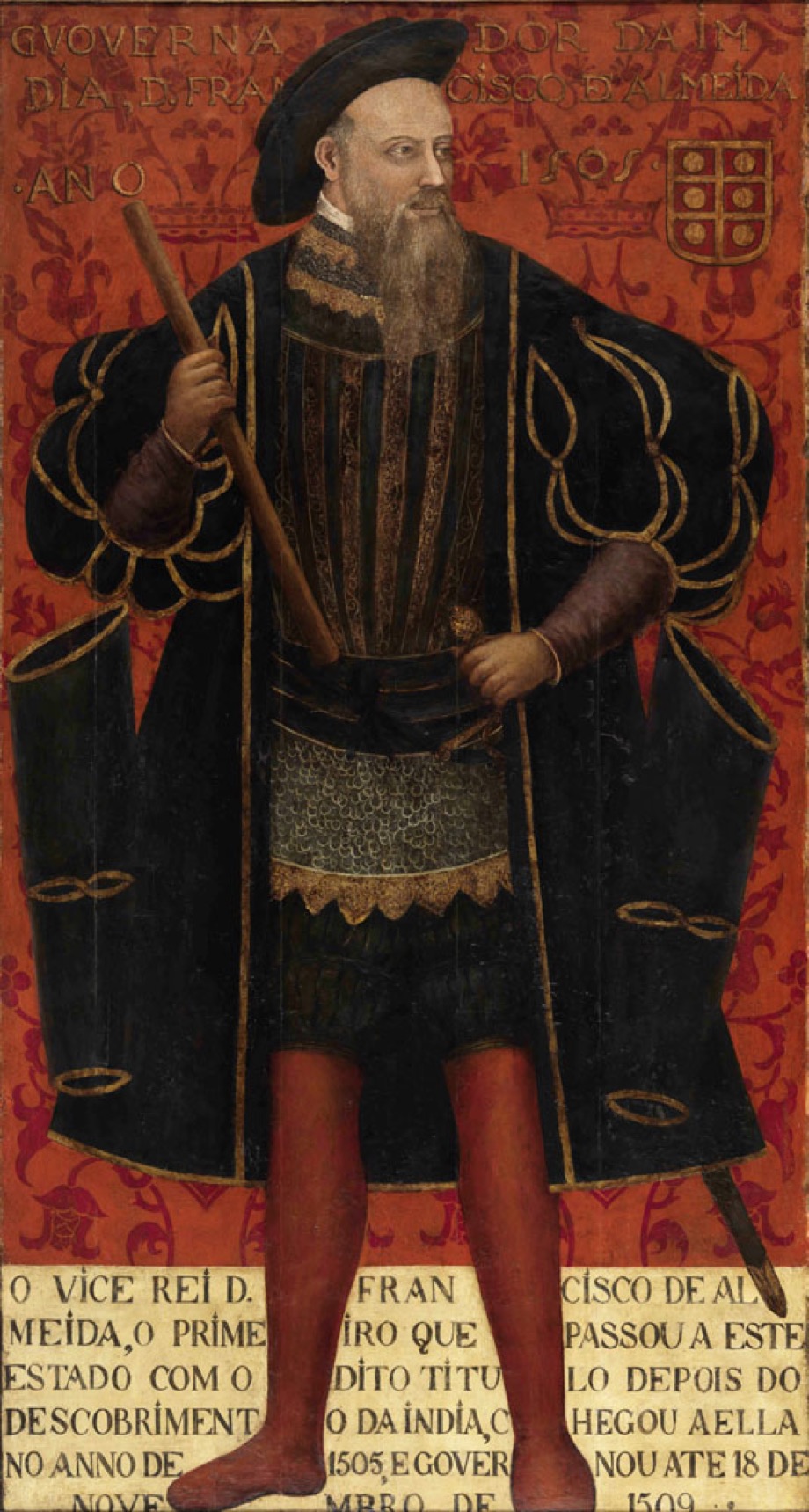
Portrait of Francisco de Almeida
The Sea Is the Wall
Francisco de Almeida sailed into the Indian Ocean in September 1505 at the head of the largest fleet Portugal had yet committed to the enterprise — twenty-two ships, thousands of soldiers, and a royal commission naming him the first Viceroy of India, a title invented because the job had no precedent to borrow one from. He was already in his fifties, a career soldier who had fought at the fall of Granada in 1492, and the brief King Manuel I handed him was really two briefs stitched together: choke the Muslim spice trade at the source, and do it without turning a kingdom of barely a million people into an occupying power it could never sustain. Almeida took that contradiction more seriously than anyone who followed him did.
His answer was a doctrine, not just a campaign: treat the ocean itself as the fortress. Burn what threatens the sea-lanes, garrison only where the map forces your hand, and never let the enterprise grow legs on land. It was coherent, disciplined, and largely unglamorous — and Portugal would spend it, and him, and then abandon it for something far more expensive within five years of his death.
“As long as you are powerful at sea, you will hold India as yours; and if you do not possess this power, little will avail you a fortress on shore.” The line attributed to Almeida is the purest possible statement of ESTJ dominant Te: strategy as an enforceable system, stripped to the one variable that actually decides the outcome.
A Chain of Command Around an Ocean
Almeida ran the Indian Ocean the way a soldier runs a campaign: as a chain of command with measurable objectives. Within weeks of landfall his fleet reduced Kilwa, then burned and sacked Mombasa when its sheikh refused terms — not for plunder’s sake but because both Swahili ports sat on the route he had been sent to secure, and an unsubdued port was a variable he would not tolerate. He installed a garrison at Kilwa, extracted tribute, and moved on; the objective was never conquest of the coast, only its compliance.
That same instinct for enforceable order shaped everything downstream — factories built only where trade required a fixed point, fleets rotated on a schedule, subordinates given explicit orders and held to them. When his own son Lourenço was trapped and killed off Chaul in 1508, Almeida’s response was not grief translated into improvisation but grief translated into logistics: he refused every request to be relieved of the viceroyalty until he had assembled a fleet capable of finishing the job properly, and at Diu in February 1509 he did — annihilating the Mamluk-Gujarati coalition in the battle that settled who owned the Indian Ocean for the next hundred years. It is Te at its most total: command exercised not as ambition but as an obligation that ends only when it is discharged.
Defending a Model That Worked
The line about power staying at sea was not a slogan Almeida improvised for a crisis — it was the whole of his position, argued consistently and against real opposition for the length of his term. His rival Afonso de Albuquerque wanted permanent fortresses and conquered territory: Goa, Malacca, a land empire to anchor the trade. Almeida thought this was exactly backward. Fortresses cost garrisons Portugal did not have, invited sieges Portugal could not always win, and converted a cheap maritime monopoly — ships that could be everywhere and nowhere — into an expensive fixed target. He built factories only under duress, at Kilwa and a handful of other points, and resisted the larger commitments Albuquerque pushed for at every turn.
What makes this Si rather than mere stubbornness is where the conviction came from: not a new theory of empire but a remembered one. Portugal’s entire advantage since Henry the Navigator had been naval — better ships, better navigation, a hundred years of proof that the caravel beat the army. Almeida was not innovating; he was refusing to be argued out of a model that had already been tested and had already worked. History is ambivalent about who won the argument — Albuquerque’s fortresses built the empire that lasted — but it largely vindicated Almeida’s arithmetic: the land empire bankrupted the crown that built it.
Two Debts, Both Paid in Full
Almeida’s inferior Fi surfaces exactly twice, and both times it overrides the disciplined Te that governs everything else — with fatal consequences. The first was vengeance: after Diu he had captured prisoners killed and their remains fired from cannon into the city, a private reckoning for a dead son that no doctrine required. The second was pride of office: when Albuquerque arrived bearing the king’s commission to succeed him, Almeida refused to yield command and had his rival imprisoned at Cannanore for months rather than hand over a post his own logic said mattered less than the mission. He relented only when an unambiguous fleet arrived from Lisbon.
He finally sailed for home in late 1509, and at Table Bay — the future Cape Town — a dispute with the Khoikhoi over water and cattle escalated into a punitive landing Almeida did not need to order. He and some sixty-five Portuguese, a dozen of them captains, were killed on the beach in March 1510. The first Viceroy of India, architect of the doctrine and victor of its defining battle, died in a skirmish that had nothing to do with either.
Why ESTJ Over ENTJ
Why not ENTJ?
An ENTJ viceroy would have been building the future — a new architecture for empire, argued from first principles, the way Albuquerque in fact did. Almeida was doing the opposite: defending a proven system against exactly that kind of ambition. His authority rested on rank, royal commission, and precedent, not on a constructed vision he needed others to accept — and when the argument came, he did not out-imagine Albuquerque, he out-stubborned him, citing what had already worked rather than sketching what could.
The tell is the shape of his one recorded doctrine. It contains no plan for what comes after the sea-lanes are secure, no theory of governance, no appetite for the next innovation — only a refusal, restated under pressure, to abandon what already functioned. That is auxiliary Si running the argument, not a dominant Ni or Ne casting forward. Even his two great failures of judgment were failures of loyalty and pride, not of overreach into some grander scheme; an ENTJ undone by his own inferior function tends to be undone by a plan too large, not a grudge too personal.
Connected Figures
Further Reading
- Conquerors: How Portugal Forged the First Global Empire — Roger CrowleyThe clearest narrative account of Almeida’s viceroyalty, the fight with Albuquerque, and Diu.
- Foundations of the Portuguese Empire, 1415–1580 — Bailey W. Diffie & George D. WiniusThe standard scholarly history of the doctrinal split between sea power and fortress-building.
- The Portuguese Empire in Asia, 1500–1700: A Political and Economic History — Sanjay SubrahmanyamPlaces Almeida’s tenure within the longer arc of Estado da Índia policy.
- The Portuguese in India — M. N. PearsonA concise institutional history covering the viceroyalty’s administrative logic.
- Lendas da Índia — Gaspar CorreiaThe principal 16th-century chronicle source for Almeida’s career — vivid but unreliable on precise detail.
