 Historical Figure MBTI
5 min read
#284 · 3-25-26 · Catherinian Russia
Alexander Vyazemsky
Prince · Attorney General · Catherine's Indispensable Bureaucrat
1727 — 1793
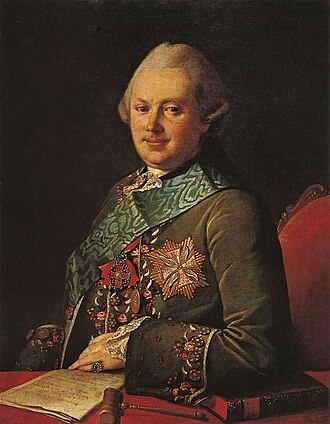
Portrait of Alexander Vyazemsky
The Rarest Thing in Catherine's Court
In a court defined by intrigue and spectacular corruption, Prince Alexander Alexeyevich Vyazemsky was an anomaly: he was incorruptible. He served as Procurator General of Russia — the senior law enforcement position in the empire, directly subordinate to the Empress — for twenty-one years under Catherine the Great, from 1764 until his stroke in 1792. No one held that position longer. Catherine called him "my general" and trusted him in a court where trust was a scarce and dangerous commodity.
Vyazemsky was not a military hero or a political schemer. He was, in the most precise sense, an administrator — but one of the kind empires require and almost never find: genuinely reliable, methodically thorough, resistant to the financial temptations that corrupted nearly every other official of his era. When Catherine needed to know that a law had been properly administered, she sent for Vyazemsky. He would know.
The ISTJ is not the most dramatic personality in any room — but they are, often, the reason the room still exists. Vyazemsky held Russian legal administration together for two decades through Si-driven institutional memory and the kind of Te that made the system actually function.
The Meticulous Memory of the Law
Si — introverted sensing — expresses itself as a deep, detailed relationship with accumulated experience and precedent. For Vyazemsky, this meant an extraordinary grasp of Russian legal history and administrative custom. After twenty-one years as Procurator General, he was not merely familiar with the law — he embodied it. He knew which precedents applied to which cases, which exceptions existed and why, which procedures had been superseded and which retained their force. This institutional memory was not stored in documents; it was stored in him.
Vyazemsky's reputation for reliability was not merely a character trait. It was a cognitive orientation: he did not improvise where precedent existed, did not cut corners where proper procedure had been established. When Catherine pushed for administrative reforms, Vyazemsky was often the one who slowed the process — not out of reactionary instinct but because his Si-dominant mind wanted to ensure existing procedures were properly understood before they were replaced. This occasionally frustrated the Empress, but it also meant that the reforms he did implement were durably constructed rather than hastily conceived.
The Systematic Enforcer
His Te auxiliary — extraverted thinking — made his Si-stored knowledge operationally useful. It is not enough to know the law; someone must also enforce it, organize the offices that administer it, and build the institutional structures that translate legal principles into practice. Under his tenure, the Office of the Procurator General was systematized in ways it had not been before: clearer procedures, more reliable oversight mechanisms, the kind of institutional accountability that turned the office from a position dependent on its occupant's personal authority into a durable institution. The Te-Si combination produces exactly this kind of builder.
His engagement with the legal reformers of Catherine's court — including the drafters of the Nakaz — was characteristically ISTJ-Te. He asked not whether an idea was philosophically elegant but whether it would actually work, whether it was compatible with legal traditions already in place. This practical pushback was sometimes dismissed by those more attracted to Enlightenment theory than administrative reality, but it was usually the better-grounded position.
The Genuine Incorruptibility
The most remarkable fact about Vyazemsky — the one that contemporaries noted with something close to wonder — is that he did not take bribes. In eighteenth-century Russia, where official bribery was so endemic as to be effectively institutionalized, this was not a minor distinction. Other ministers took payments; other officials supplemented their salaries through favors and arrangements. Vyazemsky declined, across twenty-one years in one of the most powerful administrative positions in the empire.
This incorruptibility was not Te-driven rule-following. An official who refuses bribes because the rules say to is different from one who refuses because taking them would be personally wrong. Vyazemsky was the latter. His Fi tertiary — introverted feeling — appears to have been genuinely active here: he believed, in a personal rather than procedural sense, that corruption was wrong. Not dangerous or imprudent — wrong. Fi tertiary in ISTJs operates quietly, without moral expressiveness. Vyazemsky never made speeches about his integrity. He simply refused, consistently and without drama, to do what he thought was wrong. Over twenty-one years, that refusal defined him.
Why ISTJ Over ESTJ or ISFJ
Why not ESTJ?
The ESTJ performs duty outwardly — more comfortable with direct authority, more energized by external enforcement of standards. Vyazemsky's satisfaction came from the internal sense that the work was done correctly. He did not build a political following, did not maneuver for advancement. He simply did the work. That inward orientation — fulfillment through internal consistency rather than external recognition — is the ISTJ signature.
Why not ISFJ?
The ISFJ's Si is oriented toward people — the memory of how individuals have behaved, care for the emotional fabric of groups. Vyazemsky's Si was oriented toward legal precedent and institutional procedure — how cases had been decided, how the law had been applied. This is Te shaping how Si expresses: not interpersonal care but institutional mastery. An ISFJ in his position would have been warmer and more relationship-focused. Vyazemsky was precise, procedural, and reliable in a distinctly impersonal way.
Connected Figures
Further Reading
- Russia in the Age of Catherine the Great — Isabel de MadariagaThe standard account of Catherine's government, useful for understanding the Procurator General's office Vyazemsky held for twenty-one years.
- Catherine the Great: Portrait of a Woman — Robert K. MassiePortrays the court around Catherine and the rare officials, like Vyazemsky, she trusted absolutely rather than merely tolerated.
- The Romanovs: Autocrats of All the Russias — W. Bruce LincolnPlaces Vyazemsky's decades of incorruptible service within the broader arc of Romanov administrative history.
