 Historical Figure MBTI
#558 · 4-27-26 · The Age of Saladin
Baha ad-Din ibn Shaddad
Qadi of the Army · Biographer of Saladin · The Witness Who Made the Legend
1145 — 1234
7 min read
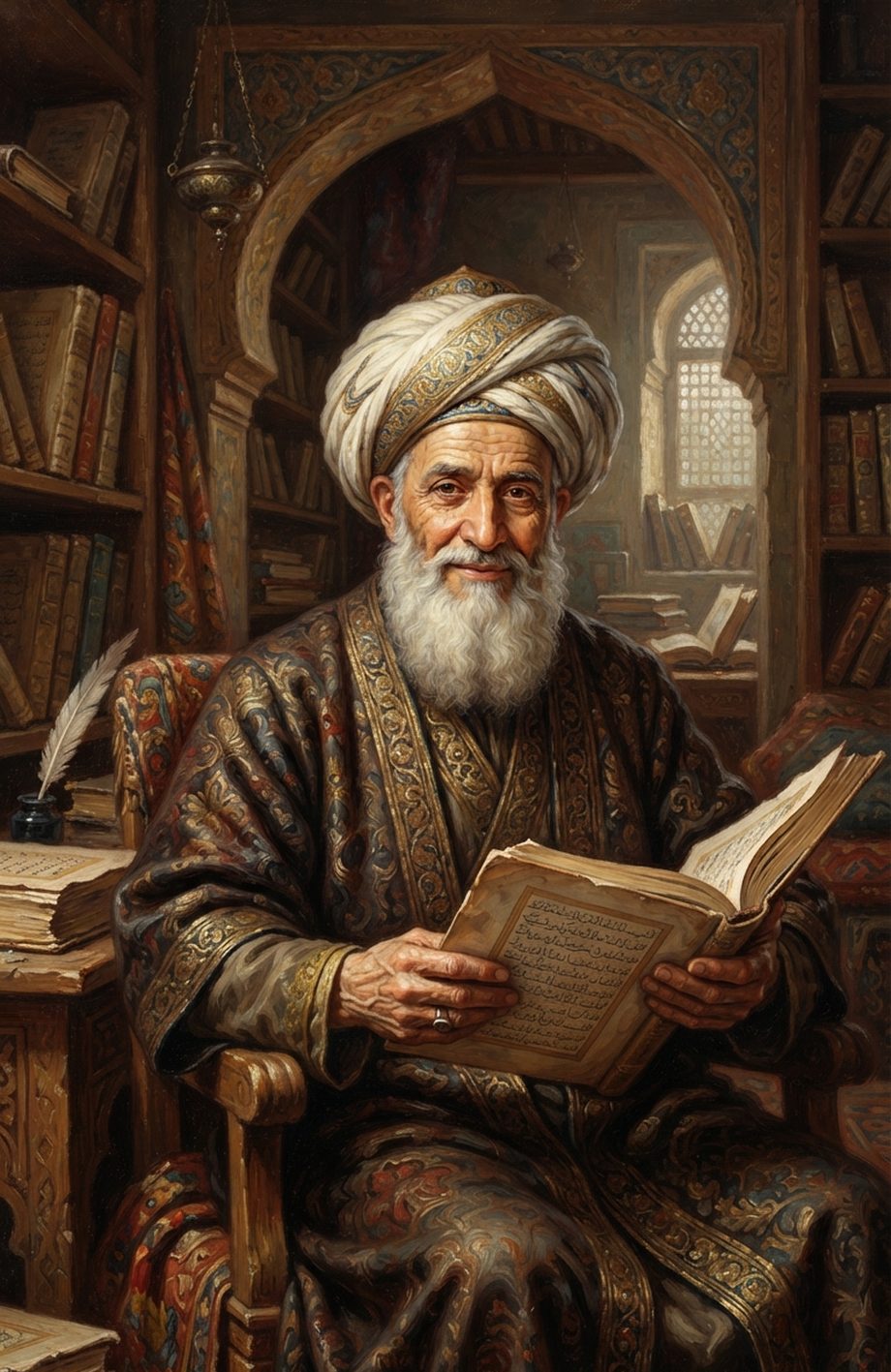
AI-assisted Portrait of Baha ad-Din ibn Shaddad
The Man Who Wrote a Legend into Being
Almost everything the world believes it knows about the character of Saladin — his mercy, his weeping at bad news, his open-handed generosity, his gravity in prayer, his courtesy to a hated enemy — reaches us through one pair of eyes. They belonged to a judge from Mosul who left the quiet of the law to ride with a sultan through the last great war of the Crusades, and who came home to spend the rest of a long life setting down, from love, the man he had watched. Baha ad-Din ibn Shaddad was not the maker of Saladin's empire. He was the maker of Saladin's memory.
Born in 1145, learned in Islamic law and the traditions of the Prophet, he entered Saladin's service in 1188 as qadi al-askar, the judge of the army, and quickly became something rarer than an official — an intimate, a companion in the tent and on the march through the Third Crusade. Out of that closeness came al-Nawadir al-Sultaniyya, “The Rare and Excellent History of Saladin”: an eyewitness biography so warm, so exact in its affection, that it fixed its subject's image for eight centuries across both the Islamic world and Christian Europe. He did not merely remember a master. He distilled a whole man into a moral pattern, and made the pattern permanent.
This is the INFJ as devoted witness: Ni composing a single idealized portrait out of a thousand scattered scenes, Fe supplying the loyalty and love that made the portrait glow — a life defined by seeing one man truly and rendering him for all time.
The Portrait Beneath the Facts
Ni — dominant
A chronicler records what happened; a biographer decides what it means. Baha ad-Din was the second thing. Out of the daily chaos of a campaign — councils, sieges, truces, the endless movement of an army — he was forever reaching past the events to the essence underneath, selecting and framing each episode so that it revealed one thing: the character of the man at the center. His book is not a ledger of dates. It is a single, coherent inner portrait, assembled scene by scene toward a unified vision of what Saladin fundamentally was.
That synthesizing eye is the mark of dominant Ni. When he shows Saladin weeping at the death of a friend, or dismounting to pray as arrows fell, or pardoning an enemy who had every reason to expect the sword, he is not cataloguing incidents at random — he is choosing the moments that crystallize a moral pattern, so that the reader comes away not with a chronology but with a type: the just ruler, the model prince, the ideal made flesh. Baha ad-Din saw the legend inside the living man, and wrote toward it with the quiet certainty of someone who already knew the shape of the whole.
A Biography Written from Love
Fe — auxiliary
What warms the portrait is devotion. Baha ad-Din did not write about Saladin from the cool distance of a scholar; he wrote from inside a bond, and the tenderness bleeds through every page. This is auxiliary Fe — the loyalty that attaches wholly to a person and then labors, faithfully, on that person's behalf. He left the settled dignity of a judgeship in Mosul to follow a sultan into a war of exhaustion, and stayed at his side to the end, and when the master died he carried the grief forward into prose, guarding the memory the way one guards something beloved.
Fe is also what made the portrait land in the wider world. A colder book might have been truer to the ambiguities of a ruler who was, after all, a conqueror; Baha ad-Din's is truer to the feeling Saladin inspired in those close to him, and it is that feeling — warmth, humanity, reverence — that the reader catches and keeps. The affectionate, magnanimous Saladin who became a figure of admiration even among his Christian enemies is in large part a Fe creation: a man rendered not just accurately but lovingly, so that centuries of readers would love him too.
The Jurist's Precision
Ti — tertiary
Devotion untethered from rigor produces hagiography; Baha ad-Din's did not, and the reason is the trained lawyer underneath. He was a qadi, schooled in the exacting logic of Islamic jurisprudence and the disciplined authentication of tradition, and that tertiary Ti gives his warm portrait a spine of accuracy. He is careful with detail, sober in his distinctions, and precise about what he witnessed himself versus what he had on report — the habits of a mind that respects internal consistency and will not let feeling override fact.
It is this marriage of the loving eye and the legal one that makes his book endure as a source rather than survive as a mere tribute. Historians still lean on it not because it is fond but because it is reliable — the fondness is disciplined by a jurist's scruple. After Saladin's death he returned to that same exact temperament, serving as chief qadi of Aleppo and founding a madrasa and a school of hadith, spending his last decades as a keeper of legal and religious precision.
The War He Watched but Did Not Fight
Se — inferior
Baha ad-Din lived for years amid the most physical drama of his age — the clash of armies before Acre, the maneuvering of Richard the Lionheart and Saladin across the coast of the Holy Land — and yet he is never the actor in it. He is the observer at the edge of the field, the man who describes the charge rather than joins it. That is the signature of inferior Se: the sensory, martial world is vividly present to him, but it is not his native element. His gift was to witness the moment, not to seize it.
Where a man of dominant Se would have hungered for the fight, Baha ad-Din's energy ran the other way — inward and backward, toward meaning and memory. His account of Richard is telling: he registers the English king's ferocious physical courage with a kind of wondering respect, the way a contemplative notes a force he admires but could never be. The war passed through his hands and became a book. The doing belonged to the sultans and the knights; the seeing, and the lasting, belonged to him.
Why INFJ Over ISFJ
Why not ISFJ?
The case for ISFJ is genuinely strong: both types are warm, loyal Fe-users, and the faithful servant recording his beloved master is squarely ISFJ territory. But the ISFJ's gift is Si — the concrete, accurate preservation of what actually happened, the trusted keeper of the record. Baha ad-Din did more than remember. He shaped an interpretive, idealized portrait, selecting and framing episodes to reveal Saladin's essential virtue for posterity — a synthesizing moral vision, not a faithful transcript. That reach past the facts toward the pattern is Ni, not Si.
The distinction is the whole difference between a diarist and a legend-maker. An ISFJ keeper of the record would have given us an invaluable, trustworthy account of Saladin's days. Baha ad-Din gave us the man's soul — the just ruler, the ideal prince — an image so coherent and so morally luminous that it outlived every rival source and became the Saladin the world remembers. He did not write to remember a master. He wrote to define a legend, and that is the INFJ's vision at work.
Connected Figures
Further Reading
- The Rare and Excellent History of Saladin (al-Nawadir al-Sultaniyya) — Baha ad-Din ibn Shaddad, trans. D. S. RichardsHis own book — the intimate eyewitness biography that fixed Saladin's character for posterity; the primary source read alongside any account of him.
- The Life and Legend of the Sultan Saladin — Jonathan PhillipsEspecially good on how Saladin's reputation was constructed — and on the outsized role Baha ad-Din's portrait played in shaping the legend East and West.
- Saladin — Anne-Marie EddéThe fullest modern scholarly life, weighing Baha ad-Din's testimony against the other Arabic sources with a careful, critical eye.
- The Crusades: Islamic Perspectives — Carole HillenbrandThe landmark study of the Crusades seen from the Muslim side, placing Baha ad-Din among the chroniclers and jurists who recorded the age of Saladin.
