 Historical Figure MBTI
#559 · 4-28-26 · The Age of Saladin
Richard the Lionheart
King of England · Crusader · The Lionheart
1157 — 1199
10 min read
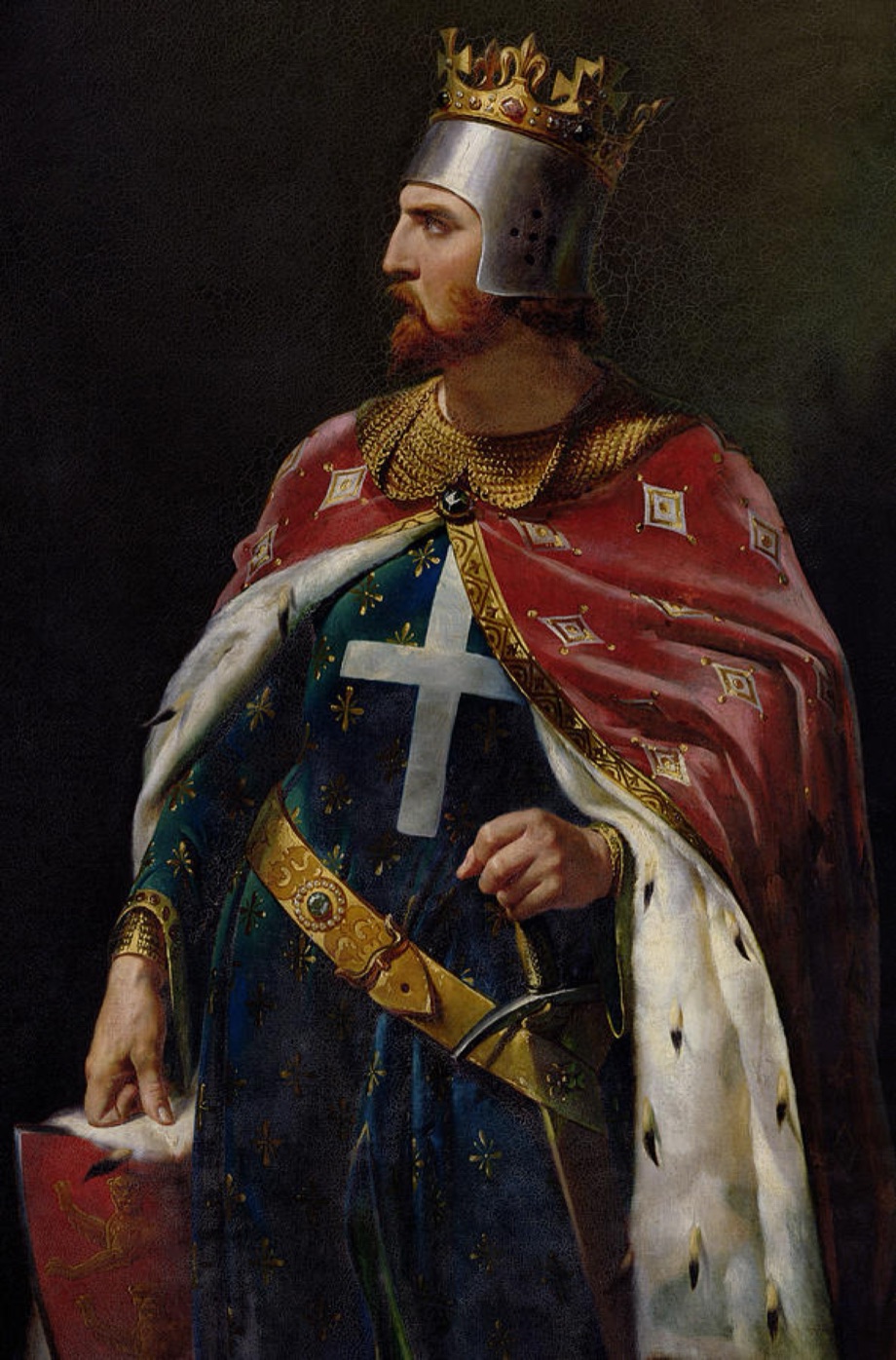
Portrait of Richard the Lionheart
The King Who Lived for the Fight
He was the greatest soldier of his age and one of the worst kings England ever had, and the two facts are the same fact. Richard I ruled for ten years and spent perhaps six months of them in the country he governed. He did not care for London; he is said to have declared that he would have sold the city itself if only he could find a buyer. What he cared for was the campaign, the siege, the charge, the chance to test his body and his tactics against the best opponents the world could offer — and in the pursuit of that he squeezed his kingdom dry, took the cross, and rode east to become the terror of the Third Crusade.
Third son of Henry II and Eleanor of Aquitaine, Richard was his mother's favorite and, from boyhood, a duke who preferred war to administration. He rebelled against his father alongside his brothers, and by 1189 he had helped harry the old king into a broken grave. Crowned at Westminster, he did not settle in to rule — he liquidated the realm for cash and left for the Holy Land, where he took Acre, crushed Saladin's army at Arsuf, and twice came within sight of Jerusalem before turning coldly back, having judged that he could win the city but never hold it. He died not on a great field but at a trivial siege in the Limousin, cut down by a crossbowman while quarreling over a rumored pot of buried treasure.
Richard is the ESTP as warrior-king: Se's genius for the physical moment — the terrain, the charge, the split-second of battle — married to Ti's cold soldier's logic, brilliant at the fight in front of him and blind to the kingdom behind him.
He is remembered as the Lionheart, the beau ideal of the crusading knight. He was also an absentee landlord of a king who governed nothing and conquered everything — a man who understood war completely and the state not at all.
The Genius of the Moment
Se — dominant
Dominant Se lives in the physical present — the body, the terrain, the immediate sensory field — and reads it faster and truer than anyone else in the room. On a battlefield this is the rarest of gifts, and Richard had it to a degree that awed both his own men and his enemies. He did not fight wars from a tent. He led from the front, in the press of the melee, close enough to be wounded and often was. At Jaffa in 1192 he came ashore ahead of his men, waded through the surf, and stormed the beach in person; days later, caught with a handful of knights against Saladin's cavalry, he rode the length of his own thin line to steady it and dared the enemy to break it. Muslim chroniclers wrote of him with a fear that shaded into wonder — the Frankish king who was everywhere the fighting was thickest.
His masterpiece was Arsuf. Marching his army down the coast under constant harassment, Richard held his cavalry in an iron discipline, forbidding the charge Saladin was trying to provoke — and then, at the exact instant the enemy had overcommitted, he loosed it. Timing is Se's native genius: not a plan drawn up in advance but a live read of the developing moment, the perception that now, this heartbeat and not the last, is when the ground has tilted. He had the same eye off the battlefield, improvising the conquest of Cyprus almost on a whim when its tyrant Isaac Komnenos insulted his party — seizing an entire island in weeks because the opportunity was in front of him and he took it.
This is the engine of the whole man. Richard was most fully himself in the concrete crisis where perception and action collapse into a single act — which made him perhaps the finest field commander of the medieval West, and meant that the parts of kingship living in the abstract and the future could not hold his attention. The gift and the flaw are the same faculty, pointed at the world.
The Soldier's Cold Arithmetic
Ti — auxiliary
Se supplies the nerve; auxiliary Ti supplies the ruthless internal logic that tells Richard what the moment is actually worth. This is what separated him from a mere brave knight. He did not fight for glory when glory made no military sense — and the supreme proof is the decision that most disappointed his own contemporaries. Twice Richard led the crusade to within a day's march of Jerusalem, the very object of the whole expedition, the city every man in his army had crossed the world to free. Twice he turned back. He had done the arithmetic and it was pitiless: he could probably take Jerusalem, but the moment the crusade dispersed and the western knights sailed home, he could not possibly hold it, isolated and surrounded, against Saladin. To besiege it would be to spend his army for a prize he would lose the day he won it. So he refused — against the fervor of the whole Christian enterprise, against his own reputation, on the strength of a cold private calculation of what would actually stand.
The same detached logic produced his darkest act. When Saladin's payment of the agreed ransom for the captives of Acre stalled, Richard had some two thousand seven hundred Muslim prisoners marched out and slaughtered before the walls. It was not rage; it was a transaction. The prisoners were a logistical liability he would not feed and could not guard while he marched south, and their deaths were, in his arithmetic, a means of forcing Saladin's hand. The chilling thing about it is precisely its lack of heat — the Ti soldier treating human beings as a factor in an equation. It is the shadow side of the very faculty that made him refuse Jerusalem.
Ti here is auxiliary, not dominant, which is why it serves the fight rather than governing a philosophy. Richard's reasoning was always the engineer's reasoning of the campaign — supply, ground, timing, the holdable and the unholdable — never the statesman's. He could tell you, better than any man alive, whether a position could be taken and kept. He could not tell you what a kingdom was for.
The Theater of Chivalry
Fe — tertiary
Tertiary Fe gives the ESTP a feel for the social performance — the code, the gesture, the shared theater of honor — and in Richard it produced one of the strangest and most enduring relationships in the history of war: his courtesy with Saladin. The two men were locked in a war to the death, and they never once met. Yet across the lines they conducted an elaborate exchange of chivalric grace. When Richard fell ill with fever, Saladin sent him fruit and snow from the mountains to cool it, and, hearing that the king had lost his horse in battle, sent him fresh mounts. They traded envoys, gifts, and courtesies; they even floated a fantastical peace by marriage — Richard's own sister, Joan of England, to Saladin's brother al-Adil, the pair to rule Jerusalem jointly. The scheme came to nothing, but that it was proposed at all captures the register the two commanders shared.
This is Fe as tertiary function — genuine, but a performance more than an intimacy, the enjoyment of a beau geste rather than a deep reading of another soul. Richard loved the style of chivalry: the magnanimous word, the noble opponent honored across the field, the theater of two great captains treating each other as equals worthy of respect. It was real, and it was also a game he was very good at, one that flattered his sense of himself as the finest knight in Christendom. The Treaty of Jaffa that finally closed the crusade in 1192 was cut from the same cloth: Richard left Jerusalem in Saladin's hands but secured safe access for Christian pilgrims — a settlement that let both men bow out of the field with their honor intact.
The limits of that tertiary Fe show in the rest of his conduct. The same king who traded snow and horses with his enemy could butcher the prisoners of Acre and swindle his allies of their due; his warmth was for the noble equal in the chivalric drama, not a steady humane feeling for the ordinary or the inconvenient. He performed honor beautifully. He did not always possess it.
The Future He Could Not See
Ni — inferior
Inferior Ni is Richard's blind spot, and it is the exact shape of his failure as a king. What Ni does — hold a single long trajectory, see how the present quietly determines a distant outcome, build for the day after tomorrow — Richard could not do, or would not. He mortgaged England to the hilt to fund a single crusade, indifferent to what the bleeding of the realm would cost in the years after. Captured on his way home by Duke Leopold of Austria and handed to the Emperor Henry VI, he was held for a ransom so vast it had to be wrung from every corner of his kingdom — and while England scraped the silver together, his brother John and his rival Philip Augustus carved into his French lands. A ruler with foresight does not leave a vacuum that large behind him. Richard had ridden east without seriously reckoning what would happen at home while he was gone.
The deepest failure of Ni is the succession. Richard fathered no legitimate heir and never settled who would follow him — the single most important act of foresight a medieval king owed his realm. His death left the claim contested between his brother John and his young nephew Arthur of Brittany, a quarrel that helped unravel the whole Angevin empire within a decade. Compare his rival Philip, an INTJ who won few battles but patiently built a French state that would outlast them both: Philip saw the future Richard never glimpsed.
His end is the perfect emblem of the inferior function. In 1199, warring with Philip in the Limousin, Richard laid siege to the petty castle of Châlus over a rumored hoard of buried gold — a trivial object, a nothing of a fight. Strolling the perimeter without his full armor, careless in the concrete moment as ever, he was struck in the shoulder by a crossbow bolt, and the wound went gangrenous. The supreme warrior of the age died at forty-one at a meaningless siege over treasure — the opportunist's death, seizing one more immediate prize, blind to the last of the larger game he was throwing away.
Why ESTP Over ESTJ or ENTJ
Why not ESTJ?
The ESTJ is the dutiful administrator — the king who builds and maintains the institutions of his realm, holds the parliaments, balances the exchequer, keeps the machinery of the state running. That is the precise opposite of Richard, who neglected England almost entirely: he governed nothing, drained the kingdom for his crusade and then for his ransom, and joked that he would have sold London for the right price. He spent virtually his whole reign abroad on campaign because the campaign was the only thing he wanted. A dutiful Te–Si organizer maintains the realm; Richard was Se–Ti, a warrior who used the kingdom as a purse and forgot it the moment he sailed.
Why not ENTJ?
The ENTJ is the empire-builder, driven by Ni–Te toward a long strategic and political vision — and this is exactly what Richard lacked. His rival Philip Augustus was the ENTJ (typed INTJ here) who won few battles but built a lasting French state; Richard out-fought him everywhere and out-planned him nowhere. Richard's brilliance was tactical and immediate, not strategic and generational: he could not hold Jerusalem in his imagination, could not settle his succession, could not see past the fight in front of him. He died besieging a trivial castle over rumored treasure — the opportunist's death, not the empire-builder's.
The distinction is the whole of him. The ESTJ governs, the ENTJ builds, and Richard did neither — he fought, better than any of them, and cared for almost nothing else. His faculties all pointed at the concrete present: Se to seize the moment, Ti to calculate what the moment was worth, Fe to perform its chivalric grace, and an inferior Ni that left the future to fend for itself. He is the type in its most magnificent and most limited form — the supreme tactician who won every battle and lost the long game he never even saw he was playing.
Connected Figures
Further Reading
- Richard I — John GillinghamThe standard modern biography (Yale English Monarchs) — the essential scholarly reappraisal of Richard as soldier and ruler.
- Richard the Lionheart: King and Knight — Jean FloriA searching study of Richard against the ideals of chivalry and kingship, especially strong on the crusade and the legend.
- The Reign of Richard Lionheart — Ralph V. Turner & Richard R. HeiserA focused analysis of how Richard governed — or failed to govern — his sprawling Angevin dominions.
- The Crusades: The Authoritative History — Thomas AsbridgeThe best single-volume narrative of the crusading movement — vivid on Acre, Arsuf, and the Richard–Saladin duel.
- A History of the Crusades, Vol. III — Steven RuncimanThe classic sweeping account of the later Crusades, unmatched for narrative grandeur and its portrait of the Third Crusade.
