 Historical Figure MBTI
#560 · 4-28-26 · The Age of Saladin
Philip II Augustus
King of France · Builder of the Royal State · The Cold Strategist
1165 — 1223
7 min read
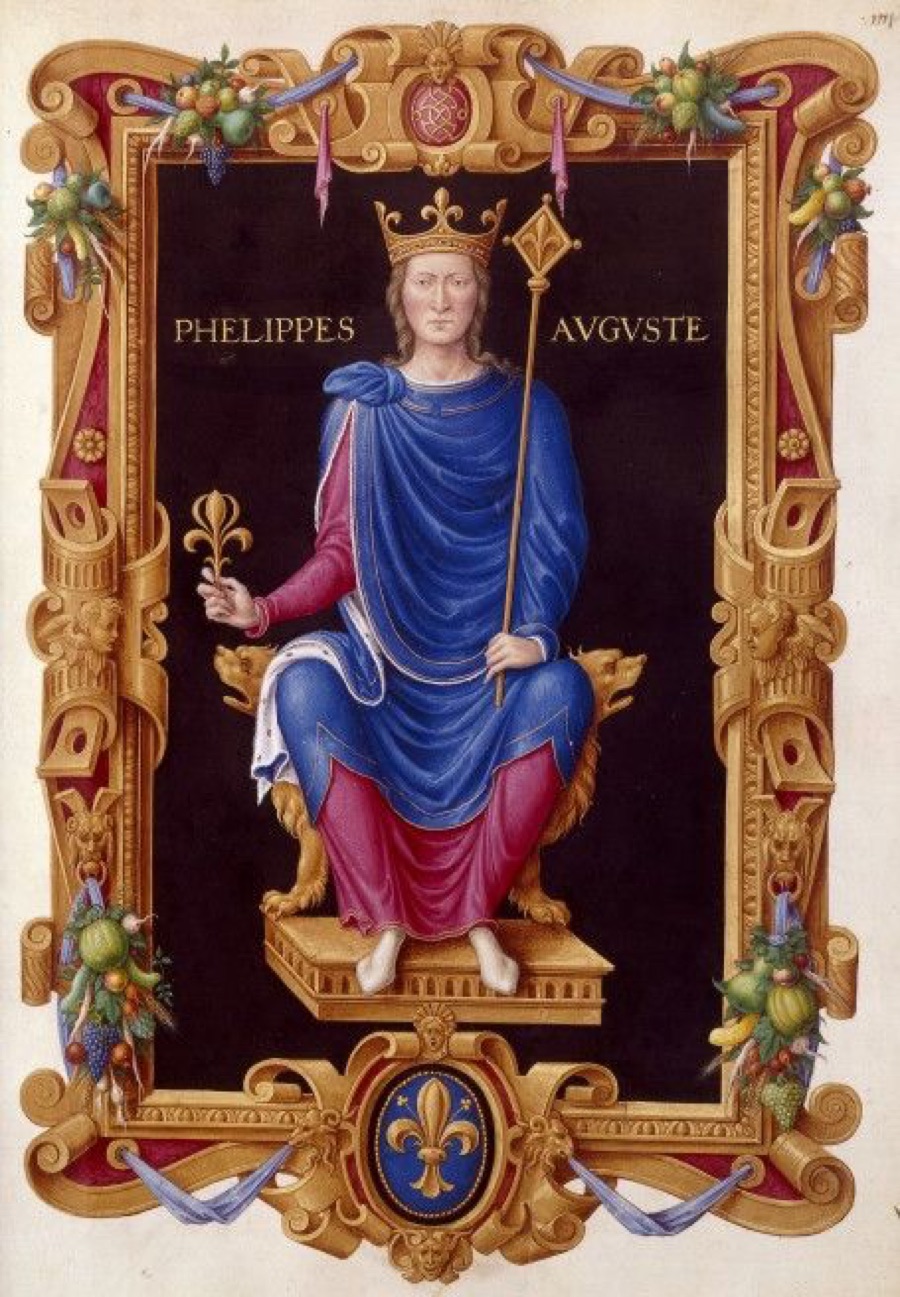
Portrait of Philip II Augustus
The Man Who Built a Kingdom Out of Paperwork
He is the least glamorous great king in French history, and that is precisely the point. Philip II was no warrior in the mold of his rival Richard the Lionheart, who won his legend on the battlefield and lost his kingdom everywhere else. Philip won almost nothing by charisma and almost everything by patience. He inherited, in 1180, a monarchy weaker than the great vassals hemming it in — a king whose writ barely ran beyond the Île-de-France, ringed by the vast Angevin empire of the English crown. He left it, in 1223, the dominant power in France and the founder of a state that would become the model of European monarchy — not with a sword but with a system.
The name “Augustus” — the augmenter — flatters the wrong faculty. Philip did not enlarge France by heroic conquest but by calculation, outlasting and outadministering better-loved men. Where other medieval kings ruled through personal bonds that dissolved on their death, he built machinery that would run without him. He is the anti-Richard — remembered not for glory but for building.
Philip Augustus is the INTJ as state-builder: a single decades-long vision of a centralized monarchy (Ni) pursued through the unglamorous machinery of law, bureaucracy, and systematic expansion (Te) — a man who preferred to win the long, cold game rather than the open contest.
The Kingdom He Could Already See
Ni — dominant
Dominant Ni holds a single fixed image of the future and bends everything toward it, through reversals that would break a man ruled by the present. Philip held one his whole adult life: a France in which the king, not his mightiest vassal, was sovereign. It is why he could tolerate humiliations Richard could not. On the Third Crusade in 1190 he took his share of Acre and then, sickly and having done enough for honor, simply went home — to Richard's lasting fury. To a warrior culture it looked like cowardice; to Philip the war that mattered was not in the Holy Land but in France, winnable while his rival was pinned down abroad.
So he spent those years scheming — allying with Richard's brother John, seizing Angevin territory while the Lionheart sat captive in a German prison. Ni does not fight the battle in front of it; it fights the one that matters, content to look bad meanwhile. And the patience paid out with almost mathematical precision: Richard died in 1199 and left his lands to the weak, distrusted John, and by 1204 Philip had taken Normandy, Anjou, Maine, and Touraine, dismembering the empire that once dwarfed his own.
Government by System, Not by Personality
Te — auxiliary
If Ni supplied the vision, auxiliary Te supplied the apparatus — perhaps the most consequential Te in medieval Europe, because Philip used it to invent an administrative state where there had been only personal lordship. Before him the crown governed as every feudal lord did: through the king's own body and the shifting loyalties around him, a government that largely died with the king. Philip broke that pattern. He created a corps of salaried royal officials — the baillis and prévôts — who administered justice and collected revenue on fixed schedules, answerable to the crown rather than their own bloodlines. Government became a machine that ran on procedure, and procedure survives the man who set it in motion.
The monuments are the same instinct in stone: he walled Paris, raised the fortress that would become the Louvre, chartered the University of Paris. None of this is the work of a romantic or a crusader; it is the work of a mind that treats a kingdom as an engineering problem — asking not “what is glorious?” but “what will keep functioning?” Even his warfare was Te rather than heroic: he won at Bouvines in 1214 not as a battlefield genius but by assembling resources, buying alliances, and choosing his ground. He measured a campaign by its results, not its honors.
The One Door the Calculator Would Not Open
Fi — tertiary
For a man so relentlessly instrumental, Philip had one blazing exception — exactly the kind tertiary Fi produces: a private, unaccountable aversion that overrode every calculation of interest. In 1193 he married Ingeborg of Denmark for a Danish alliance. The morning after the wedding night, for reasons no chronicler ever satisfactorily explained, he conceived a violent physical revulsion toward her and tried at once to be rid of her. When Ingeborg appealed to the Pope, the strategist who bent institutions to his will found himself, for once, immovably in the wrong.
What followed is astonishing precisely because it was so irrational. Innocent III placed all of France under interdict in 1200 — churches closed, sacraments suspended — to force Philip to take her back. And Philip, who had abandoned a whole crusade rather than waste effort on a war he did not care about, simply would not yield: he kept her imprisoned for some twenty years rather than share his life with a wife he could not stand. It is the one subject on which the machine broke down. The king who governed a kingdom by document could not govern his own aversion to one woman.
The Battlefield He Would Rather Avoid
Se — inferior
Inferior Se is the INTJ's weakest register — immediate physical action, bodily courage, the live theatre of the battlefield — and Philip's discomfort with it is written across his reign. He was no coward, but he never sought the open contest the way his contemporaries did. This is the deepest contrast with Richard, whose entire genius lived in the Se arena of siege and charge and personal prowess. Where Richard hungered for the field, Philip treated it as a last resort, always preferring the maneuver that made the battle unnecessary: buy a vassal, isolate an enemy, seize a province while its lord looked away.
At Bouvines in 1214 — the one great battle he could not avoid, forced on him by a hostile coalition — he was unhorsed and nearly killed, dragged into the one dimension he could not control and saved only by other men's bodies. It is the inferior function's classic ambush: the planner forced into the raw present, surviving by the narrowest margin, then relieved to return to the treaties and accounts where his real power lived.
Why INTJ Over ENTJ or ISTJ
Why not ENTJ?
The ENTJ is the obvious near-miss, and figures like Frederick Barbarossa show what that type looks like on a throne: a commanding, front-of-the-field driver who leads by force of personality. Philip led by none of it. He worked through patience and quiet maneuver rather than charisma — abandoning the Third Crusade rather than contesting it, beating Richard by scheming rather than by commanding the room. The ENTJ's extraverted Te sits in front; Philip's Te served an introverted Ni vision — an Ni-dominant strategist, not a Te-Ni field general.
Why not ISTJ?
Philip has a surface resemblance to the ISTJ — the bureaucrat's love of records and orderly administration. But the ISTJ is a keeper of tradition, a Si-anchored guardian of how things have always been done. Philip was the opposite: a transformer. He did not preserve the feudal monarchy he inherited; he reinvented royal government from first principles, imagining an administrative state that did not yet exist. That is intuition, not sensing — bureaucracy as an instrument of radical change.
The essential distinction is where the power originates. The ENTJ commands; the ISTJ conserves; the INTJ envisions and engineers. Philip saw, decades before it was possible, a France that did not yet exist, and built the machinery — patiently and coldly — to make that vision inevitable. That is the INTJ's signature motivation: not to win the contest of the day, but to build the system that renders the contest moot.
Connected Figures
Further Reading
- The Government of Philip Augustus: Foundations of French Royal Power in the Middle Ages — John W. BaldwinThe standard scholarly study — the definitive account of how Philip built the administrative machinery of the French royal state.
- Philip Augustus, King of France 1180–1223 — Jim BradburyThe fullest English-language biography of the reign — a clear, narrative account of the man, the wars, and the transformation of the monarchy.
- Richard I — John GillinghamThe authoritative life of Philip's great rival; indispensable for understanding the Philip–Richard contest from the other side.
- The Crusades — Thomas AsbridgeA vivid modern narrative of the crusading movement — essential context for the Third Crusade that Philip helped begin and then quietly abandoned.
