 Historical Figure MBTI
#561 · 4-28-26 · The Age of Saladin
Frederick Barbarossa
Holy Roman Emperor · Crusader · The Emperor Who Drowned
1122 — 1190
8 min read
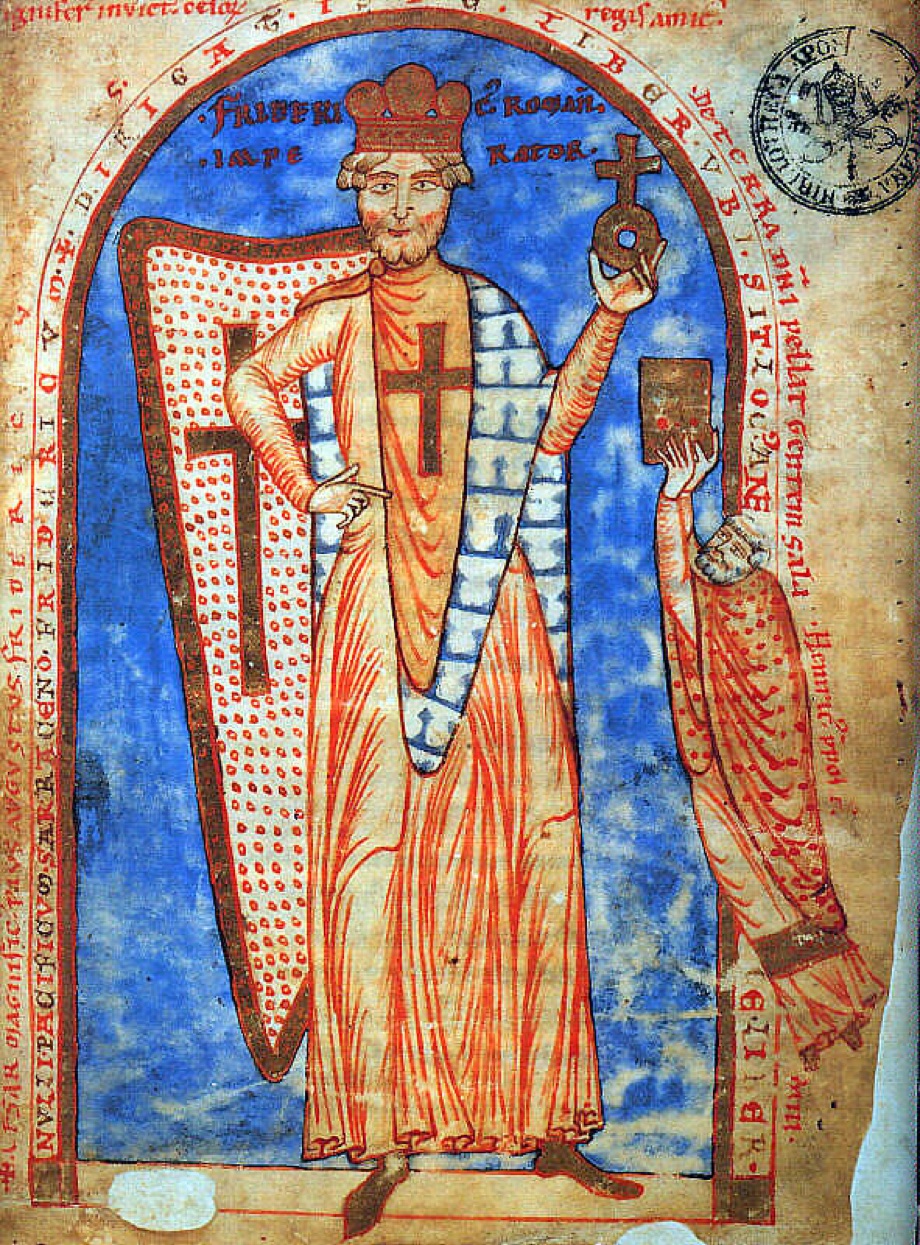
Portrait of Frederick Barbarossa
The Emperor Who Chased a Ghost of Rome
For thirty-five years he marched over the Alps to make an idea real. The idea was enormous and slightly unhinged: that the Holy Roman Empire he had inherited was not a loose German confederacy of dukes and bishops but the living continuation of ancient Rome itself — the universal Christian monarchy of Augustus and Charlemagne, whose emperor stood by right above kings, cities, and even popes. Frederick I of Hohenstaufen — called Barbarossa, “Redbeard,” by the Italians who both feared and defied him — spent his whole reign forcing a divided medieval world to bend to that vision, the grandest political dream of the twelfth century, and he very nearly imposed it by sheer, patient will.
Crowned German king in 1152 and emperor in Rome in 1155, Barbarossa found an empire in which the crown's authority had rotted — German princes governing as they pleased, the wealthy Lombard cities of northern Italy running themselves as free republics, the papacy claiming to make and unmake emperors at will. He set out to reverse all of it: six times he led armies into Italy to master the cities and the popes, revived the majestic vocabulary of Roman law to dignify his claims, and dubbed his empire “Holy” to place it beyond the Church's reach. He was checked — humiliated, even, at Legnano in 1176 — and he adapted, salvaged, and endured, dying at last not on a throne but in a river, an old man leading the largest army of the Third Crusade toward Jerusalem.
Barbarossa is the ENTJ as empire-builder: Te's half-century of relentless campaigning, lawmaking, and dynastic engineering, all harnessed to a single sweeping Ni vision — a restored, universal Rome under his crown — that he pursued against popes, cities, and time itself.
The Machinery of Empire
Te — dominant
Dominant Te builds systems to impose order on a disordered world, and Barbarossa built them tirelessly. His method was never simply to win battles but to convert force into law, and law into permanence. At the Diet of Roncaglia in 1158 he summoned jurists trained in the newly recovered Roman law of Justinian and had them define, item by item, the “regalian rights” owed to the emperor — tolls, coinage, magistrates, the revenues of the Lombard cities. He was not raiding Italy but auditing it, drawing up a legal ledger of everything the empire could claim — Te in its purest imperial form, the conviction that authority must be codified and made administratively real.
For thirty-five years he ran the same relentless campaign. Six times he crossed the Alps; he leveled rebellious Milan and scattered its people; he brought the overmighty Henry the Lion to heel and redistributed his duchies. When brute conquest failed — and after Legnano it did — he renegotiated, hammering out the Peace of Constance in 1183, which conceded the cities their self-government while preserving his ultimate suzerainty. He measured success by the durability of the settlement, not the glory of the fight.
His masterstroke was dynastic engineering. Rather than conquer the rich Norman kingdom of Sicily, he acquired it by contract: he married his son and heir, Henry VI, to Constance of Sicily, folding the whole southern kingdom into the Hohenstaufen inheritance by marriage settlement. A single arranged match did what a decade of war could not — the characteristic ENTJ horizon, the mind that arranges the institution to outlast the man, planning past his own death into the reign of his heirs.
The Dream of a Universal Rome
Ni — auxiliary
Auxiliary Ni is what elevates Barbarossa above the competent warlord and makes him a visionary. Behind every campaign lay one fixed, mystical conception of the future toward which all the marching bent: a single, sacred, universal empire, descended in unbroken line from Augustus through Charlemagne and now vested in him. It was less a policy than a revelation. He had the bones of Charlemagne exhumed and canonized; he deliberately styled his realm the Sacrum Imperium, the Holy Empire, so that its dignity would rival the papacy's own — not administrative measures but the acts of a man reaching for a symbol that could organize centuries.
Ni is what allowed him to absorb defeat without abandoning the goal. Legnano in 1176 was a catastrophe — his cavalry broken by the militias of the Lombard League, the emperor himself unhorsed and briefly believed dead. A ruler defined by the present moment would have been shattered; Barbarossa treated it as one lost move in a longer game. He reconciled with Pope Alexander III at Venice in 1177, knelt, and then quietly went on building — because he could see the end state so clearly that no humiliation in front of him could dislodge it.
Barbarossa did not want a bigger Germany. He wanted to make a fading memory — the majesty of Rome reborn as a Christian empire — into a permanent institution. That is Ni giving Te its target: the whole apparatus of law and war aimed at an idea only he could fully see.
The Soldier in the Saddle
Se — tertiary
Tertiary Se gave the strategist a body as well as a mind — a physical appetite for the field and the decisive personal act. Barbarossa was no armchair emperor directing wars from a chancery; he was in the saddle for the better part of four decades, personally leading army after army across the Alpine passes, enduring the fevers of Italian summers that killed thousands of his men, fighting in the press of battle in his own person. That Se is most striking — and most fatal — in the final act: in 1189, aged roughly sixty-seven, when he might have sent gold and stayed home, he took the cross and led the largest and most disciplined army of the Third Crusade overland through Anatolia, a host so formidable it genuinely alarmed Saladin.
In June 1190 that same physicality undid him. Crossing the Saleph River in Cilicia, the emperor drowned — his horse slipping, or the shock of the cold water stopping an aged heart. The commander who had survived six Italian wars and countless battles was killed by a river crossing, felled not by an enemy but by the sheer physical world he had spent his life mastering. Se, the source of his tireless presence in the field, delivered him his most banal and devastating end.
The Honor He Would Not Forget
Fi — inferior
Inferior Fi is the ENTJ's buried, unadministrable core — the private code of honor and personal loyalty that the instrumental mind usually overrides but that can erupt with unexpected force. In Barbarossa it shows in his fierce, almost brittle sense of imperial dignity. The kneeling at Venice in 1177 was politically necessary, but the legend that clustered around it — that the pope set his foot upon the emperor's neck — captures how deeply the humiliation cut a man for whom the crown's honor was not policy but something closer to sacred. He could calculate the concession; he could not entirely forgive it. The same undercurrent runs through his crusade: to lead an army across the world at his age was less a strategic necessity than the discharge of a vow. The coldly effective politician who had spent decades bending the Church to his will ended his life in an act of pure devotional obligation — the inferior function claiming, at the last, the reign that Te had run for half a century.
Why ENTJ Over ESTJ
Why not ESTJ?
The case for ESTJ is tempting: the codes of law, the regalian ledgers of Roncaglia, the tireless administration all look like a supreme executive upholding the established order. But the ESTJ administers the world that exists — enforces the accepted rules, defends the inherited hierarchy. Barbarossa did not defend an existing order; he chased a transformative, half-mystical idea of one that had lapsed for centuries, reviving the majesty of ancient Rome and dignifying his crown as “Holy” against the fierce resistance of popes and free cities. That is Te in service of an Ni vision, not Si-anchored administration of the given.
The distinction is the whole man. An ESTJ emperor would have governed Germany well, collected the tolls, and left Italy's cities to their charters; the sensible course was always to consolidate what he held. Barbarossa instead bent an entire reign — six wars, a lifetime of Alpine crossings, an old man's crusade — to an intangible conception of universal empire his contemporaries thought anachronistic. He was not the steward of a system but the prophet of one, and that is why he is the ENTJ: the commander whose true campaign was never for territory but for a vision of the future only he could see clearly enough to serve.
Connected Figures
Further Reading
- Frederick Barbarossa: The Prince and the Myth — John B. FreedThe major modern biography in English — exhaustive, authoritative, and attentive to both the reign and the legend that outgrew it.
- Frederick Barbarossa: A Study in Medieval Politics — Peter MunzThe classic analytical account of the reign, focused on the machinery of imperial politics and the long struggle with the papacy and the Lombard cities.
- The Deeds of Frederick Barbarossa — Otto of FreisingThe contemporary chronicle by the emperor's own uncle — the indispensable primary source, written from inside the Hohenstaufen court.
- The Crusades — Thomas AsbridgeThe best single-volume narrative history of the crusades — excellent on the Third Crusade and the catastrophe of Barbarossa's drowning.
