 Historical Figure MBTI
#562 · 4-28-26 · The Age of Saladin
Conrad of Montferrat
Defender of Tyre · King of Jerusalem · The Assassinated Rival
c. 1140 — 1192
7 min read
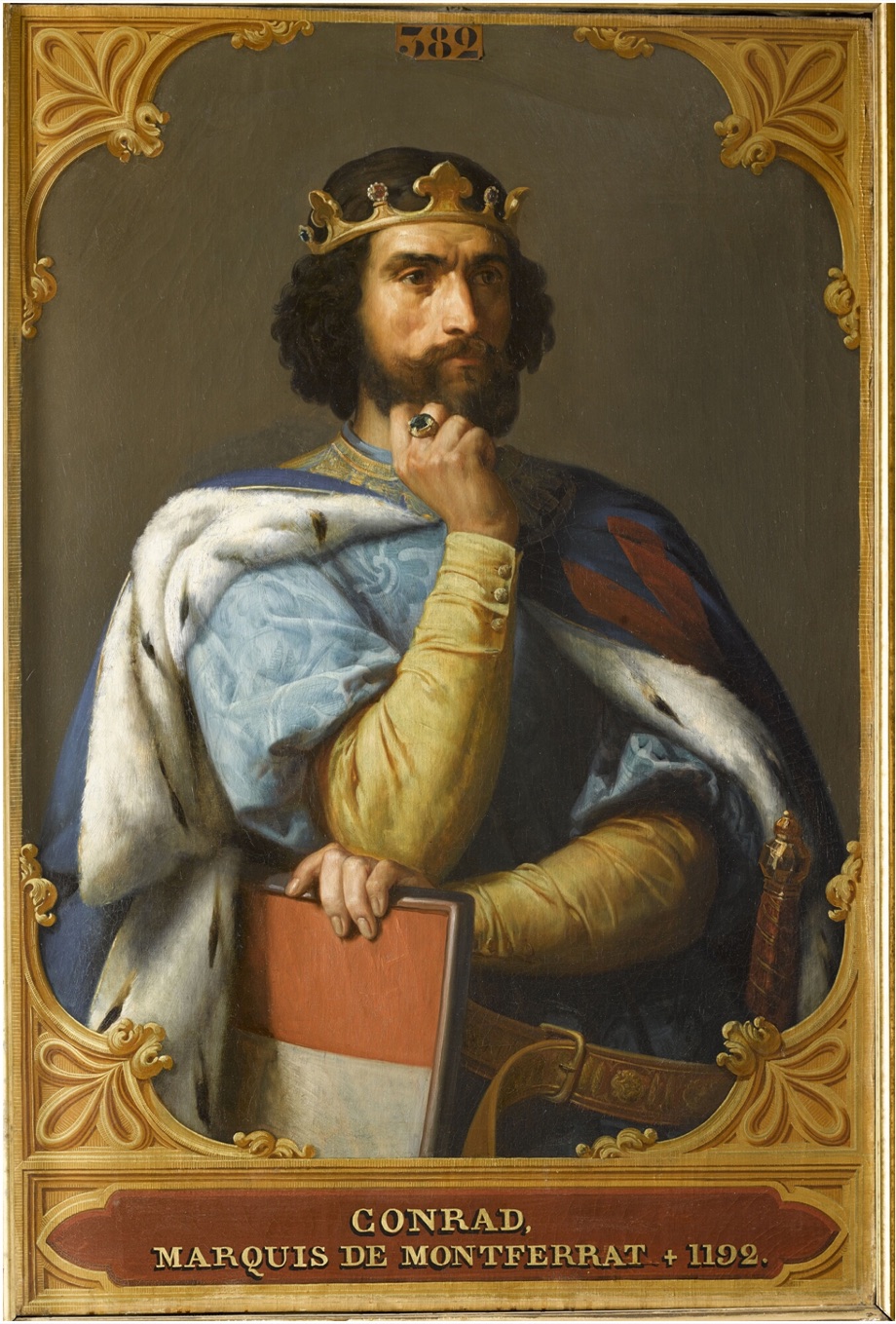
Portrait of Conrad of Montferrat
The Operator on the Last Shore
He sailed into a dying city and made it the hinge of a war. In the summer of 1187, weeks after Saladin annihilated the Crusader army at Hattin, Conrad of Montferrat — an Italian marquis of an old and grasping house, able and nakedly ambitious — arrived by sea at Tyre just as its garrison was preparing to hand the keys to Saladin. He refused the surrender, took command of the walls, and held them. Tyre became the last great Crusader stronghold on the Levantine coast, the single foothold from which the Third Crusade would later claw the kingdom back. Everything that followed for Conrad flowed from that one act of seizure: he had seen, before anyone else, that whoever held Tyre held the future of the kingdom.
What he did with it was colder still. Having saved the realm, he set out to rule it. He made himself leader of the baronial faction ranged against the discredited Guy of Lusignan, married Isabella of Jerusalem to manufacture a royal claim in his own right — a match of dubious legality, her existing marriage annulled under pressure — and out-maneuvered every rival until, in April 1192, he was at last elected King of Jerusalem. He is the ENTJ as pure political operator: a man who read exactly where power lay and moved, without sentiment, to take it.
Conrad is the ENTJ stripped to its engine: Te's decisive command of a defense and a faction, welded to Ni's cold reading of the endgame — a man who saved a kingdom chiefly so that he could inherit it.
The Defense as a Feat of Organization
Te — dominant
Dominant Te takes a chaotic external situation and imposes order on it toward a result, and the salvation of Tyre is a textbook of the function under maximum pressure. The city was leaderless, its defenders demoralized, terms of surrender all but agreed. Conrad, a stranger arriving off a ship, simply assumed command — because someone competent had to, and he was competent. He organized the walls, marshaled the harbor and the fleet, stiffened the garrison, and turned back Saladin's siege by the concrete work of defense: manpower, supply, and the refusal to yield a defensible position. He measured the situation by what could be held and then held it.
The same instrumental intelligence governed his campaign for the crown, which was a logistical and factional problem before it was a chivalric one. Conrad did not simply claim to deserve the throne; he built the apparatus that would deliver it. He assembled the baronial party against Guy, secured the backing of powerful lords such as Balian of Ibelin, courted the Italian maritime cities whose ships and money the war required, and controlled Tyre itself — the one asset every faction needed. Where Guy had a coronation and a lost battle, Conrad had a working power base and the organizational patience to out-administer his rival year after year.
That is the ENTJ's deepest tell: he treated a kingdom as a machine to be assembled and run, not a prize to be worn. The 1192 election that finally named him king was not a stroke of luck but the arithmetic result of a decade of methodical position-building — a man out-organizing better-born rivals until the outcome was no longer in doubt.
The Man Who Read the Endgame
Ni — auxiliary
Auxiliary Ni supplies Te with its single, fixed reading of the future, and Conrad's genius was that he saw the strategic shape of the war before the war had shape. In the panic after Hattin, when the kingdom seemed simply to be ending, he grasped the one insight that mattered: that Tyre was not a refuge but a foundation — that whoever held the last harbor would hold the platform from which everything could be rebuilt, and that the rebuilt kingdom would belong to the man who owned the platform. He did not defend Tyre to survive. He defended it because he had already seen the crown at the far end of the road.
The pursuit of that crown is Ni playing a long game against a rival who never understood he was in one. Guy had legitimacy and did nothing with it; Conrad had a vision of the endgame and bent every present move toward it. The marriage to Isabella of Jerusalem is the clearest sign — not a passion but a maneuver, a claim engineered to order, executed with a strategist's indifference to the scandal of an annulment forced through under pressure. Each step — the faction, the marriage, the grip on Tyre — was a stone laid toward a throne he had fixed his eye on from the start.
The Nerve to Seize the Moment
Se — tertiary
Tertiary Se gives the ENTJ strategist the physical daring to act decisively in the present when the plan demands it — and Conrad's whole reputation was made in a single bold stroke. To sail into a collapsing city and refuse a surrender already all but signed is an act of nerve as much as calculation: it required standing on the walls, in reach of Saladin's army, and gambling one's life on holding them. He did not deliberate his way to safety; he seized the moment that was there and dared the enemy to take it from him.
Where a dominant Se would have made him merely a brilliant reactor, in Conrad it stayed a tool of the larger design. The boldness always served the strategy: the daring defense of Tyre was in the same breath the foundation of the political campaign. He was present enough in the fight to win it, and calculating enough to know precisely what winning it was worth.
Why ENTJ Over ESTP
Why not ESTP?
The ESTP case is tempting: Conrad was bold, opportunistic, and physically fearless, and the seizure of Tyre has the flavor of a daring man reading a chaotic moment and pouncing. But the ESTP is a tactician of the immediate — live in the present, take the opening in front of you, move on. Conrad ran a sustained, multi-year political campaign for a crown: a faction patiently assembled, a strategic marriage engineered to build a claim, a rival ground down by organization rather than a single decisive blow. That is not the moment-to-moment seizing of Se–Ti but the long, calculated ambition of Te–Ni playing for the whole board.
The sharpest contrast is with the man who backed his rival. Richard the Lionheart is the true ESTP of the story — the incomparable battlefield tactician who could win any fight in front of him but never built the stable settlement the fighting was for. Conrad's gift ran the other way: he was a lesser warrior than Richard and a far better politician, a man who understood that a kingdom is not won in a single brilliant action but assembled, coldly and patiently, out of position and time. Where the ESTP seizes the day, the ENTJ builds the machine that takes the throne.
Connected Figures
Further Reading
- The Crusader States — Malcolm BarberA comprehensive modern history of the Latin East — the clearest account of the crisis after Hattin and the fight for the throne of Jerusalem in which Conrad rose.
- The Kingdom of Jerusalem and the Crusades — Peter W. EdburyThe authority on the kingdom's politics and succession; essential on the Guy–Conrad rivalry and the disputed marriage to Isabella.
- Richard I — John GillinghamThe standard life of the Lionheart — measured and skeptical on the assassination of Conrad and the tangle of suspicion surrounding it.
- A History of the Crusades, Vol. III — Steven RuncimanThe classic narrative of the later Crusades — vivid on Tyre, the Third Crusade, and the killing in the street that ended Conrad's week-old kingship.
