 Historical Figure MBTI
#556 · 4-27-26 · The Age of Saladin
Guy of Lusignan
King of Jerusalem · Loser of Hattin · The Weak Consort
c. 1150 — 1194
5 min read
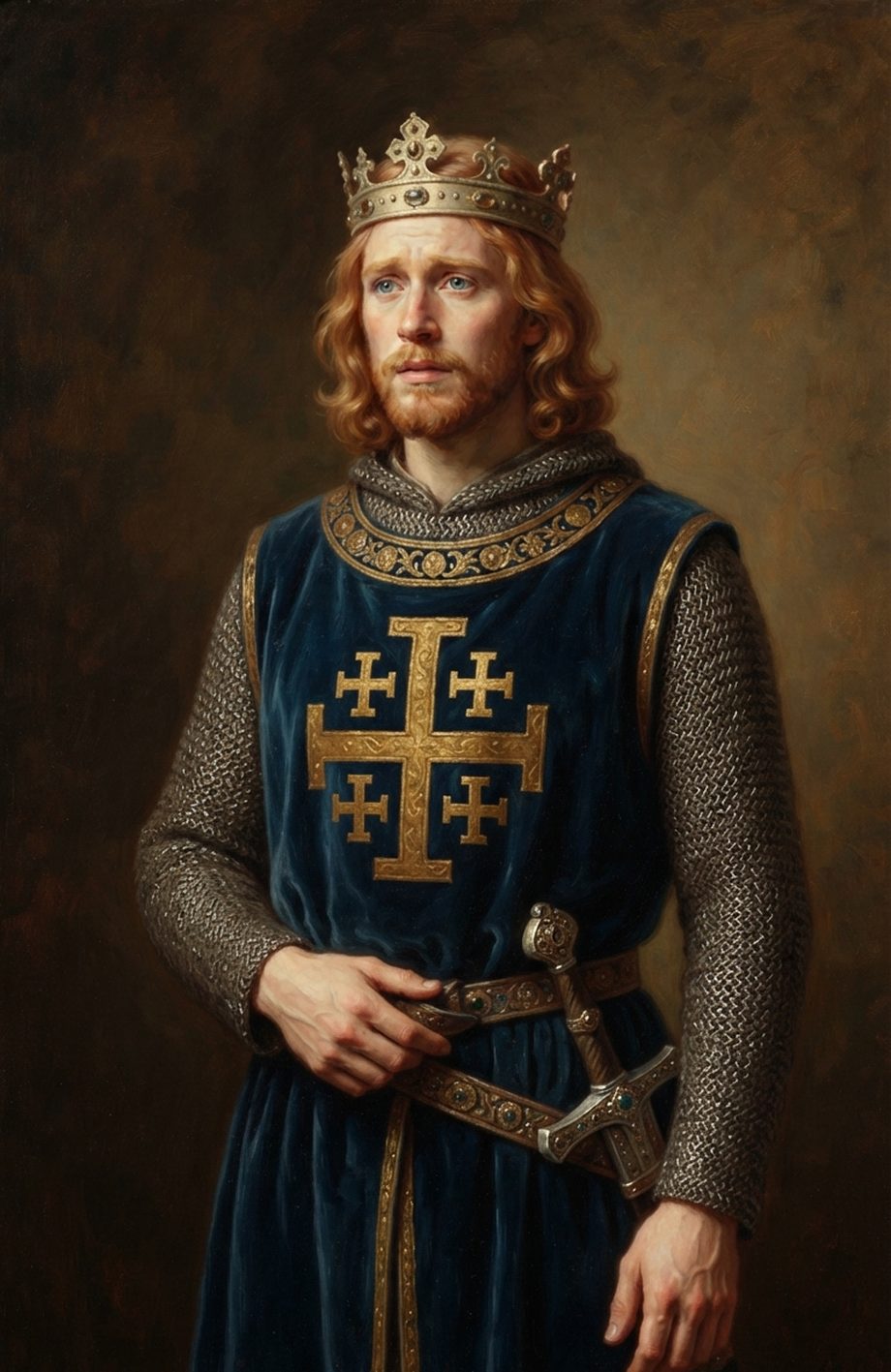
AI-assisted Portrait of Guy of Lusignan
The Pleasant Man Who Lost a Kingdom in a Day
He was handsome, charming, and agreeable — exactly the wrong virtues for the crisis he inherited. Guy of Lusignan was a French knight of no great distinction who rose by the one talent that never fails at court: being liked. Through his wife Sibylla, married against fierce opposition, he found himself in 1186 wearing the crown of Jerusalem. A year later the kingdom was gone — undone not by any nameable vice but by a temperament: the inability to say no to a stronger man.
The story is almost unbearably simple. In the summer of 1187, Guy let the war-party talk him into marching the whole host of the kingdom across waterless country to relieve Tiberias. Saladin trapped the parched army beneath the twin peaks called the Horns of Hattin and destroyed it; the True Cross was lost and Jerusalem fell within months. Captured and famously spared — Saladin declared that a king does not kill a king — Guy emerged to find his throne already taken, and ended his days a lord of Cyprus: consolation prize for the man who had presided over the worst disaster in the history of the crusader states.
Guy is the ESFP without ballast: a Se–Fi charmer who lived wholly in the present and was governed by personal bonds rather than strategy — a warm, reactive, pliable man carried by whoever had spoken to him last, set in the one throne on earth that demanded the opposite.
The Charm That Opened Every Door
Se — dominant
Dominant Se lives in the immediate, sensory present — the room, the face, the mood of the moment — and its gift is a personable charisma that reads a gathering and pleases it. Guy had this in abundance. It was his charm that captivated the widowed princess Sibylla and carried the marriage through in the teeth of a court that wanted anyone but him. In a courtier, that is a career. In a king facing Saladin, it was very nearly nothing.
The shadow side of Se dominance is a life lived without a horizon — a man reacting to the situation in front of him rather than shaping the one to come. The council tent before Hattin is the whole man in miniature. First Reynald of Châtillon and the hotheads pressed him to march, then Raymond of Tripoli begged him to hold, and Guy — seeming to agree with each speaker in turn — finally did what the last, loudest voices demanded. He could feel the pressure of the men around him far more vividly than he could picture the waterless miles ahead.
Governed by Loyalty, Not Strategy
Fi — auxiliary
Beneath the sociable surface, Guy's compass was auxiliary Fi — a set of private loyalties that mattered to him far more than any calculation of interest. He was steered by whom he loved and trusted, not by what the kingdom required. His bond with Sibylla is the clearest case: when the barons, desperate to be rid of him after Hattin, offered to let her keep the crown on condition she set Guy aside, she publicly agreed — and then, in the ceremony itself, crowned him with her own hands.
Fi in the auxiliary seat gives loyalty without the executive judgment to rank it against necessity. Guy clung to the men who flattered and dominated him — Reynald, the Templar Grand Master Gerard de Ridefort — and distrusted Raymond of Tripoli, the ablest head in the kingdom, over an old quarrel. A stronger ruler subordinates his feelings to the realm's survival; Guy did the reverse, and let the men he trusted walk the whole kingdom into a trap.
The Horizon He Could Not See
Ni — inferior
Inferior Ni is the ESFP's weakest faculty — the long vision of where a course of action leads — and Guy did not possess it. Where a strategist sees three moves ahead, Guy saw the tent, the pressure, the need to decide, and nothing beyond. The march to Tiberias is that failure written across a landscape: everyone competent could see the trap in leaving the springs of Sepphoris to cross a burning plateau toward an enemy who had chosen the ground, but Guy could not hold that future in his mind against the noise of the present.
The pattern repeats after the disaster. Guy, stripped of a kingdom, drifted where a man of foresight would have moved to secure his position; he was outmanoeuvred by Conrad of Montferrat — who saw exactly where events were heading — and lost the crown by default. He was never wicked and rarely even foolish in the moment; he was simply blind to the arc of things, a man of the present set against rivals who lived in the future.
Why ESFP Over ISFP
Why not ISFP?
Both types share the Se–Fi pairing, and Guy's loyalty and lack of strategy could read as the quiet of an Fi-led ISFP. But the ISFP is inward and self-possessed, steered by a private value-core firm enough to resist pressure — the introvert who cannot be talked out of what he believes. Guy was the opposite: outwardly sociable, eager to please, and endlessly pliable, dominated in turn by every stronger personality who reached him — Se-led extraversion and a following temperament, not the anchored interior of an Fi-dominant.
The distinction is the whole tragedy. An ISFP king might have failed too, but on his own terms, holding some conviction the war-party could not shake. Guy had no terms of his own: his extraversion made him permeable, and his auxiliary Fi bound him to people rather than principles, so that the strongest wills around him became his policy. He was not a man with a bad plan but a man with no plan, waiting to be given one.
Connected Figures
Further Reading
- The Leper King and His Heirs: Baldwin IV and the Crusader Kingdom of Jerusalem — Bernard HamiltonThe essential study of the court Guy married into — indispensable on the succession crisis and the faction politics that raised and destroyed him.
- The Crusader States — Malcolm BarberA comprehensive modern history of the Latin East; the clearest account of how the road to Hattin was walked and why the kingdom fell.
- The Kingdom of Jerusalem and the Crusades — Peter W. EdburySharp on the legal and dynastic tangle of Guy's claim, his loss of the throne to Conrad, and his afterlife as lord of Cyprus.
- A History of the Crusades, Vol. II: The Kingdom of Jerusalem and the Frankish East — Steven RuncimanThe classic narrative — vivid and unforgiving in its verdict on Guy, and still the most readable telling of Hattin and its aftermath.
