 Historical Figure MBTI
#554 · 4-27-26 · The Age of Saladin
Baldwin IV
King of Jerusalem · The Leper King · The Boy Who Held the Kingdom
1161 — 1185
8 min read
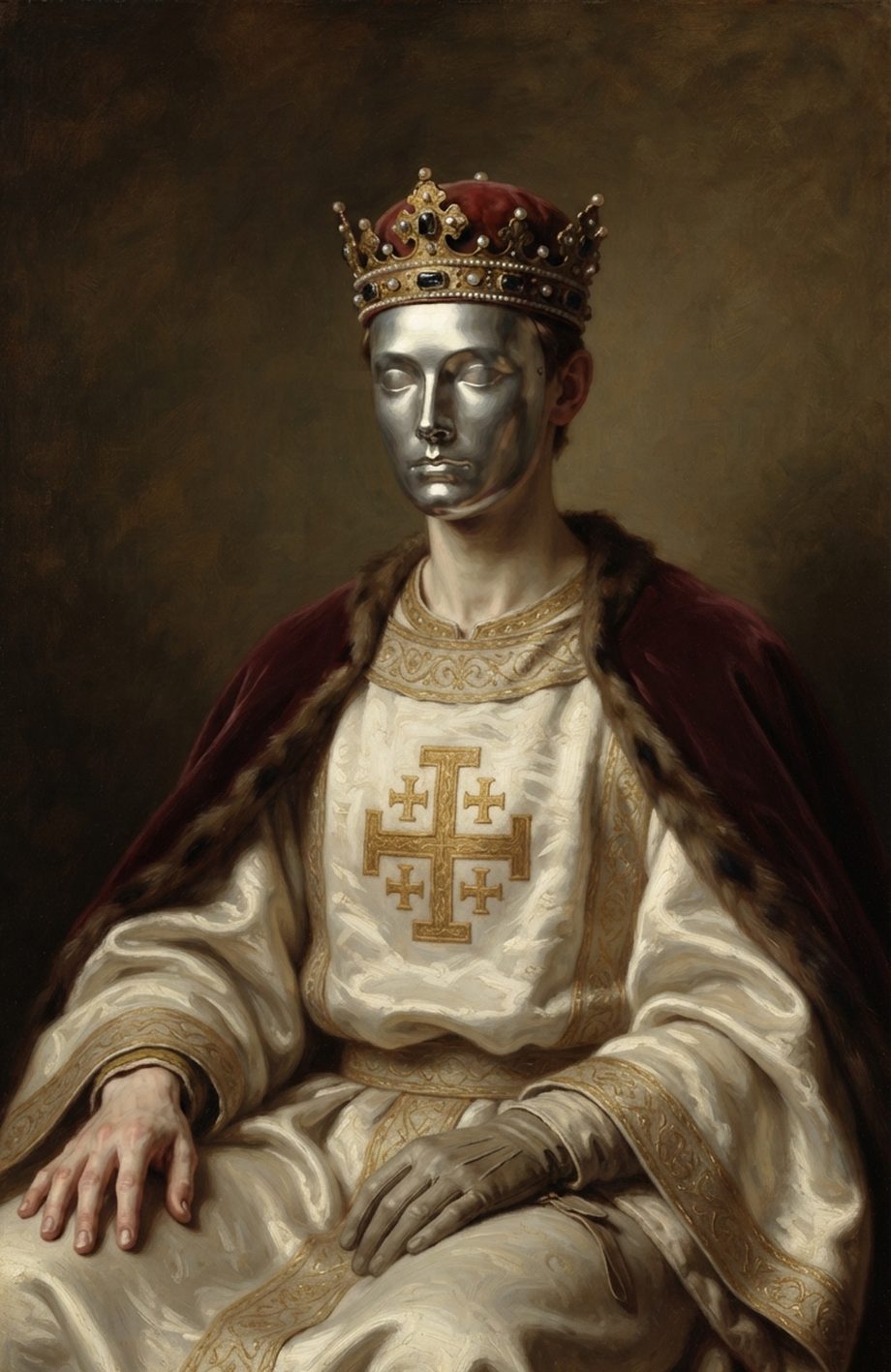
AI-assisted Portrait of Baldwin IV
The King Who Outlived His Own Body
His tutor found it first. The historian William of Tyre, watching the boy at play, saw that when the other children bruised his arm in their games, the young prince felt nothing. No pain, no flinch. William understood the numbness at once for the horror it was: the first sign of leprosy in the child who would be king. Baldwin IV came to the throne of Jerusalem in 1174, crowned at thirteen, already carrying in his flesh the sentence that would dissolve him limb by limb — and he ruled for eleven years, while the disease took his hands, then his ability to walk, then his sight, with a clarity and a courage that shamed the whole-bodied men around him.
That is the paradox that makes him one of the most poignant figures of the medieval world: a body in visible ruin governed by a mind that never lost its focus. Baldwin did not merely endure his kingship; he wielded it toward a single, unwavering end. He could see, with terrible precision, the catastrophe waiting for his fractious little kingdom — and he spent every year of his short reign trying to build the succession that would forestall it. He is the INFJ stripped to its essence: a man whose entire greatness lived in the gap between what his body could do and what his vision demanded.
Baldwin is the INFJ as doomed idealist-king: Ni holding one fixed image of the kingdom's survival against every physical betrayal of his own flesh, and Fe binding a realm of quarreling barons to a duty larger than any of them. He governed toward a future he could see and would not live to reach.
The Vision He Would Not Live to See
Ni — dominant
Dominant Ni is the faculty of holding a single, fixed picture of the future and bending every present act toward it. Baldwin's picture was the survival of the Kingdom of Jerusalem after his death — and he grasped, earlier and more coldly than anyone around him, that his death was coming soon and that his kingdom stood one bad succession away from annihilation. So he worked the succession like a chess problem with the clock running out. He married off his sister Sibylla, had her infant son crowned as Baldwin V in his own lifetime — co-king to a dying uncle — and arranged a regency to carry the realm past the dangerous years. And he read the men around him with the same clarity: he saw that the war-faction, the brigand Reynald of Châtillon and the weak, ambitious Guy of Lusignan, would provoke a catastrophe the kingdom could not survive, and he spent his failing strength trying to fence them out of power.
The tragedy of Ni is that it can see the ending and still be unable to prevent it. Within two years of Baldwin's death the fence he had built collapsed: Baldwin V died a child, Guy seized the throne, Reynald broke the truce, and Saladin destroyed the kingdom's whole army at Hattin and took Jerusalem. It was, almost to the detail, the exact catastrophe Baldwin had spent his life trying to avert. He had been right about everything — and being right had not been enough.
The Duty That Held the Realm Together
Fe — auxiliary
Auxiliary Fe gave Baldwin's vision its moral gravity and its instrument. The Kingdom of Jerusalem was a snakepit of factions — native baronage, newly arrived adventurers, military orders, Italian merchant communes, all pulling in different directions. That so fractured a realm held together at all through eleven years of a disintegrating king is the work of Fe: the reading of a whole community's loyalties, and the binding of them to a shared duty. Baldwin governed not by force — he had less and less of it — but by the moral authority of a king who had visibly given his body to the crown. He could have retired to a monastery and let his ruined flesh excuse him from everything; instead he had himself carried on a litter to the councils and the campaigns, and the barons who would knife each other over a fief still, for the most part, bent to him. The sight of a leper king spending his last strength on their behalf placed a claim on their honor no healthy king could match.
It is the same Fe that explains the shape of his fears. His anxiety was never for himself — a man losing his sight and his limbs has stopped fearing for himself — but for the people who would be left to Guy and Reynald. His entire late statecraft was an act of care aimed past his own grave: an attempt to hand a living realm to those who would come after, by a man who knew he would not be among them.
The Cold Reading of Men and Danger
Ti — tertiary
Tertiary Ti is the INFJ's private analytic engine — the capacity to reason through a situation to its logical bones, beneath the surface of feeling and loyalty. In Baldwin it shows in the precision of his political judgment. He assessed the strategic position of his kingdom with a realism his impulsive nobles lacked: he understood that Jerusalem could not win a war of extermination against Saladin's consolidated power, that its survival depended on truces bought with restraint, and that every unprovoked raid by his own vassals shortened the kingdom's life. This was not squeamishness but a cool structural analysis of where the balance of force actually lay.
The same Ti drove his reading of the men. His distrust of Guy of Lusignan was not personal dislike but diagnosis: he had watched Guy fail in the field, tested him with command, found him hollow, and concluded — correctly — that the man was unfit to hold a frontier kingdom together. In moving to strip Guy of the regency and redirect the succession to the child Baldwin V, he followed the logic to its conclusion regardless of how much easier it would have been to let his sister's husband simply inherit. The tertiary function reasoned; it did not flatter.
Montgisard, and the Body He Defied
Se — inferior
Inferior Se is the INFJ's most alien terrain — the physical, the immediate, the body in motion — and for Baldwin it was terrain his own flesh was actively taking from him: the use of his hands, the strength to ride, the sight in his eyes. And yet the single most astonishing act of his life was an eruption of Se in its purest form. In November 1177, aged sixteen, with Saladin's far larger army loose in the kingdom and expecting no resistance, Baldwin gathered what force he could and fell on them at Montgisard — a stunning, headlong upset, a boy king, already visibly diseased, routing one of the greatest commanders of the age in one of the celebrated victories of the crusading era.
What makes Montgisard so revealing is that it was not the start of a career of battlefield glory — the inferior function does not sustain that. It was a single, total mobilization of everything the moment demanded, spent at once. For the rest of his reign the physical world became the enemy that ground him down: the litter, the failing eyes, the hands he could no longer use. The function most foreign to his type, and the very body it inhabits, betrayed him a little more each year — and he answered that betrayal not with retreat but with will, forcing the ruined instrument to keep serving the vision as long as it could hold together at all. Baldwin's courage was never the careless boldness of a man at home in his body. It was the harder thing: a mind refusing to let a dissolving body dictate the terms of a life.
Why INFJ Over ISFP or ISTJ
Why not ISFP?
The ISFP reading is tempting because it honors the courage: a young man enduring unimaginable suffering with quiet dignity looks like Fi–Se fortitude — personal, present-focused, expressed through brave action in the moment. But Baldwin's greatness was not endurance; it was statecraft. His defining work was future-oriented — he governed toward a foreseen succession crisis and spent years engineering around it, fencing out the men he predicted would doom the realm. That is a Ni–Fe reading of where the whole kingdom was heading, not the felt courage of the present tense. The ISFP bears the moment; Baldwin was fighting the future.
Why not ISTJ?
One might read the litters and legislation and co-coronations as ISTJ dutifulness — a king executing the offices of the crown by the book. But Baldwin's rule was visionary and principled rather than procedural or precedent-bound. He was not preserving inherited forms; he was improvising an unprecedented solution to a catastrophe only he clearly saw coming. That is Ni building toward a foreseen end, not Si defending established practice.
The essential distinction is where the courage points. An ISFP's bravery is centripetal, drawn inward to the self's own integrity and borne in the present. Baldwin's was centrifugal, aimed years past his own death at a kingdom he was trying to save from men he had already diagnosed. He was not a brave man who happened to be king; he was a king whose vision required a brave man's body, and who spent that body without mercy to serve what he could see coming. That is the INFJ — Ni and Fe — in its most tragic form.
Connected Figures
Further Reading
- The Leper King and His Heirs: Baldwin IV and the Crusader Kingdom of Jerusalem — Bernard HamiltonThe definitive modern study — a full rehabilitation of Baldwin as an able and clear-sighted ruler rather than a mere invalid.
- A History of Deeds Done Beyond the Sea — William of TyreThe contemporary chronicle by Baldwin's own tutor, who first detected the leprosy — the closest source we have to the king himself.
- The Crusader States — Malcolm BarberA comprehensive, authoritative narrative of the Latin East that situates Baldwin's reign within the kingdom's long decline toward Hattin.
- A History of the Crusades, Vol. II: The Kingdom of Jerusalem — Steven RuncimanThe classic sweeping narrative — dated in places but still the great readable account of the kingdom in Baldwin's era.
